#73 Unstoppable: The 80-Year-Old Who Runs 100+ Mile Ultramarathons—and Reminds Us Why Showing Up Still Matters
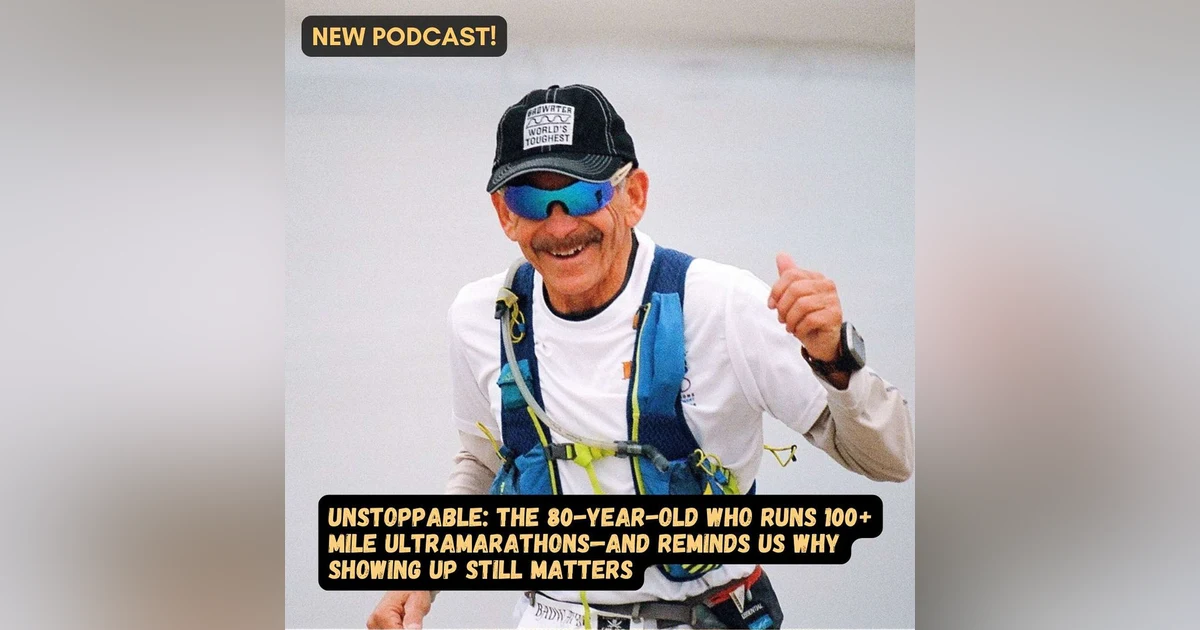
Bob Becker didn’t grow up an athlete. He ran his first marathon in his 50s. Now, at 80, he’s outlasting runners half his age—competing in 100+ mile ultramarathons across deserts, through mountain passes, and deep into the unknown. But this isn’t just a story about extreme endurance. It’s a meditation on purpose, perseverance, and the ripple effects we create when we keep showing up. In one unforgettable story, Bob recalls finishing a brutal desert race just past the official cutoff—only t...


Bob Becker didn’t grow up an athlete. He ran his first marathon in his 50s.
Now, at 80, he’s outlasting runners half his age—competing in 100+ mile ultramarathons across deserts, through mountain passes, and deep into the unknown.
But this isn’t just a story about extreme endurance. It’s a meditation on purpose, perseverance, and the ripple effects we create when we keep showing up.
In one unforgettable story, Bob recalls finishing a brutal desert race just past the official cutoff—only to be handed a note from a stranger who had been watching. It read: “I’ve been looking for a reason to stay alive. If you made it to the finish line, I promised God I’d live 100 more days.”
Moments like that don’t happen by accident. They happen when people live with grit, intention, and heart.
In this episode, you’ll learn:
- Why Bob believes the second half of life can be the most powerful
- How he started running at 57—and why starting late might be an advantage
- The mindset that gets him through the most painful, isolating miles
- How to find meaning in the journey, even when you don’t “win”
- Why your effort matters, even when no one seems to notice
- How to balance drive with community, service, and family
- What aging athletes can do to keep moving forward with strength and joy
This is one of the most powerful conversations we’ve had on Ageless Athlete—a reminder that what looks like the end might just be the beginning.
🎧 Listen in. Share with someone who needs it. And remember: it’s never too late to do something extraordinary.
Subscribe to the Ageless Athlete newsletter — 2× a month, no spam. We share behind-the-scenes reflections, longevity tips, and athlete wisdom you won’t find anywhere else. You can sign up at https://www.agelessathlete.co/newsletter/ 📩
If you've enjoyed the show, please hit 5 🌟 on Spotify or Apple or wherever you can leave a rating. It helps keep the show coming to you for free! 💜
🟢 Spotify
🎵 Apple Music
▶️ YouTube
📸 Instagram
💧 Substack Blog
27:03 - [Ad] Resilience Podcast Series
27:27 - (Cont.) In His 80s, He Runs 100-Mile Ultras — What Keeps Him Going | Bob Becker, 82
Ageless Athlete - Bob Becker
===
[00:00:00]
Bob: Well, right now I'm in Fort Lauderdale, Florida in my condominium apartment. Uh, for breakfast this morning. I had a healthy granola with some, uh, almond milk, a bunch of fruits and coffee, um, some quality bread with peanut butter, and I'm ready to go.
Kush: Amazing. Well, you sound fortified I'm curious, uh, , is that like a pre workout breakfast that you typically do, or do you like do one of those like fasting workouts and then you come back home and, uh, replenish.
Bob: Pretty, pretty much the latter. I may have a little something beforehand, but for the most part, no, I don't eat much, I might have a little. Larabar Mini or a gel or something, but typically, uh, I eat breakfast after it's all done. Uh, I don't have a lot in my stomach to begin with typically.
Kush: Sure, and then that breakfast tastes that much, uh, tastier, right? When you have put, put the, [00:01:00] uh, put the effort in.
Bob: you've earned it. That's right.
Kush: , amazing. actually, uh, an old surfing friend of mine, we used to always joke that, you know, one always needs to be earning one's brekkie. And Brekkie being short for breakfast. And when I started this podcast for, for a little bit, I toyed with that idea of calling this podcast, earning your Brekkie, but then people told me that nobody, nobody understood that.
So
Bob: I would, I would have understood, I would have understood it, but uh, there's one.
Kush: Thank you, Bob.
Bob: I like
Kush: Thank you. Uh, and Bob, uh, um, how old are you?
Bob: Uh, 79 and three quarters. Uh, I will be 80 on April 18th. So it's, the big numbers coming right over, coming right up. Okay.
Kush: big is coming right up. Well, happy early birthday. And I actually just turned 47 yesterday. And I feel I'm [00:02:00] getting closer to 50. So, it's, yeah. Uh, for me, that seems like a big number.
Bob: Uh, cuz I can't even remember 50. So, uh, yeah, my, my youngest, my youngest kid is only two years younger than you. So, yeah, there you go.
Kush: Okay. Okay. I get it. I'm, I'm, I'm still a little, little baby here, I want to start off, uh, talking of age, I want to start by painting a contrast. Most people your age are winding down. Maybe enjoying retirement, spending time with family, taking it easy. Meanwhile, you are grinding through 100 mile plus races in brutal conditions.
Yeah. What is it about this challenge that keeps calling you back?
Bob: I suppose it's that type a [00:03:00] personality of mine, you know, the old competitive spirit. I enjoy it. I still love it. Um, you know, my life has been largely oriented around ultra running for the last 20 years or close to it. So actually more than that. with running itself, but also for the last 17 I've been a full time race director producing ultra marathon races.
So basically everything I know and all my friends and all of it is, it's all geared around this passion of mine. and I think a big part of it actually is because I hear so often from people that I've inspired them or their parents to, uh, Get off the sofa and do something they might not otherwise have done.
Uh, presumably healthy things, moving. And that for me is a huge motivator to, uh, to keep doing this as long as I can and as long as I still want to. And at this point I still do.
Kush: That sounds, uh, [00:04:00] incredible, Bob. I understand that you may not have even started formally running until you were in your fifties.
yeah. So talk to us about your first big run or what was that launch point where you, you felt like this was great. This is my calling. Or was it like that was terrible? I will never do it again.
Bob: Well, fortunately the former and not the latter. Um, uh, I ran the mile back in high school. And, uh, during my entire adult life, I played sports, uh, went to the gym, uh, worked out to stay in shape, uh, never power lifted or anything. I'm, I'm, I'm a little guy. Um, and I ran a little bit to stay in shape, but I never raced.
Um, I think probably in my, maybe [00:05:00] my forties or early fifties, I might've done. 5K associated with a, you know, a business conference or something. But I, yeah, I wasn't a runner. Uh, when I was 57 in 2002, I got a call from, um, some friends of mine in Minnesota where I had just lived, I moved from there to Florida in 2000, early 2001, and they said, um, we're gonna run grandma's marathon.
Why don't you come up here and join us? It was out of the blue, and I thought, you know, it's a great, great excuse to party with my friends. So why not? So I literally went to a shoe store here in Fort Lauderdale and bought a pair of running shoes and then said to them, Okay, what do I do now? I'm gonna be running a marathon in June.
Uh, and they put me in touch with the training program here, a group that's still around. And I started training with this group and, uh, made friends immediately, some of whom are still my very close friends and, uh, went up and ran grandma's and I did [00:06:00] pretty well. I wound up actually qualifying for Boston and, um, you know, this was going to be a one and done, but I couldn't not do Boston.
So I kind of got the disease just a little bit. Um, and I wound up actually later in the year, excuse me. Moving over to a different group, kind of a, a faster group, uh, of runners and, uh, continue to train with them for a long, long time. And in, uh, 2004, one of them said to me, have you ever heard of the marathon to sob?
It's an ultramarathon, and I said, what's an ultramarathon? Because like so many people, 20 years ago, I didn't know what an ultramarathon was. Um, so I went home and checked it out, and I saw that the next version of the Marathon des Sables in Morocco, in the Sahara Desert, was going to be in April of 2005.
So the following week, and I was very intrigued by the [00:07:00] whole idea. Uh, so the next week I went back and talked to Jared, this friend who had mentioned, who had asked me the question initially. And I said, don't you have a birthday ending in a zero next April? And he said, yes, I'm turning 40. And I was turning 60.
And I said, Jay, why don't we give ourselves a birthday present? And do this race, and that's how it started. I, uh, his wife hasn't talked to me since, by the way. Uh, but, uh, Ha, ha, ha, ha, um, So, yeah, we, uh, We took it seriously. We both trained well. That's, in fact, when I met Lisa Smith Batchen. I'm sure we'll be talking about Lisa at some point.
I went to, uh, her, Jay, Jay Batchen and Lisa, uh, to their training camp for Marathon to Sell On. That's how I met them. And I went out to Morocco in April and it was just a mesmerizing experience. It wasn't, it was, uh, for me, absolutely life changing. I just fell in love with the [00:08:00] challenge, but also with the camaraderie that was very, very much an evident at that race.
And the thing I learned then, and I see it repeated over and over and over again in the sport of ultra running is if you have trouble out there on the course and somebody sees you, they're going to typically stop to help. And, uh, it doesn't mean people aren't competitive and don't want to beat you race wise, but people support each other and recognize that the next person to run out of water or whatever it is could be them.
It's a, it's very much an integral part of the spirit of the sport. And actually the story I love to tell was my first hundred mile individual race in 2007, when I wasn't prepared for the very, very cold weather at night, I was really freezing. It was, uh, it was, um, uh, a race of four 25 mile loops. Rocky raccoon was the race.
And in the middle of the night, late at night, I was almost too cold to continue. And a runner [00:09:00] came through, saw what was going on. I didn't have any clothes to put on. He literally, he was layered up and literally took a shirt off his back. and gave me his shirt so that I could continue the race. My literal shirt off the backstory.
And it's that spirit that, in part, won me over. Plus, again, as I say, the challenge of doing this, this extraordinary stuff that we ultra runners do. I was hooked and, uh, been at it ever since.
Kush: Thanks for sharing that. wonderful story of your, uh, of your beautiful and, uh, theory beginnings into the sport.
Bob: May I interrupt with a, with a footnote that I think's
Kush: Going back to that moment, you know, when you started, uh, you got this Let's say there's random invite to travel to Minnesota to do this race and Sounds like your personality type is to say yes, is it?
Bob: is. [00:10:00] Yes. Yes, it
Kush: Is it the kind of is it your yeah? yeah, I'm just wondering if there's like a if there's like a like like some sort of a peek into who you are as a Person Bob like, you know, you didn't even own a pair of proper running shoes and you accepted this Invite is that a personality trait that you have had all your life?
Or is that something that you have honed over the years, which is to, you know, jump into things, embrace things and then take them as far as you can?
Bob: Thinking about it as you ask it, uh, probably a personality trait. I can, I can sit here and think of lots of examples, both in terms of athletics and sports and, um, and business where somebody comes up with an idea or I conjure up an idea and I say, why not? Other people can do it. Why can't I? That sort of thing.
[00:11:00] Um, I remember the first time I ever tried barefoot water skiing. I mean, why do such a crazy thing? Well, because my friends were doing it and why couldn't I? So, um, um, and I've never let, I've never let age be within reason. I've never let age be a consideration. If somebody else can do it, I always believe at least the possibility exists that I can too.
So yeah, good question. I think it's probably a personality trait.
Kush: Well, yeah. I mean, you accepted this thing, this invitation. Did you have any idea of how profoundly it could shape the next couple of decades when you went,
Bob: Absolutely not. No, no idea. No idea whatsoever. and, and even, even running that first marathon, which again was going to be a one off, um, and then qualifying for Boston and say, okay, I, I've got to run Boston. That was also the end of the story in theory. [00:12:00] I wasn't looking at the longterm at all. I had no idea what, what ultras were, as I explained earlier.
So, um, yeah, that, it just. It just evolved. It just happened. There was no life plan there, that's for sure.
Kush: this is. Incredible. Bob, like you were in your late fifties. You had no background in, let's say formal running and something happened when you went to Minnesota after doing a bit of training. Two things I can see of one is you obviously did quite well. You qualified for Boston. And then maybe something shifted in you and you found out that this was like a calling.
So yeah, talk to us about like, what, what was this like pivotal thing that happened? Suddenly you found yourself in love with [00:13:00] running and racing.
Bob: Yeah, and I, we, as I mentioned, we had just moved, my wife and I had just moved to Florida from Minnesota, where we had lived for four and a half years and two and a half before that in, also in the Midwest. And prior to that in Maryland for many, many years. Um, and the things I did when I wasn't working in Maryland were different than the things I did in the freezing cold upper Midwest.
When we lived there for seven years, but I always been a play hard work, hard kind of guy, and I always wanted something to be able to do. when I moved here to Florida, uh, and got that invitation and began running, that seemed to me to be, um, Something I could do because among other things, you can run 365 days a year here.
I don't know that I'm really answering the question, but, um, uh, uh, well, actually I'm sorry, you better, would you repeat the question? I've, I've lost my train of thought.
Kush: [00:14:00] Certainly. Uh, what I was trying to get to is, you know, you accepted this invite. Um, and you showed up in Minnesota for this race with some training, with a new pair of running shoes, and you did quite well. So what I'm wondering is like, obviously you had some latent, um, uh, talent for running, right? How was it that You only found yourself in this position to run this race.
Like, were you busy doing other sporting activities? Um, and then what happened at that race? Like you, you sound like you, there was some kind of love at first sight where you had such a good time and you're like, you know what? I just want to keep doing this.
Bob: there's a certain element of that. I did enjoy it. Uh, on the other hand, I remember [00:15:00] after the race was over sitting down and thinking how. My feet really hurt. but it somehow spoke to me. I mean, like I told you, I ran the mile in high school. I played sports my whole life. Uh, I go to the gym and, uh, do these bootcamp kind of heavy workouts in every one of the places I lived in, including Florida, but it wasn't really playing sports here at that time.
So maybe I was looking for something else to do and it just fell in my lap and it looked like, okay, I can do this. And maybe I can run a little faster the next time, you know, which in fact happened at Boston and, um, yeah, I mean, it just, again, because I started training with a group and had not been living here too long, I wound up making friends who happened to be runners.
And so my social life expanded right away, and it became part of my, uh, my life, uh, and [00:16:00] remains that way. So I think it was all, it was kind of the same piece. It was part, partly it was timing.
That makes sense
Kush: yeah, 100 percent no, that makes, makes so much sense that, uh, some beautiful things came together between your move to a new place, your, um, let's say maybe this, uh, timing of this opportunity falling into your lap when you were ready for it. And then the, opportunity running offered for you to.
Make friends in a new place and find this, find this community. One last question here. So Bob, like you had talked about running a little bit in the past, but you didn't take it up formally until you went to Minnesota. Was there something also about running or that race has [00:17:00] that, which appealed to you so personally, like where it could be, it Actually, I'll let you speak to that because one can go and do this run and have a good time but then it just kind of launched you into this path. So, I'm just wondering if there was something during that race that really, , transformed you, made you, you light up and you felt like, okay, you know what, this is something that is.
so profoundly appealing to me. And I'm just going to keep taking this further and further.
Bob: I, I don't know that I thought it through that, that, at that time, uh, that way, but it certainly appealed to me. I certainly enjoyed it. I enjoyed the beauty of running that course, for example, and interestingly, I have one sister and my sister's son, Adam [00:18:00] is an Olympian, Adam Goucher, and his wife Kara Goucher are Olympians.
And Kara is from Duluth, Minnesota, where grandma's marathon. Was, uh, it was takes place. So I got to spend some time with her family up there and certainly, uh, their, their excellence as runners is, uh, not only a source of pride, but a source of motivation for me as well. And so when I ran this race and did well, I thought, you know, maybe I can, maybe should consider doing more of this.
And again, of course, the Boston motivation was a big help. And then again, training for Boston that following year and meanwhile, becoming part of this group of runners and, you know, creating regular Saturday morning and Thursday night running routine that I hadn't done before. It all cemented the whole picture for me as a new resident of Florida and as somebody who was no longer playing basketball, but found a new [00:19:00] sport that maybe I could stick with for a while. yeah, and that, so that's kind of how it evolved. Again, there really wasn't a plan, but there was a. A little piece here, a little piece there that contributed to the good timing, put this thing in my lap and with which I then kept going with it. That's, that's really kind of my best answer for you.
Kush: Thanks for sharing about the Olympians in your family. It sounds like, uh, there is something special in your gene pool when it comes to, uh, endurance sports. And again, um, You know, many people may attempt, to begin a sport like this, in the upper fifties, but very few are able to maybe stick with it.
Maybe they do it once you took it that much deeper. So before that you spoke about. Doing some other sports. He talked about going to the gym, about doing bootcamps. I'm just [00:20:00] wondering, like, was there something special in some of this, uh, let's say non running training that you did, or maybe your genetics, which allowed you to just take it further and further, you know, you did this marathon.
You did like so well. And then you started, training and, uh, competing in longer distances. So did that like just come naturally to you, Bob?
Bob: Well, I think part of it's genetics, but a lot of it was, I was in pretty good shape because I worked out and, um, was, and had been for years and years. So my core strength is good. And, I guess my, my, my running style is such that, I tend, I really never had, uh, Knee problems or, or most typical runner issues.
so whatever that running thing is, it, it, it is a natural thing for me. Plus again, I think the, the, the idea of having a, a, a core, a strong foundation is what enables me to go out there and [00:21:00] do that sort of thing. and I'm, I'm, I just, I'm always up for a challenge, always something. for something that, uh, I hadn't thought about before or had never tried before.
So if there was a period from 2003 to 2006, when I was actually commuting from Fort Lauderdale up to Northern Virginia, the DC suburbs. I would fly up on Sunday night, work all week, come back on Friday night. I did that for almost three years. So since I was there during the week, I joined a gym up there and, uh, got involved with a kind of a heavy duty bootcamp group.
that was led by a guy whose name was Sean Birch. And Sean, among other things, uh, in 2004, set the speed ascent record up Mount Kilimanjaro. I mean, he's a mountaineer like yourself, a climber. Uh, he's done a lot of first attempts in different places. In [00:22:00] any event, that was in 2004. He came back and he said, uh, to those bunch of us in the class, Hey, I'm going to go back next year and just climb Kilimanjaro just to have fun.
Would anybody like to come with me? I never climbed a mountain. I never had any thought about climbing a mountain, but I said, wow, here's an opportunity to do this with this guy and, uh, who's already been there and who's done it faster than anybody else. Why not? So in 2000, uh, and, uh, maybe getting my, yeah, it was 2000, 2006, excuse me, 2006.
He ran it. He set the record in five, 2006, went and ran Kilimanjaro, uh, climb Kili. Um, and that's the kind of stuff that, uh, somebody will mention an adventure to me or something I hadn't tried before. And, uh, if the circumstances are right, time wise, money wise and everything else, if there's an opportunity for me to do it, I'm going to try to do it.
And. That's, [00:23:00] uh, not atypical for me.
Kush: That sounds, again, yeah, uh, accepting a challenge, you know, being a little pragmatic about it. Of course, it has to be, it has to come together well. And, but then once you accept it, like it seems like there's no looking back. You, you take it all the way. I want to talk a little bit about, uh, your journey as you progressed and you took part in some incredible races, this race and the training.
In morocco sounds incredible across this horror. So can you Can you talk to us about that particular event? And I think it was your first big ultra and you went overseas and there was this, uh, preparatory period with Lisa. How did you [00:24:00] discover this thing and how did you get so inspired to want to go from like, again, maybe doing marathons or more to being Now add like the, uh, uh, let's say the cutting edge or like the, uh, the, the biggest like, um, uh, canvas in the sport.
Bob: Well, again, 2002 was my first marathon, and then in 2003 I ran Boston. In June of 2003, I went back to Minnesota because my friends were going back there, so I went up to just run it with them again. And that was really the last marathon I ever ran, other than I ran a few for training purposes for ultras.
I never really ran another marathon again to see if I could beat my time or anything like that. So that was, um, 2000 and into 2003. Um, again, in 2004, uh, this running friend [00:25:00] asked me, asked me if I'd ever heard of, of MDS Marathon desal. And when I checked that out, I was absolutely fascinated by the idea that you could spend seven days.
Running 100 and almost 160 miles in the Sahara Desert in Morocco, uh, and how it worked, a stage race where each day you run a certain number of miles called a stage. Uh, you basically sleep in a tent with nine of your newfound friends. You get up the next morning, you do it again. You sleep and you do it again, and you carry all your own gear, food, and everything for that week on your back, with the exception of water, which is just too heavy, you couldn't do that.
So the race provides water, it provides the tent for ten, which at least then was basically a bunch of canvas coffee sacks sewn together and held up in the air with sticks. I mean, very, very rudimentary. Uh, with, uh, with, [00:26:00] like, Persian type rugs on the ground, so you're not right on the sand, although the sand gets in there for sure, and you're just packed in tight next to your, next to all these people.
and, again, that certainly contributes to the camaraderie, uh, in getting to know people. Well, that was in April of 2005. Unfortunately, I wound up fracturing my femur during that race, which was not caused by a specific incident. The only thing I've been able to figure out is that I had probably, probably had a stress fracture before I ever arrived and didn't know it, probably from overtraining.
But, um, so I started running and then each day I got successively slower, and then it was walking and then it was hobbling. Um, and I wound up, um, going to the medical tent with two days left to go. There was, uh, the race includes a 50 mile day. I've completed the 50 mile day. There were only [00:27:00] two short days left, but I was hardly able to walk at all.
And, uh, so I went to the tent and they took an x ray with a portable x ray machine and said, yeah, you've got a fracture and we're pulling your number, you can't finish. And when I was devastated, uh, although it turned out it was the right decision. So I came home, I wound up having surgery, had a couple of pins put in my hip, you know, putting me back together again.
Um, and that was in 2005 and it was, uh, it was a slow process healing because it wasn't 25 anymore as my. Surgeon kept telling me when I would complain about how long recovery was taking. and then I started feeling better. I started, uh, running a little bit and I found out in February of 2006 that I had developed prostate cancer.
So I had surgery, shortly in March, I think it was. March or April? March, I guess. caught it early. Uh, my, my, my father had died from prostate cancer. So I was very aware of it and checked it early [00:28:00] and caught it early. so that was in March. Uh, it was in, in May that this group was climbing Kilimanjaro.
The doctor said, if you feel like doing it, you can do it. So, so I did. So it proved a couple of things to me. One, there are a lot of these challenges that I don't think I have to be restricted from doing by age, as long as I'm, as you use the word, pragmatic. Uh, I don't want to, you know, I, don't be stupid about it.
I don't have a death wish. The second thing, going back to Marathon to Sob, while I wound up with that fracture, I absolutely knew that that I could have otherwise done that race. I mean, there was no question in my mind that I wanted to do it again or do something like it again. Um, that again, age was not the reason I didn't finish that race.
I didn't finish it because, unfortunately, it broke a bone, and so that was motivating in the sense that [00:29:00] I just knew that I could do more and wanted the opportunity to do more. I didn't know what the next big thing would be, but anyway, that was, that was where my head was at that point. So as these other opportunities came together, um, and Lisa was part of that, being in touch with her and asking for her suggestions about maybe what other races should I consider.
Um, that's kind of how it, that's where my head was and that's kind of how my ultra journey began or continued after those temporary setbacks.
Kush: Wow, Bob, uh, you, you certainly, you know, in, in, in, in many ways, your, your accomplishments are extraordinary. At the same time, you have, fought back against, uh, at least some, some key challenges that all of us do, including, yeah, including cancer, including, uh, uh, broken or injured joints, [00:30:00] injured limbs.
Uh, one thing I wanted to ask you is about how you met Lisa and got on this, uh, cleaning journey, because it sounds like you were also, uh, forward thinking about the kind of, uh, Uh, training and coaching that would help you accomplish a race like that. And one thing that, you know, intrigues me is you found this coach and at any point, was there any skepticism from Lisa or others in your training camp or? Others, maybe who were approving your applications to enter these races on again, how old you were, right? Because you were, I'm, I'm guessing often one of the older people there. So did they ever question or challenge [00:31:00] your ability to undertake these massive races?
And how did you fight that?
Bob: Well, uh, I met, I met Lisa Smith Bachin at the training camp. in advance of Marathon du Sable. Uh, she and her husband, Jay, were actually the American representatives of this race, which is based in France, or at least was at the time. Uh, and so their training camp was very specific to preparing for that race.
Uh, and I learned so much. It was incredible. And, you know, I kind of fell in love with both of them. They're great people, and she's the most positive person in the world. But she's also a realist in many ways. So when it comes to me and my training and my age, the training regimen that she provides for me would be very different from the training regimen she would provide for you.
Um, each of her clients is, uh, is specific. The training regimen is specific to them, their ability. [00:32:00] Uh, their condition, including their age, uh, what their work schedule allows and all the rest of it. So I just found that with Lisa, it was a very, very good fit and that it wasn't one size fits all. I knew that I was in good hands and in fact, I've never really been injured and I've always been ready on race day.
Because of her person specific training, if you will, an event, an event specific training, right? So, training for bad water is going to be different from, you know, some race in cold climate somewhere or train or trail race. Um, yeah, it's just, she's basically, she's been, she's been training me regularly for 20 years and, um, uh, there is no one coach that's the perfect fit for everybody.
But she certainly has been the perfect fit for me. And, uh, she has crewed me before. In fact, I'll be running Badwater again this summer, which I'm sure we'll talk about, Lisa will be my crew chief at Badwater. [00:33:00] So there's a close relationship there. And she just, uh, you know, she's my, uh, she's my mentor in every way.
Kush: Sure. Lisa is amazing and I've heard that from different people now on her ability to, uh, to identify every individual's unique needs and then provide, an appropriate, training plan just trying to get a peek into what some of the training would look like to help you prepare for either the race across the Sahara or, for All right. Bad water that you're famous for. Could you give us a sense, Bob, of what let's say a day or a week of training would look like in the time leading up to either of those races?
Bob: Well, Lisa is not a believer in just long mileage as, as, as [00:34:00] some trainer, some coaches are, and that's fine for some runners. she's a big believer in core strength, developing core strength. So that's part of your week is going to be involved with some lifting, some core work, uh, and probably some cross training.
So it's not all about miles. So, for a race like Marathon to Sob, where you're carrying, at the beginning, probably anywhere from 25 to 28 pounds on your back, uh, not something most of us are used to running with, uh, the training involves, starting to use a running pack and building, building weight, so you get used to the weight that you're going to be carrying.
Now, as each day goes by, you kind of eat through some of those pounds, but still a lot of weight that you're carrying, certainly at the beginning. And you're running through sand, sand and rocks for 160 miles. So fortunately, I live in Florida. I live at the beach so that I'm able to, uh, to run on the beach and train on the beach.
So a lot of the training involved. running with [00:35:00] the pack, uh, on the sand. Um, I mentioned to you earlier that I had run a couple of additional marathons as training runs. Well, so I ran the Miami Marathon with a pack on my back with a bunch of weight. That was to get some distance and also to have that, that weight training.
So that would be an example. and both, both Badwater and Marathon to Saab involve a certain amount of climbing. Certainly Badwater does. And Florida, where I am, is dead flat. There just are no hills. So, um, you know, I like to joke that the biggest hill we have is the 17th Street Causeway, and at the top of the bridge, it's 75 feet above sea level.
So, you know, you can only get so much hill training when you don't have hills. So, some of the techniques that Lisa uses, other than, Obvious stuff like find an office building and climb stairs up and down or use a stair master is pulling a tire And I don't know that Lisa necessarily originated it, but [00:36:00] it's certainly the first time I'd ever heard of such a thing So and it's a technique basically where you wear a waist belt with a rope attached to it And about 12 feet behind you, it's attached to a, like an SUV tire that you pull along the ground.
And what it does is it creates drag, which in effect simulates uphill, uphill running or walking. So a lot of the training I did then, uh, was pulling a tire to again, get used to the notion of hills. And then if I was out of town somewhere and there was an opportunity to run a hill, I would try to take advantage of those things.
So a typical week to. Again, get back to your core question is certainly running an appropriate number of miles, but it's also cross training and then finding ways to, uh, approach the specifics of that event, geographic, weather wise, the surface that you're going to be running on the heat, for example, which is another big deal for both of those races.
Again, I'm here in [00:37:00] hot Florida, but I also spend time, especially before bad water in a sauna. because it's extremely dry heat at 120 plus degrees. Uh, we're here. It's a, it's a very different kind of humid heat. And, um, so I do, I do both run outside here in a heat, but also use a dry sauna, a lot, a lot of component parts.
Kush: Absolutely. yeah, sounds like a training that was carefully customized for each goal. And I can only imagine, people who. may have seen you dragging a tire behind you in the beaches or the streets of Fort Lauderdale and what may have crossed their mind. I wanted to ask you a little bit about the race itself.
You talked about, you know, sleeping in threadbare tents and [00:38:00] finding camaraderie and support with your crew of runners. I've also heard this being said that. Pain is a given in ultra running and, uh, but, but suffering is a choice. So, uh, do you believe that? And then, um, yeah. How do you, Bob, how do you personally separate, um, Pain from suffering when you are a hundred miles deep into a race and then everything hurts.
Bob: Well, unfortunately I've had my share of DNFs did not finish races as well. Marathon Dassault being the first one because they wouldn't let me with a broken femur. and, uh, it's a, it's always humbling. But you also learn a lot from it, which is that, um, you know, it's, uh, I like to say, and it's not original, I suppose, but the pain, unless it's [00:39:00] a real, uh, life threatening kind of a thing or permanent injury kind of a thing, pain is temporary, and the bragging rights when you finish are forever, you know, you chose to be out there, uh, and the idea, the, the, the sense of accomplishment when crossing the finish line for me is is pretty overwhelming.
And so when I'm in that pain cave and really hurting and don't want to continue, and asking myself, what the hell am I doing out here? I always try to take a moment and offset that with the notion that I chose to be here. And at the point at which I cross that finish line, it may take me a little while to recover, but I will recover.
And I'll be awfully glad that I finished and I didn't stop, didn't have that DNF because whenever I have one, there was always deeper grit, no matter what the reason is. I had a unfortunate I had one time opportunity [00:40:00] to run Western States and got to, uh, get out there about a truckie at about, I don't know, five days, four or five days before the race to get acclimated, get organized, and I immediately developed.
Uh, a very bad cold and a lung infection. So here's my one and only opportunity having been awarded a special entry to run Western. And basically I couldn't do it. Uh, I went to the start line, but I just missed the cutoff, the first cutoff at 30 miles. And I was done and absolutely the most devastating race that I've ever had.
and yet it wasn't anything I could really do about it, you know. But the point is, when you don't finish a race, uh, it's very, very frustrating, and, uh, you want to absolutely minimize that feeling whenever you can. So, if your blistered feet, if your feet are blistered, or whatever, aches and pains, Um, you, you kind of work [00:41:00] through them and, you know, it's mind over matter.
I, uh, you may know of a Canadian ultra runner, an adventurer whose name is Ray Zahab. And I love something that Ray said a number of years ago. He said, ultra running is 90 percent mental and the rest is in your head. I just love that idea because obviously you have to train, but it is a mental game.
There's no question about it. And, uh, I try to keep that in mind.
Kush: For sure. And actually Ray has been on the podcast and I encourage people to listen to Ray's episode as well. He shared some, yeah, incredible words of wisdom, including, I think he talked about this one as well. You talked about this, um, for sure. You know, DNFs are unfortunate because there's so much preparation that has gone in and some of these opportunities [00:42:00] are rare, like being invited and, uh, making time to come to California, for example, for the Western states.
again, curious, Bob, you know, talk to us maybe about like, maybe one of the worst moments. Thanks. Thanks. That you've had to push through because like running is an incredible activity. A lot of us will go running and then we will often stop because you're like, okay, you know what? We are tired now. This is hurting. Being able to complete an ultra run requires one to push through sometimes really deep moments. So. Yeah, is there like a particular moment that comes to mind when things were incredibly brutal, but you kept going?
Bob: Yeah, I suppose the best example was three years ago at Badwater. 2022. Um, and I was trying to set the [00:43:00] record as the oldest finisher, uh, at 77 at the time. And I was doing well. I was, I was on track. My, my time was good, but the further down the course I got, I think probably, probably started about a hundred after about a hundred miles.
So I had another 35 miles to go, including a 13 mile climb up Mount Whitney to the finish line. And, um, my back started giving out. And I started leaning, uh, not to the side, but leaning forward. And I just couldn't straighten up. It was really bothering me a lot. And by the time I got into Lone Pine, I was almost bent in half.
I mean, my body, my, I looked like a, like an L shape or something. Um, And it wasn't so much pain as it was just the inability to stand up straight and to move in a normal way. And it was putting pressure on my legs and it was, uh, not good. Well, I still had a lot of time [00:44:00] in theory to finish the race. So I started up the mountain and by the time I got within about a mile of the finish line, not only had my back seized up and was totally worthless, but my legs began to seize up as well.
Um, and I literally had to had to use my hands to help my help my legs one step at a time. I'd go 12 or 15 steps and I had to stop and take a break and try to straighten up a little bit and then do it again. And as I approached the finish line. uh, even closer. Uh, that just wasn't working. So it turned out that the race medical director was walking alongside me, being sure that I wasn't causing that I was okay.
First of all, I was lucid. Secondly, that I wasn't going to have permanent damage. And I wasn't. I was I was fine. It was totally lucid. It was just my back. Uh, and at one point I said to her, [00:45:00] you know, if I could change up the muscle movement a little, maybe maybe that would help. I said, is there any reason why I couldn't get out on all fours and bear crawl a little bit?
And she thought about it and said, well, the rule is you have to get to the finish line under your own power, so, you know, why not? So I did. I did some bear crawling up that mountain for a while and stood up and walked and then a little bear crawled again. Um, and I wound up finishing, but I wound up finishing 17 minutes over the 48 hour cutoff.
That was one of the most difficult and frustrating experiences of my life. But, I wasn't going to not finish that day, and I didn't care what was involved. And, uh, I just was bound and determined to make it. And, um, there were a lot of people up there urging me on and helping me, encouraging me to do what I could to finish.
And, uh, and I suppose that's the best example I can give you of a [00:46:00] Kind of a tough day.
Kush: Wow. Well, you were dogged and creative in not giving up and making sure you completed the race. Bob, any specific mental strategies that you have, you have, uh, created, adopted or honed over the years that have helped you push through these dark moments? Because like, we Talked about earlier. Yes, it is really all mental once you get past a certain point
Bob: yes and no. I wish I had something enlightening to be able to share with your listeners. I really do. Um, I don't know that I really have. I mean, one of the things that I've, that I've learned is to really be in the moment, [00:47:00] you know, people ask me all the time, what are you thinking about out there?
And I, I respond to them by saying, I'm, I'm not writing the next great American novel in my head. I can assure you of that. I'm very much in the moment. I'm thinking of that next step. I'm thinking of that next football. And importantly, I'm thinking of. Getting to a point two miles or five miles up the road.
In other words, taking a, taking a small bite out of this a hundred mile race. That's my goal. And then when it, once I'm there and then it's, then it's the next one. So it's. It's piece by piece and, um, yeah, I, you know, the other thing I've, uh, it, where it's allowed, uh, in the, in recent years, I've listened to audio books as something that really distract me, uh, and make the time go by very quickly, uh, because in some races you can't do that, but music, eh, typically not, more often it's an audio book of some kind and it might just be, uh, something totally frivolous like a, you know, an adventure thing or a spy thing.
And other times it might [00:48:00] be historical, but, it's more than likely not too serious, but something that interests me so I can focus and it keeps me going. but yeah, I really don't have any specific mantra or, uh, other than again, always keeping my eyes on that finish line, you know, keep your eyes on the fries kind of thing. I'm not going to DNF this thing if it's humanly possible.
Kush: Well, one certain thing that you point to is the importance of goal setting like you have this note star Which is like I'm training not for just for health or for sanity I'm training because I have this concrete goal in mind so to me it sounds like for somebody listening who's trying to you know, fight an uphill battle with either a fitness, sports, athletics, or anything.
It sounds like having a finish line, a goal is, is [00:49:00] key. I also want to ask you this, which is, you've had some setbacks. You mentioned you had. a femur injury. Then you also talked about, fighting and overcoming cancer. And I am curious if there were naysayers in that journey that you have proven wrong.
Maybe your doctors, maybe others, other, other well intentioned, uh, people around you.
Bob: Yeah, never, never doctors. Uh, but when I first did Marathon to Sob, uh, again, I was commuting back and forth to Virginia and I was working for a company up there and, um, Uh, one of the things I wanted to do was raise money for prostate cancer, which I, as a part of that raise, which I did, and I remember a lot of the people in the company thinking I [00:50:00] was completely nuts.
They were supporting, they were supportive, but they said, this makes no sense. particularly your age. So I wind up coming back, uh, with a broken leg, which, um, to many of them proved their point, which to me didn't prove their point at all. In fact, quite the opposite. Um, and so, yeah, those, there were some naysayers in those days.
That's, that's, that's for sure. But for the most part, uh, people have been very encouraging, not the other way around. and you know, again, part of it, I think, Kush, is that I've, I've been careful to choose races that are, or, or adventures that are realistic for me. Um, I told you where I live and where I train, it wouldn't make a whole lot of sense for me to, even if I could get in, to try to race hard rock, right?
I mean, there's no way I could train for it. There's no way. Um, when I, when I was younger, and when I say that, I'm talking about in my 60s. I would bomb down [00:51:00] a downhill trail. No more. I am much, much more careful. I just can't do it. So Uh, not only is training for that kind of a steep technical mountain race, not realistic, but uh, I wouldn't make the cutoffs anyway because I'd be too slow, too careful, too trepidatious.
so part of it is picking, picking a race that makes sense. and in a couple of cases where I've done really, really well, I had chosen a race where I really thought given the circumstances of the race. that I had a chance to win it or to break a record or something like that. So, yeah, I train, I select my races very carefully.
There are only so many I have left in me. so I'm careful what I, what I choose.
Kush: Certainly. Yes. No, I think you point to that,
before as well, which is the importance of being. [00:52:00] Realistic and planned, but then also I think being willing to maybe, um, rewrite the script a little bit, but because again, like there isn't a script out there for people who are pushing 80, you know, running, running for like a hundred plus miles in Death Valley.
And you also seem so self aware, Bob, of who you are and your strengths. And also perhaps your opportunities. If you take your running career, or maybe if you take one of your most important and, uh, uh, proud races, is there something about the sport that is? revealing to you about yourself that you didn't already know.
Bob: [00:53:00] Well, part of it is recognizing when I do something that is at least for me a little bit on the extraordinary side is that. Yeah, I can do that. I can set a goal, um, look a little bigger than maybe to most people would make sense and be able to, uh, be able to accomplish it. And as the years go by, I'm still able to do those things so that it once again gets back to the notion that there's no reason that age has to stand in the way of. Adventure and excitement and doing, doing difficult things and, uh, remaining active in the, in this world of sports. And, uh, uh, so it's sort of like each time I'm able to do something, it motivates me to, uh, want to do or explore even more. Um, it's self fulfilling, I suppose, in that respect, if that makes any sense.
When I select a difficult race, something that most people would think doesn't [00:54:00] make a whole lot of sense for somebody my age, or maybe it doesn't make any sense at all. Why would somebody run a hundred miles or whatever it is? And then I, and I finish it or I accomplish it.
it becomes self-motivating. It, it, it, it tells me, yeah, I can look at bigger and better, you know, bigger and more complicated things, and absolutely have the opportunity to, to complete them, to, uh, to set the goal and achieve the goal. And there's no reason why I can't continue to do that indefinitely, as long as, again, I'm pragmatic about what makes sense.
I mean, I, I'm still 80 years old, but, uh. Challenging myself is still very important to me, and I'm sure it will be for a long time. And by actually being able to accomplish something or know that I could have, except for some odd circumstance like getting sick, it motivates me to continue to look for the next, next big thing.
Or just the next fun adventure to have, that's all. Running with [00:55:00] friends in Europe or something, which I did last year. It wasn't a race, it was just a one off adventure that was absolutely fun. You know, a blast. I had a great time. And we ran a lot of miles, but it was something I was able to do and absolutely love doing.
So it doesn't have to be a formal race either. a one off kind of adventure.
Kush: Absolutely. Um,
you have built in the last couple of decades, Bob, this incredible running career. and you've also given back through nurturing this amazing community with the work that you're doing. Could you speak about, uh, The work that you're doing outside of the running itself.
Bob: Absolutely. Yeah, I, um, so I think I mentioned my first Ultra was 2005 marathon stop, and I came back to Fort Lauderdale and for the next year or so was, uh, uh, looking around and realizing how very few ultra marathons there [00:56:00] were, certainly in Florida, and there weren't any in South Florida at all. Keeping in mind that in 2005, I didn't even know what an ultramarathon was, and I was a runner, so most people certainly did not know what an ultramarathon was.
Very, very small world. So I came back and, shortening a long story, some friends of mine and I decided that maybe running across the islands of the Florida Keys, race and could be really interesting. I mean, it's absolutely beautiful. You're got the ocean on one side and the Gulf of Mexico on the other side.
Um, so in April of 2007. five of us went down to Key Largo at the beginning of the Keys and ran 100 miles to Key West with a group of seven supporting us and thought that, yeah, you know, this, this could become something, this, this could be a race, could be viable. and so the next year, 2008 in May, the [00:57:00] Keys 100 was born with 131 people running the distance.
Uh, and as the race director, uh, I had absolutely no idea what I was doing, uh, learned it all the hard way. there was a momentous change in my life at that point. It was around the time of the real estate crisis and economic collapse here in the United States, not just here in the States, but, um, and without going into unnecessary detail at this point, uh, I was looking for something else to do and decided to, Take a vow of poverty and become a race director.
And, um, so, and that's what happened. And so for the last 17 years, I've been a full time race director, creating, uh, creating new races and producing them and really introducing thousands of people to the sport over those years. And I'm very, very proud of that and excited about it. because it's been really great to me.
It's not everybody's cup of [00:58:00] tea, that's for sure, but. It's been, uh, it's been really fun to see new people see their eyes open to the possibilities for themselves. so yeah, I, uh, at this point. Keys 100 is my primary race, and I also produce a race from Jacksonville, Florida to Daytona Beach called Daytona 100.
Both are point to point, 100 mile races along the Ocean Road, so they're beautiful, flat. Daytona is in December, so the weather's great. It's a perfect, perfect race for a, for a PR, for a personal best, or for a first ultra. Keys is run in May when it's really, really hot, so it's beautiful, but it's also very, very challenging, much harder than it looks on paper.
And in fact, this weekend, uh, is the inaugural Miccosukee glades runner race. The Miccosukee [00:59:00] tribe of Indians of Florida hired me as a race director to help them put on a brand new ultra marathon. And it is this weekend. It's, uh, in a few days, in a few days out in the Everglades, it's going to be a lot of fun.
So, yeah, for me, uh, creating these races, that's the most fun, um, and bringing people into the, into the sport, uh, training people, even volunteers, all of it. I love doing it, and that's what I've been doing full time, and still do, uh, since 2008. Uh, so yeah, keeps me out of trouble, Kush. It really does. I have no time to get in trouble at
Kush: Yeah. Bob, thank you for all the work you've done in giving back. I'm curious in your time, introducing new people to the sport, like you are leading by example, that aging doesn't have to mean the inevitable [01:00:00] decline. Do you have maybe one or two stories of transformation where? somebody that you perhaps inspired or coached or brought into running changed their lives.
Bob: You know, I think I can only, uh, generically say that I've had many, many people who've told me just exactly that, who never thought that they could. Uh, do something like this and that, uh, going from, and many of them were runners, they'd run a half marathon or something and then they, they moved up, decided to try an ultra became very, very important to them and in many ways, in many cases translated to other part of their lives where that might have been in a job that wasn't the greatest thing in the world and just found the, the courage to go out and try something new and they never thought they could do.
[01:01:00] so I'm not, I'm not trying in any way to say that this is the case, uh, broadly, but from, for more people than I could ever imagine, it not only has meant, uh, a new and exciting sport for them, but in some ways, uh, major other changes in their lives that they learned they could, they could try and give a shot and it would, and it might work.
if I can give you an aside that is. related. Um, I was telling you about that 2002 experience of finishing Badwater. And I want to share this with you because, and with people who might be listening, because it was so Unbelievably profound for me. And to this day, when I read what I'm going to read you, uh, it's very hard not to get emotional.
So I've said to you that some people have been [01:02:00] inspired to, uh, to try new things. When I finished that race at, in 2002, I crossed the finish line. Somebody pulled up a chair. I sat down for a while. There were a lot of people around. And as I started leaving a woman who I did not know, who was not part of the race came by.
And handed me a note and said to me, Will you please read this, but not now, read it later. And I said, sure. Now the finish line at Badwater is on Mount Whitney, and it's an area where there's camping up there, there's a campground. And I'm guessing that she came from the campground, and because of all the excitement of the finish line, very frequently people who are camping up there kind of hang out and see what's going on, and I'm guessing that's what happened here.
Well, she left me a note, and I read the note, and I'm going to read it to you now, and she said, I have been looking for some reason to stay alive. As I watch you make it up the hill, I [01:03:00] told God, if you made it to the finish line,
I promise to live 100 more days. then take it from there. Uh,
you never know how you're going to affect people. You just never know. Uh, so I wanted to share that with you. Um, because that was certainly the most impactful thing that's ever happened to me in 20 years of doing this crazy stuff. And that sort of alone by itself almost makes it worthwhile.
Kush: Wow, Bob, I am still processing that, but it gives me goosebumps and sounds like when you got down on your knees to finish that you were carrying these hopes for so many who are inspired by you. And even [01:04:00] though you may have missed the 48 hour cutoff, I think in that race, you had an impact perhaps more profound.
Wow. Um, Bob, so talking about, uh, talking about some of these deeper themes, you know, you have beaten aging in many ways, but do you have any fears about getting. older yourself.
Bob: Well, I, to the extent that, uh, somebody who's been overly active my entire life, reaching a point where I might not be able to get myself off the couch, even if I wanted to, that. I don't know if the word is frightening, but certainly not something I would look forward to. And frankly, I don't really ever expect, but, no, I don't think the word is frightening, but, uh, their reaches, they [01:05:00] will reach a point in the not too distant future where I'm probably going to have to give this up.
Even training right now is not quite as much fun as it used to be. It's a little harder on my body. I've got more aches and pains. I've had to miss a couple of training days in this cycle because I just, my body was just too, uh, too sore when I got up in the morning and I said, you know, I, I need more sleep right now.
And that's more important. And to which coach Lisa agreed, by the way. so, yeah, I mean, there's a slowing down process no matter what you do, no matter who you are, that is, just happens, and so I'm not looking forward to that day, but I'm realistic about it. Like I said earlier, there are only so many more races that this old body has, uh, has in me, and, and, you know, we'll see how long the string goes, and maybe we do something else.
You know, I, Mentioned last year I've spent time in Europe along the Camino de Santiago with some friends over a number of days. We've actually done it twice. [01:06:00] It was wonderful experience. It's running. It's running the X number of miles a day from point A to point B. But it's not a race. Take your time. Do all the walking you want to do.
And so if that's my next, if that's my next phase of adventure, where I'm not really racing at all, but doing things like that, if I'm able to, so be it. I look forward to, uh, what, whatever that challenge will be and however that whatever that experience will, will become. And that's, that's my best, my best philosophy.
I mean, I, you can't change what's happened. And, um, you can only do, uh, you know, you dealt the hand and you do your best with it. And I always try to be very optimistic and, and see how, see how I can challenge myself.
Kush: Bob, I'm told that the Camino de Santiago is not a hike, um, it is a pilgrimage and [01:07:00] I am curious if you have a spiritual or a meditation practice that brings you peace and keeps you grounded.
Bob: Well, it's a fair question. I re I don't, uh, I'm not a religious person, but I am a spiritual person. And I suppose, uh, uh, so, you know, doing the Camino de Santiago and winding up at Santiago de Compostela at the, at the Basilica was a fabulous experience, but it wasn't a religious experience for me, but, but it was, um, meditatively, it was important.
Uh, so I don't have a real meditation practice. but, uh, on a, in a formal way, but informally, uh, yeah, I, I, I mean, I do, and, uh, part of that is the reading I do, um, but I don't really do yoga, which I should, and I [01:08:00] recommend to runners. and I don't particularly, I don't specifically have a meditation practice.
Um, uh, but, uh, again, it's something that is a great idea. And if it's for you, if it's something that works for you. Absolutely encourage it.
Kush: Well, uh, obviously you have cultivated all kinds of other practices which are just as powerful and, and profound., Bob, this is a question I like to ask, uh, most people that is, uh, what does being ageless mean to you?
Bob: Uh, what does ageist mean to me? I suppose it's not letting somebody else define for you that you are over the hill. Or that by a certain age, you really shouldn't be doing that anymore. uh, you know, you could get injured. Uh, or you could be out there on a trail and have a heart attack. Error. Uh, yeah, [01:09:00] any of those things can happen, but, uh, being ageless to me is not letting a number stand in the way of, uh, continuing to explore yourself and the world around you.
again, you need to be pragmatic, you need to select things that make sense for you. that are within the realm of possibility. I don't have a death wish. I don't have an injury wish. In fact, I do everything I can to assure that I won't become injured. But, uh, short of that, uh, within my means, and recognizing I need to respond, be responsible for my wife and my family.
to the extent that I can explore something new, I want to continue to do that. Uh, and there's no reason why any of us at 80 years old cannot at some level doesn't have to be ultra marathon running.
Kush: I love that, Bob. a few minutes ago we spoke about how [01:10:00] your running career has impacted and inspired others. Curious who inspires you at this stage
Bob: Well, as as a as a runner, um, well, that's a good question. I've
Kush: doesn't have to be from the world of running.
Bob: well, as I look around at almost any field of endeavor, whether it's, uh, whether it's theater or acting or sports or politics. or religion at people who are well into well beyond my age and still very, very active. They all, again, inspire and reinforce this notion in my head that I don't have to be limited by age.
And, so I [01:11:00] can't point to a specific person necessarily, but there are many of them, and, uh, I think just generically as you look around and see that other people are doing extraordinary things. I see no reason why I can't be among them to, to a lesser degree, but that I can't continue to do things that, others might say I shouldn't do because I'm too old.
Kush: Bob, that's amazing. And then. Yeah, I mean, I can see you are still so fired up about running and I have to remind myself that, you know, you only started your running career Just over a couple of decades ago and I'm guessing that there are adventures that are ahead of you What is next what excites you
Bob: Well, in the most immediate short term, I'm going back to Badwater this summer. at 80 to try to, um, [01:12:00] and I, I got in, thank the Lord, uh, to try to set that oldest finisher record this time inside of 48 hours, so that it's not an unofficial finish. It's an official finish. Uh, in the short term, uh, Badwater has become a very important part of my life every year.
I'm always there doing something, crewing for another runner or working on the staff or racing. So it's really important that as my possible swan song, I don't know, we'll see that, uh, To go out finishing that race, finishing it within the allowable time. Beyond that, um, I have a friend who's going to be, uh, later this year running across Europe.
I wanna try to go over there and pace him for a few days. uh, I want to do more of these camino kinds of, uh, of adventures. I don't have a specific mountain climbing item on my bucket list. In fact, I don't really have a bucket list. 'cause what really happens most often is. [01:13:00] Somebody will say to me, uh, I'm going to be doing such and such a thing, or have you heard of such and such a thing?
And it gets me excited. And it sounds like something that I would really love to do and think I can. that's kind of how my next thing happens more often than not. And that's been true with specific races I've run as well, where somebody's mentioned one to me and it sounded like a heck of an idea and went ahead and did it.
So again, no real bucket list, but, uh, There will be, there's more, more to follow, I hope.
Kush: Bob you talk about this, you know, you're you certainly let's say Rewriting the script on a bucket list. Well, I I love it. It's like you surround yourself by this amazing powerful community That just, uh, opens up doorways. And as long as you're keenly listening, [01:14:00] amazing things just arise and pull you in their direction.
Bob, we know you as this overachieving ultra runner. Is there. Is there perhaps a mundane thing that you do, let's say every day that brings you, let's say, overwhelming peace or joy?
Bob: Yes, um, spending time with and enjoying my wife's company. Um, and, and my extended family. It brings great, great joy to me. and when I say extended family, I have, I have three kids, uh, only one of whom has ever been married, and, and her and her husband Greg's. Daughter is graduating from college in May.
So my close family is obviously extremely [01:15:00] important to me, but also my extended family. I have very close with, uh, a large group of cousins on one side of my family. We'd stay in very, very close touch. We try to see each other as often as we can. unfortunately scattered all over the country. So it makes it difficult sometimes.
Family is extremely important to me. And, um, I spent a lot, a lot of time in contact with and thinking about and reminiscing about, um, all of them, uh, and my wife has this wonderful thing she does every Thursday, which is she posts a number of family photos. on Facebook that the family has come to absolutely love.
Uh, and these come from family reunions. And we had a number of professional photographers in the family. And my wife, Suzanne, has gathered a lot of that of those photographs. So, um, month after month, week after week, month after month, year after year, she posts those [01:16:00] things every Thursday, and it's become a A bonding mechanism for a lot of the family.
Uh, you can have a thing to gather around. It's been great to see. So yeah, all of that is really important to me.
Kush: That is beautiful, Bob. One thing I wanted to ask you earlier, which was around your, your, let's say maintenance and dietary practices. So maybe we can just start with the first, which is obviously you do some very. specific training that you spoke of, but as we get older,
Bob: You, you broke up and I couldn't hear your question. I'm sorry. Can you repeat that again? Forgive me.
Kush: absolutely. Uh, one thing I wanted to ask you earlier, Bob was around your, maintenance and, mobility practices. We spoke about your. running earlier and specific [01:17:00] training you do for preparing for big races, but also as we get older, you know, our bodies change and sometimes we get stiffer, we lose muscle.
What are some of your, uh, practices today with being able to stay fit and agile and strong besides running?
Bob: Um, They're probably not as extensive as they should be. I mentioned before that yoga would be a great thing to do and I, once upon a time I did and I have not done yoga in a long time, but that kind of stretching and conditioning is an important thing that I don't typically do. But I do go to the gym or do online workouts.
In fact, Lisa does an online class a couple of days a week where I'm lifting and doing a lot of balancing work. And with that class and also on my own, I do a lot of core work. I think it's very, very important to build a strong core. [01:18:00] when I can walk instead of take an elevator, I climb the stairs.
You know, it's just as simple things like that. about two and a half years ago, my wife and I, decided to leave behind the world of, of animals and become vegan. And actually even beyond that, it was, it's a diet that is. based on the China study and you not only don't eat any, anything with a, a mother or a face or egg products or butter or milk or any of that, um, but also very, very little oil.
There's a very strict diet that we've been pretty good about maintaining, except when I travel, because it's really difficult. Um, and I found that that diet, at least for me, and for both of us, has been really great. Uh, we feel. strong. we, uh, we've lost our baby fat. Um, and, uh, it just, it, it certainly is very, very heart healthy.
And I had, I have a couple of lung issues and [01:19:00] a couple of heart issues. and this diet has been a very important factor in, my not deteriorating and remaining strong and remaining healthy enough to do these things. So, because I train With Lisa year round, even if I'm not training for a specific race, I am doing all the physical things that are most of them that I should be doing.
Plus my core work on the side. And then the diet again is extremely important. Uh, And I've always been somebody that's been proactive in terms of, uh, of medical care. So I never shy away from, having a test done or having something checked early, like my prostate. Um, so if there's a sign that there could be an issue, uh, I don't delay.
I don't put my head in the sand. I check it out and get, get on it early. So if there is a problem, it can be addressed early. So I think all of those things are part of my best answer to that question.
Kush: [01:20:00] Bob, I love that answer. I also turned vegetarian, almost vegan about, uh, eight years ago and I wanted to understand for a second, how do you make sure you're getting, you know, the, the macronutrients and other needs through a vegetarian diet, any specific things you do to make sure you're getting like all the right amounts of things, whether it's eating certain kinds of foods or supplements.
Bob: Yeah, I don't do a lot of, excuse me, I don't really do supplements. I do a couple of vitamins because a non meat protein diet, um, can sure change you in a couple of areas, but for the most part No supplements. Uh, I take a couple of prescriptions, uh, but not a whole lot of medication. Um, fortunately, my wife Suzanne is not only a great cook, but somebody who is very on top of the whole nutritional side of [01:21:00] things.
And she in particular, both of us, but she in particular spent a lot of time, uh, reading and watching, studying the latest and greatest in terms of what foods, are going to offer the best nutritional value. we don't sit down at every meal and count calories and count grams of protein and so on, but we're pretty much on top of what those numbers are.
Um, so we have a pretty good idea what we're, that we're, that we are consuming sufficient quantities during the course of the day. And the other thing is not everybody, needs the same, same caloric intake, same, same intake of of every nutrient for that matter. Our bodies are, are not the same. So we found over these last two and a half years on this diet that what, that's, that, that what we're doing is working for us.
So we tweak here, we tweak there, but a lot of, we, we eat pretty healthy. That's, that's the bottom line.
Kush: That's wonderful, Bob. You spoke about your breakfast earlier. Is [01:22:00] there a meal that you love that you could eat every day?
Bob: Yeah. That breakfast, and I do eat it every day. Yeah. And, um, you know, a lot of, a lot of, uh, a lot of salads, a lot of. Uh, a lot of greens, a lot of, a lot of vegetables, we have compromised in this respect that at first we didn't eat any processed food either. But now there are some vegetable based processed food.
That is really, really good. Tastes good, um, very little downside, so, you know, vegan butter, for example, um, is something that makes that slice of whole grain bread a heck of a lot better tasting than without it, right? and I've really become to rely a lot on peanut butter. Peanut butter's a go to for me, even though, because of the oil, I really shouldn't be eating it, so that's a compromise in my diet, but, so there's certain things you kind of Learn that work for you and, um, yeah, I mean, [01:23:00] it. You know, we're, we've, we've figured it out, at least at this point.
Kush: very nice. No, I think, uh, I'm all over nut butters myself. And one thing I found recently that I've also grown to love is, I carry this, uh, again, this, processed, vegetarian thing, which is, uh, textured vegetarian protein. And, uh, it's great. Like, uh, you just rehydrate it and, uh, sorry, you hydrate it and then it's readily available protein.
Bob: Interesting.
Kush: I recommend it. Easy to carry. One other thing I wanted to ask you is you spoke about, you know, being proactive and sounds like you are with looking after any health needs, any aches and pains that need to be looked at. Are you getting regular checkups, regular blood work? How have you learned to listen to your body better?
Bob: yes, absolutely. On a [01:24:00] regular checkup basis, right? and I see, uh, a cardiologist twice a year. I see a pulmonologist a couple of times a year. Just keep an eye on some things that are going on. again, trying to be as proactive as possible. Um, also a number of years ago, I took a, I was living in the Washington, D.
C. area, and at Georgetown University took a, took a class on biofeedback that, was really helpful, and it, among other things, kind of gives you the ability to listen to your body, as you just, I think you used that expression, and to, let it tell you that it's time to have something checked, or something's not quite right, something is changing, something's new.
So, yeah, paying attention to what's going on and responding to it. If there's any question that it might not be a positive thing for me has has always been the way I've approached the medical side of my life. [01:25:00] I'm not afraid of going to the doctor by any stretch of the imagination. Hope that answers it.
Kush: For sure. Yeah, yeah. And maybe as you have learned how to listen to your body and listen to your needs, were there some things that you had to like drastically stop doing? Like you were doing a certain thing and you're like, Oh goodness, I am totally ignoring this or I've been doing this wrong. And you changed.
I mean, your diet could be one thing, but anything else.
Bob: Well, I go back. I actually smoked from the time I was 18 to the time I was 28, believe it or not. And As foolish as that was, back then, uh, many if not most people smoked. So, the first and most important thing I ever did for myself was give that up. which wasn't easy, but, uh, you know, it, cold turkey, done. my health changed for the better from that point forward. So, smoking was certainly a big one. [01:26:00] But, you know, that's, uh, 50, more than 50 years ago. But to this day, I still have some scar tissue in my lungs because of that smoking, so it Does stay with you forever, and it's never a good idea. But mostly I think it's mostly it's been diet, probably more than anything else.
I've done a lot of adventurous things, but I've never done anything like, uh, you know, ride a motorcycle in the, you know, in the motocross or anything like that, where you could, where the chance of injury is really great. So, uh, I haven't done those kinds of things. the last, I think the third and last time that I played basketball with guys twice my size.
And it caught an elbow in the nose that broke my nose for the third time. I said, yeah, probably I should give up contact sports. So I haven't, um, haven't played football or basketball in a long, long time. And, you know, sometimes you have to pay attention and maybe that's not a great idea. but yeah, diet has been the big one for [01:27:00] me.
Kush: Wonderful, Bob. Uh, coming to the end of this conversation. Thanks for sharing, like, so, so much of your story. How do you want people to remember you, Bob? Maybe, yeah, maybe even beyond ultra running, but as a human being.
Bob: Oh, I don't know. I suppose, uh, don't be, don't be afraid to look over the next hill, you know, don't, don't be afraid to, uh, to consider alternatives to your life or things in your life. That somebody else might say, you know, that's too risky or, uh, that's too, could be dangerous. Uh, or, you know, why would you go there or do that?
you know, your family is here or what, don't be afraid to look ahead. about [01:28:00] that for me, that, that the comparison would be this phenomenal sensation of crossing the finish line. Whatever your finish line happens to be, whether it's in the next job or the next relationship, you know, or the next move, try to be as open minded as possible, realistic, but also open minded that you can accomplish a lot at any age in any aspect of your life.
Don't be afraid of it. Go for it. If you possibly can make it work.
Kush: Wow. Beautiful. Words of wisdom, Bob. We will be cheering for you for bad water coming up this summer. Wish you all the best. Thanks so much for coming on Aegis Athlete and for sharing your wonderful story.
Bob: My absolute pleasure. Thank you.


