The Truth About Strength No One Tells You — Until Life Breaks You | Ethan Pringle
Ageless Athlete on Substack - 1-2x / month. No spam. Longevity insights + behind-the-scenes. 👌🏾 Ethan Pringle has climbed some of the hardest routes in the world. But this episode is about the kind of strength climbing does not train you for. After his father suffered a devastating stroke, Ethan found himself living two lives: pro climber on the road, and son/caregiver back home. We talk about grief, fear, failure, aging parents, turning 40, becoming a father, and what strength means when lif...


Ageless Athlete on Substack - 1-2x / month. No spam. Longevity insights + behind-the-scenes. 👌🏾
Ethan Pringle has climbed some of the hardest routes in the world. But this episode is about the kind of strength climbing does not train you for.
After his father suffered a devastating stroke, Ethan found himself living two lives: pro climber on the road, and son/caregiver back home.
We talk about grief, fear, failure, aging parents, turning 40, becoming a father, and what strength means when life breaks you open.
Watch Strength to Weight
Strength to Weight is a climbing film on the surface, but its real story is about family, grief, and love. You do not need to be a climber to feel it. You only need to know what it means to watch someone you love change.
A sincere thank you to Ethan for his generosity, honesty, and willingness to share the vulnerable parts of this story so openly. Enjoy!
Ethan Pringle on Instagram: @ethan_pringle
Ethan's sponsors: Touchstone climbing gym, Mountain Hardwear, Madrock, DMM, Send Climbing, Gnarly Nutrition, Friction Labs
🎥 Longevity insights + behind-the-scenes.
Ageless Athlete on Substack - 1-2x / month. No spam.
🎥 Want the full experience?
YouTube — full-length video. free.
📍More clips + behind-the-scenes
Ageless Athlete on Instagram - follow along.
🚀 Love the show? Here’s how to support it
If something you’ve heard here has stayed with you, made you smile, or helped you keep going, I’d be honored if you’d consider supporting the show. 👉 https://buymeacoffee.com/agelessathlete
Topics: longevity, fitness over 40, endurance training, aging athletes, recovery, injury prevention
Ageless Athlete Recording - Ethan Pringle
===
[00:00:00]
Ethan: I was actually cooking breakfast this morning, and I wondered if you would ask me that. And I was kind of hoping- Okay ... I was kind of hoping you would 'cause, yeah, the breakfast that I made was pretty, pretty delicious.
Well, you can't keep us in the dark. Okay.
This morning I made, Well, first I made myself coffee, and then, once that kicked in I made myself, loaded up a ton of butter in this pan and I fried some, some sweet potato rounds and, flipped them over and then put goat- some honey goat cheese on them, and then, fried three eggs.
and then put the eggs on like a bed of microgreens with some olive oil and balsamic vinegar and, and then like half an avocado. That was my breakfast.
Speaker: Ethan, I have already had my breakfast, a filling one, but this description is so vivid it's making me hungry all over again. Ethan, it was so [00:01:00] great to see you this past week, and I know that you spend a lot of time outside California, maybe even outside the US, but here you were in San Francisco in person.
Mm. It was such a treat to have you introduce this movie that we are gonna talk about, but, it made me think, you started climbing at Mission Cliffs. So how did it feel to walk back into this place where the whole thing began?
Ethan: Yeah, it was really like a, like a full circle moment. It was like, like closing the loop somehow, you know?
I, I, I don't think I was really aware of what climbing was, at least as like a sport or like a serious hobby until I walked into Mission Cliffs for the first time when I was, eight years old or something. you know, I'd been scrambling around on rocks and stuff in the Sierras and in [00:02:00] Tuolumne with my parents, and I was always like interacting with, with nature in a way that climbers do, but just didn't know that climbing was like a, you know, a full-on sport that people did.
And then- When I walked into Mission Cliffs in, '95, '94, '95, I was like, "Oh, wow, this is like a whole sport activity that people take seriously, and you just scale these walls with your hands and feet and, not- nothing else really." And I don't know, it just made total sense to me, and then obviously I fell in love with it, got introduced to the youth comps and to sport climbing outside and, I've had this whole 30-year climbing career that all started at Mission Cliffs.
And yeah, to show the film that's about my career and about my relationship with my dad and stuff, at Mission Cliffs was pretty special. some of the people that I have shared this journey with for a really long time were there. Not all of them, but you know, there were some familiar faces, which was [00:03:00] cool, and a lot of unfamiliar faces, just people, like newer climbers or just people that have been climbing a while that I didn't know before.
So yeah, it was, it was pretty, pretty surreal. And there's we're like watching the film and then the walls that I'm climbing on in the film are like right there next to us.
Speaker: Exactly like you are presenting this movie in all kinds of places, and I'm sure all those places are special in their own way.
But maybe this full circle moment where your family brought you here, way back when, and now you are presenting a film about your family-
Speaker 3: Mm-hmm ...
Speaker: within those same weathered-
Ethan: Yeah ... climbing walls. Yeah, yeah. I mean, a big part of the film is, this story about me kinda caretaking or, caretaking and advocating for my dad after his stroke.
And my dad was the one who- whose idea it was to go to Mission Cliffs in the first place. I mean, I might have discovered it anyway, [00:04:00] like a year or two or three later, but I really do have my dad to thank for, introducing me to climbing. Even though he wasn't a climber, I think, I, think that the reason that he heard about Mission Cliffs was because some, some colleague of his at the elementary school where he taught told him about, these crazy sculptures in this building that, this commercial building that just opened the mission right by his house, right by our house.
And so he was like, "Hey," we were on our way back from... I used to do roller hockey back in those days. I was really big into roller hockey bec- basically because of The Mighty Ducks. But we were on our way back from a roller hockey practice or tournament or something c- going back home, and he was like, "Hey, let's stop on Harrison Street and check out this-" place that just opened up recently, and I remember I didn't want to stop.
I was like, "No, let's just go home. Like, I'm tired and I don't really feel like doing your thing right now, Dad." And he was like, "No, no, we're, [00:05:00] we're doing this," And he w- and then, I walked in, and the very first glimpse that I got of the inside of Mission Cliffs was, this railing where everyone's bike was like, when everyone's bike was, like, chained up to this railing.
And I looked up, and right above the railing where the bikes were, were fixed was this slab, and I was like, "Damn, that's a steep, thing to bike down." Like, I thought- You know, my mind was just like, bicycles, high, like, low angle slab. Yeah. How do people ride down that? That's crazy. And then I saw the holds on it, and then maybe I s- noticed someone climbing or something.
I was like, "Oh, you climb it with your hands and feet. that makes more sense."
Speaker: Wow, what a great memory, Ethan. it's funny, also this, like, this metaphor with the inside of a climbing gym being like sculptures.
And Mission Cliffs still is my home gym, and- Mm-hmm ... they have those those super tall, like, floor-to-ceiling walls.
So as people are walking [00:06:00] by, you can see them peer in, and many of them are not climbers, and- Mm-hmm ... may n- may not even have heard about climbing. And one can only wonder what's going in their heads as they peek inside and they see some exercise equipment, but be- but behind that there are all these giant walls and, like, humans, like, I guess, like, spiders and monkeys going up and down.
So yeah, sculptures I always wanna wanna ask somebody who's just walked by a climbing gym, what is the first thing that came to your mind when you saw that thing? And- Sculptures. Awesome. So Ethan, you were s- standing there presenting this movie in front of this audience, familiar faces, faces that were new to you.
Also, I think an audience that kind of spanned- Generations.
And what was special about this movie, I think, it's special in many [00:07:00] ways, but it was not just a climbing movie. Many of us have have keenly absorbed your climbing content over the years, but how does it feel different to put something out there that isn't just performance?
Ethan: it's a mixed bag, to have this film about my life that's, obviously in large part about climbing and my, my climbing career and stuff, but there's like this paralleling story about my dad and, the sort of emotional transformation that I went through, caretaking for him and stuff.
And I mean, I think that's a more important story for me than the story of hard sends, for me, I... it's funny, I say in the movie, And I don't remember if I was, like, asked to say this or if I said this on my own volition, but I say in the film at some point, if, if [00:08:00] whenever anyone asks me what I want my legacy in climbing to be, I w- I want them to remember me for having done Jumbo Love.
and I think that probably was true at some point, maybe 10 or 15 years ago or something. But I think that, If you were to ask me what you want your legacy to, in climbing to be, I would probably have a different answer more, aligned with- Just making climbing, like making climbers feel less alone in their internal world and, being someone that is, like, relatable and accessible and being someone that, just makes climbing, like, a safer, more, more accessible, more, like, welcoming space.
and I think that the film, it does that, a little bit at least. Like, everyone can relate to... I mean, most people, I mean, if, if you're lucky to have parents that are still in your lives, then you will, [00:09:00] have the opportunity to see them age and enter their last phase of life. And, and if you're a human being, then you have like a, somewhat secret internal world that is pro- that you're probably at odds with at some point.
And I think, more than anything else I wanted, I wanted to sort of peel back the curtain into my internal world, with this film, and I hope... I mean, I hope that it accomplished that. I think I've heard a couple people say, like, "Oh, it seems like at the root of this film it's, it's kind of like a mental health story more than anything."
and yeah, I mean, if I can be a mental advocate, mental health advocate in some, even really small way of just making, sharing my personal internal journey with people and, and people relating to it, that's like, that's as much as I could hope for in being a pro climber, I, I, I think at this point, like, it's, I wanna inspire people too, but I [00:10:00] wanna inspire people because I'm someone that people can relate to.
I feel like a lot of pros, they're just like, they're so good and they're so I don't know, like, they seem so nonchalant about everything. It's like it's hard to relate to them. They feel kind of, like, psychologically or emotionally inaccessible or something. But if I can be someone who inspires people but also is like, has a relatable story or has, like, a relatable, personality, then I think that's, like, that's as much as I could hope for
Kush: Ethan, that part about your public persona has always stood out to me.
which I think provides a peek into your inner world- Mm-hmm ... in a way that, like you said, is not always available from the life of professional athletes. Yeah. Just wanna stay with the movie for a second because it's so fresh. Mm-hmm. So Ethan, tell us what is this movie, and why did you want to make [00:11:00] it at this time?
Ethan: so my dad had this big, this big stroke. he had a stroke when, on around the time of his 60th birthday when he was on vacation with my mom in Venezuela. they were d- they were there on a big windsurfing trip. they hadn't... They, met windsurfing, and they... windsurfing was kind of like a, a fundamental, connection point in their relationship, and they always did it together.
And growing up they would take me on a lot of trips, both, local and far away to go windsurfing. And,I was always really happy to go with them. But, when they were on this trip to Venezuela, for my dad's 60th birthday, he had a stroke, and it messed him up a little bit, but he recovered mostly.
he was never quite the same, and I'm sure that he had more smaller strokes. But anyway, in 2013 when he was 69, he had a big one that, that he, that, that paralyzed [00:12:00] his left side. I found him. I was the one who found him at home. And, like, it was pretty obvious as soon as I saw him and talked to him that, like, he would never walk again or stand again or anything.
So, yeah. So that was, like, obviously really, that was, like, a big shock, and a big, like, life transition. and as soon as that happened, I was like, I mean, my dad was such a good dad to me in, in a lot of ways. he wasn't perfect, but he was... he really, he was really devoted to me and my life and, making sure that I knew I was loved, and, I felt like I really owed him.
So, so I took it upon myself to be one of his primary advocates as he went from, one rehab hospital to another, and then eventually into, like, a, a care home in Walnut Creek. [00:13:00] And, as the weeks and months and years went by, I kind of went through these emotional Transformations, and I think for me, like discovering climbing was like a big turning point in my life, obviously.
Kind of set me on this path of, just, yeah, living, living this life that was really dedicated to climbing and stuff. And then when I look back at my life, I think another turning point was my dad's stroke, and not just like him being like semi-paralyzed and, really debilitated and stuff, but, but just like the emotional transformation that I went through.
because while it was this really tragic thing, it also forced me to grieve in a way that I had never been forced to before. And it kind of like opened me up and showed me parts of myself that I didn't really know existed until that happened and until I allowed the, the tragedy [00:14:00] to penetrate.
And, I was like, "This is..." when when I went through that emotional transformation, I knew it was like really profound, and it was just like, I can't think of a more important story to tell than this emotional transformation, And I was still a pro climber, and I was still going on trips and stuff and trying to tackle these big projects, and then I would go home and I would kind of live this like secret life that I...
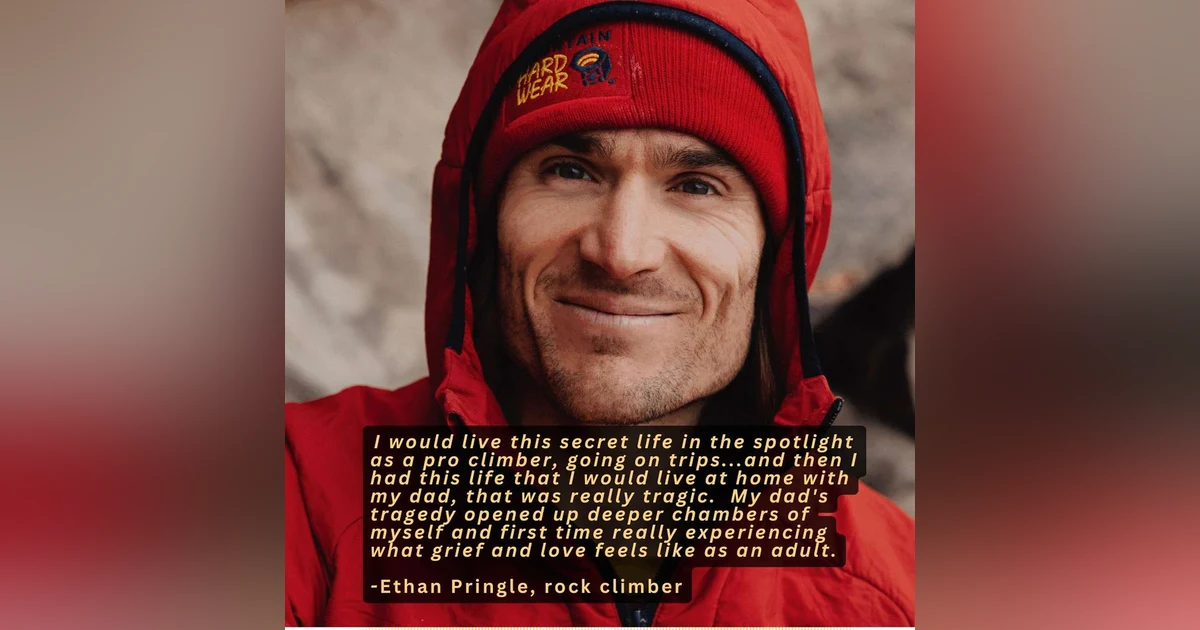
I had my life in the spotlight as a pro climber, going on trips, trying to send hard and, documenting a lot of the stuff that I was doing. And then I had this kind of like secret life that I would live at home with my dad, that was really tragic, but really sort of like emotionally transformative.
And I think that like That duality seemed like a profound story. It seemed oh, everyone is living some sort of like secret life, whether it's inside their heads or as a caretaker or s- with some other personal struggle. So [00:15:00] that I thought was relatable, but then also just like this big opening that I experienced because of my dad's tragedy that like, opened up deeper chambers of myself and like first time really experiencing like what grief and love feels like as an adult.
I mean, I was like, "Okay, this is... if I ever have like a really profound story to tell or something like a one to two sentence thesis, personal thesis that I really wanna communicate to the world, this is it." Like I wanna know, I want people to know, how profound it is and what a gift it is to allow sadness and allow grief to penetrate.
And I mean, it's like the number of people that I see, the number of adults that I see just like going through life, never really feeling sadness, never really feeling grief even though all this sad stuff is happening all around us all the time, never crying. I mean, the number [00:16:00] of, especially men, but just like adults in general who I just never see cry, who have so many good reasons to, I'm like, this is the real tragedy."
The real tragedy is that we like we're just programmed to not let sadness penetrate. We're programmed to, to exude positivity, and it's good vibes only, and I'm like, "Look at the world." Like it's... There's so many tragedies happening out there all day, every day, and we're just like really cut off from it.
But I think, for me, it kinda took this really personal tragedy to, to open myself up to grief in that way.
Speaker: That's powerful, Ethan, and, I think reflective and there's something very important that you said, which is yes, we can see and talk about all the tragedy around us but not let what is going through inside us come to the surface Ethan,
Ethan: What were your [00:17:00] parents like as athletes when you were a kid?
I mean, I think once I was born, I think their, relationship with Windsurfing probably changed a little bit. like you just, you can't go, you can't do your sport with the same amount of fanaticism that you could before you're a parent.
I mean, you have more to lose. You have a lot less time. But they were still, they were still really into it, and, they were always... I mean, before I was born and even after, they were fanatics. Ethan, , for those of us on the outside, people listening here are climbers and maybe there are other bubbles similar climbing- other sports. But how do you contrast or maybe compare, like, the lifestyle of, let's say, another fanatic pro climber or just not even pro climber, but just like full-time climbers to maybe the, the [00:18:00] windsurfing lifestyle? Like, are they similar? Are they different?
Yeah, no, there's, there's a lot of similarities to the lifestyles, I think, like, especially back when my parents were super into it.
Obviously, they would do it locally in the Bay. the Bay is actually like kind of a windsurfing mecca. and, there were tons of races. I think when they were doing it in the '80s and '90s, it was a much more popular sport. Now everyone is doing, like, kitesurfing basically. Everyone, like, transitioned to kitesurfing.
the- people dil- still do windsurf, but I think kitesurfing has really exploded and it's it's a lot of people who would otherwise be windsurfing are doing that now. But back when they were doing it, obviously they did it locally a lot. They did a ton, tons of races. There was a big community of people who were psyched on it.
But then they, f- after they got married, on their honeymoon, they just, like s- they just strapped a bunch of windsurfers to the roof of this old, Toyota van, and they drove it down to Mexico and they just, like, took a [00:19:00] one-year-long sabbatical in Mexico just, like, bumming around and dirtbagging in Mexico, which is totally something that, like, a climber would do when they're in their, 20s or 30s and they're really psyched on climbing, and they just, all they wanna do is climb and, like, live off the land basically and, like, have crazy adventures.
So there's, I think there's a lot of overlap. And, I mean, even if it wasn't Even if it wasn't windsurfing, they were always fanatics about whatever they were into. And it was, obviously windsurfing for a long time, and then it was skiing, and then it was snowboarding, and then it was, like, and then it was road biking and, cycling.
And my dad eventually got into, like, peak bagging and snow camping and stuff. And, and they were always just whatever, whatever it was, the sport of the year or the sport of the decade, they were all into it, And, and I think I really, I really have that. And [00:20:00] climbers really have that personality type too, where, where it's like, you find something you're passionate about and then you're just like, you're all in.
You're totally obsessed, and you wanna know everything about it, and you wanna meet a lot of people in the community and have crazy adventures. And, and yeah, they, they were like... I think that if you were to substitute climbing for windsurfing and my parents were climbers instead of windsurfers, like, they would've been so entrenched in the community.
They would've been-- My dad would've been, getting dragged up the nose with Jim Hirsen or, like- ... he would've been like that, They would've taken trips to the Himalaya or the Karakoram or whatever. whatever the sort of summit sort of experiences that people were having in climbing at those, in tho- during those decades.
Like, they would've been having those instead of these peak experiences with windsurfing, 'cause they were just, It like, it could've been anything, but it was windsurfing. And they were like, yeah, total fanatics.
Speaker: Comparing the two disciplines [00:21:00] Both of us know many climbers our age or whatnot who have families now, and I think they usually do everything they can to get their kids to also become climbers by hook or by crook.
So did your parents ever try to influence you? Or, like, how did you not end up becoming a windsurfer yourself? Or maybe you are a windsurfer and we don't know about it.
Ethan: I mean, I would have loved to have more experience at it and, and, I don't know. It's just, it's another thing to do.
I think I was, I don't know. I mean, I, I did do it a little bit and I would, like, sit on my parents' windsurf boards and they would, like, sail out into the bay or onto the ocean, and I would just sit there on their windsurfers and take trips with them out onto the water. I'm not sure why it never quite stuck with me.
I think it was just, like, it was their thing and, and I think also, by the time I was born, [00:22:00] like, it's the kind of thing where... And I'm sure clim- some climbers who are parents can relate to this but, you, if you travel overseas to do it, you want, a babysitter or you want, like, a careta- or you want a nanny or whatever who can kinda watch the kid while you do your thing.
And it wasn't like I was really... I wasn't always doing the thing with them. Like, I would sometimes go and, and interact, but I wasn't, Sometimes they would leave me at my grandparents' house in LA for a week when they went, while they went to Mexico or Aruba or whatever. And, so I wasn't always with them doing it.
And I think I also just, like, I got really psyched on, on snowboarding when I was, like, six. I mean, I got psyched on skiing when I was, like, three or four, and then switched to snowboarding when that became popular. I don't know. I just, I guess I had my things that I was pretty into already and, maybe windsurfing just didn't seem quite cool enough or there weren't other, there weren't other people my age doing it at all, [00:23:00] so it was, like, hard to, harder to get psyched on it.
I
Did I tell you at Mission Cliffs that my wife Katie is pregnant?
Speaker: Oh.
Wow. No, I, I met Katie there for the first time- Yeah ... and maybe I was not paying attention, or maybe she is not sh- like, showing, but congratulations. Wow. Thanks.
Ethan: Yeah. Yeah, so I mean, obviously if and when we have our kid and raise them at The Rocks in South Africa, hopefully they're psyched on it.
They're going whether or not they want to, but hopefully they, they wanna interact with it. I mean, we'll see. We're, we're not gonna push them to do anything they don't wanna do, 'cause that's never a recipe for success. But, but yeah, we'll see. You can check- How far,
Speaker: how far away are you from the baby?
Ethan: Oh, it's, it's on- we're, like, not even quite eight weeks yet. We're, like, almost eight weeks in. It ha- has a heartbeat, though. She got scanned. She's in Cape Town now, and she got, she got her first scan, yesterday, and she sent me a video of the heartbeat. [00:24:00] the thing has a heartbeat even though it's, like, the- Holy cow
size of a cashew still. Wow. Yeah, So emotional to-
Speaker: Wow, Ethan, this- Yeah ... again, congratulations, E- Thanks. Folks, you heard it here. Ethan is gonna be a dad. But now it's making me think even deeper into what might have been going through you Because here you are speaking about your father, like- like laying your heart bare- Mm-hmm ... in front of people. Mm-hmm. Coming from this deep place. At the same time, you are also about to become a father. So can you talk to us about how is that coming through inside you this time?
Ethan: yeah. It's, it's, it, feels, the timing of it feels really... I mean, the, this film, Strength to Weight, is being screened and just had its premiere and stuff.
And, and yeah, [00:25:00] now Katie, basically right before the film premiered at Telluride MountainFilm, we found out, that Katie was pregnant, and yeah, the timing of it is, is crazy. Feels like another, another, loop to, to connect. and yeah, I know my dad really wanted me to have a family.
it's, it feels like, it feels profound that it's all happening at the same time. Also, yeah, John Glassberg, the, filmmaker who made this film, his dad just passed, right around the time that the film was premiering also. So really strange timing, but yeah, I'm, I'm psyched. I'm scared. Katie and I are, are definitely both scared, and I think, Like, obviously there's, like, the fear around am I gonna be a good parent and, am I gonna be attentive enough? Am I gonna keep the baby alive? Am I gonna keep the baby healthy? Like, you really wanna do a good job and just, like, raise a really [00:26:00] healthy kid.
But then there's also the fear of, like, How sad am I gonna be that I can't do my sport as often or as freely as I wanna do it? There's, like, the selfish fear. and yeah, and then I'm just, scared for Katie 'cause she's carrying this baby, and that's a huge, that's a huge responsibility, and it's a huge tax to her body and her system.
And, and she's scared for all those same reasons. But I think the closer it gets to, I mean, obviously it's so real now. It has a heartbeat. But, the realer it gets, the more excited we get. And, I think that my excitement has finally eclipsed my, my fear and my dread. ' Cause I was like, I don't know, before we tried just the once, I was like, "Oh, man, this is, like, this is really...
We're choosing To change our lives forever, I think once you're a [00:27:00] parent, like that's just, that's a new phase of your life. Like there's the phase before I found climbing, and there's the phase before my dad had a stroke, and then there was the phase before I was a parent, and now I'm entering a new one.
yeah, it feels really scary. but I think that, it's, it also feels like super miraculous and special and, I'm... Now that it's happening, I'm, I'm pretty excited. Sure. Yeah.
Speaker: Yeah. Yeah. It's gonna be the next big chapter in the book of Ethan.
And Ethan, yeah, just for me getting ready to speak with you, I've wanted to speak with you, I think we exchanged messages last year, and the timing of even this is poignant because I have wanted to speak about many of the normal things, but then also your identity shifting as you are getting older with yourself, with your sport, with your [00:28:00] environment and your family.
But we also have the story of your dad in parallel that you are narrating, and I have this opportunity to bring your story as an athlete, but also your parents' identities and your dad's, because they just, they come together and then there is this incredible arc that has shaped you. Your parents were these elite athletes, and you just told us that at his 60th birthday, like literally on a windsurfing trip, he had his first stroke. That is so scary because I am in my upp- I'm 48 now, and I'm like, "Wow." Like some of us think, a lot of us who s- who are active and kind of obsessed with our sports, with staying healthy, sometimes think that something like this will never happen to us.
Mm-hmm. So [00:29:00] I want to understand a bit about where he was with his health and his sport when that happened. So- What is a stroke exactly?
Ethan: I mean, a stroke is basically just, it's like a... I think there's two kinds of strokes. There's like a, a clot, and, I can't remember what the clot is actually called, but, and then there's like a, a hemorrhage.
Like, so if a blood vessel, in your brain bursts. I think there's a, there's a number of different ways where, how you can, like, have a hemor- hemorrhagic stroke. and then if the other type of stroke, the one that my dad had, was, like, if a clot forms somewhere, a blood clot forms somewhere in your blood, in your arteries or whatever, it can make its way into your brain.
my dad has had a, like a heart defect where basically had like a... I don't even, I don't remember what it's called exactly, but he had a, a hole in, in one of his, one of his, [00:30:00] chambers of his heart, and they think that probably a, a clot escaped from there. and then w- slowly made, made its way up into his brain.
maybe he should've been on blood thinners every day. I can't remember if he was or not, but, but I s- I saw the writing on the wall. Like, I, I knew that something was wrong, just because of the way that he was acting
Speaker: and- So you, you saw the writing on the wall, or were there signs of this, event before his 60th, or was it more sudden?
Ethan: before his 60th, I don't think I, I don't think I really would have assumed that, he was gonna have some sort of, psychological event happening, like a stroke. But after that, especially four, five, six years after that, his personality just was slowly changing, and a lot of the sort of, harder to deal with [00:31:00] aspects of his personality were, were becoming, more obvious.
And, yeah, I mean, I just like... He was, he was like, a little bit cuckoo, and, and I was, I was living with him for a bunch of those years. So I could really see, like, oh, he is, he fell in the street again, or he crashed his bike again for kind of no explicable reason, and, the paramedics had to get called, or the fire department.
Or, like, he's, he looks, he's just standing in the house or standing out on the street in front of the house, like, looking really zoned out and- Oh, wow ... and just, like, behaving really strangely and making pretty bad decisions. about like just lifestyle choices and yeah, and just like doing really embarrassing stuff.
and I think at one point in the year or two before he had his big stroke in 2013, I told him that I really wanted him to go see a neurologist, and I think he felt pretty [00:32:00] defensive about it, like a lot of older people do when their, when their kids tell them to go get serious help. and I don't know if he actually did go or not, but he told me he did, and that his neurologist gave him a clean bill of health.
And yeah, and then that was like, that was the last we talked about it, and then, six months or a year later he had his, his big stroke and, and yeah, and I mean... Sure.
Speaker: Yes. I think we can sense that there was some denial in your dad-
Ethan: Yeah ... about-
Speaker: Yeah ... he had this one stroke, and his, he was still functional, but his life had changed forever.
Because you spent all this time with him and because you're his son, can you speak a little bit to what you can understand about his inner tumult? This thing that's happening inside of him that is, changing him.
Ethan: Yeah, I mean, [00:33:00] it's so funny too. it's a difficult or maybe impossible exercise to try to pinpoint the causes of, an elderly person's decline, even if it's just, like, mental and, oh, he had a heart defect.
The blood clot probably left this hole in his heart and made its way up to his brain, into the right hemisphere of his brain, caused this massive stroke that, paralyzed his left side, and it's kind of, like, easy to pathologize that. But I think it's much harder to, maybe there were other root causes, you know what I mean?
It's like, People are just so complicated, and we have so much programming and, so much, there's so much that goes into us and it's like I don't really know what I'm trying to say, but it's my dad's internal- I think I'm
Speaker: trying to get to, what I'm trying to get [00:34:00] to is, is your dad had this identity as an athlete.
An identity that many of us can relate to.
And that identity was somehow slipping away from him.
And you talked about, like, some things that seem dramatic, but your dad was dealing with every day. And do you think in this, in some contrarian way, like, if your dad had not been- such an athlete and was more willing to accept that he h- is going through this medical condition, do you think that would have improved his chances?
Ethan: I think if he would've... I mean, it's, it's... I think it's, like, a little bit maybe pointless to speculate what... Obviously, though, like, yes, if he would've taken his mental health more seriously at an [00:35:00] earlier stage, could he have maybe avoided having so many strokes? Maybe. I don't know. I mean, maybe he, maybe if he was more concerned or took, took his, his health more seriously, he...
All the same things might have happened or maybe even worse things might have happened. Maybe he would've just, maybe he would've had the stroke at the same time, and I would've just been gone, and he would've died. I mean, it's just, like, there's so many what's the word I'm looking for?
Hypothetical situations we could ponder, but I think yes, he was, he was someone who was delusionally positive, which I guess has its uses, Like, he, he didn't, he almost never, gave himself credit for or admitted to suffering in his own internal world. Never spoke about it.
if you, you could ask him any day of his life how he's [00:36:00] doing, and he would probably say good, even if he, just had a huge fight with my mom or had some other big life-changing event. Like, he, he was just like... he was, I think he was of a generation, like a lot of boomers are like this, where they just don't talk about their suffering.
They don't talk about their internal world. And I think that if you sort of live that suppression as a lifestyle for long enough, your internal world probably becomes inaccessible to you. Like, I, I didn't know- Mm ... what was really going on inside his head for so much of his life, because he just never pulled back the curtain.
and, he was, always really delusionally positive. I think that was part of the denial aspect, too, was like, "Oh, I'm fine. Everything's fine. There's no need to worry." And, even after he had his major stroke, he didn't get it. He didn't understand that he was gonna be in a wheelchair for the rest of his life.
He just [00:37:00] didn't, he didn't get it. and I don't know if that was, if maybe it was, like, those strokes that he had kinda just, like, reinforced this, delusional positivity. But he wanted, a cane to walk, and I'm like, "You can't use a cane. You can't... You, you still need, like, at least partial u- use of one of your legs to use a cane, and the, it's probably..."
Yeah, I mean, I'm just like Yeah, you're, you're pretty delusional. But I think that like, that sort of delusional positivity, it probably helped him in certain situations. he, he was never, he never really... I'm sure that he was down or depressed, and he did mention, he did admit once or twice during his life that he was depressed to me or to my mom or whatever.
I think he even, mentioned to her once or twice that he had contemplated suicide. But, but it's, it's like, it's not that surprising. So many [00:38:00] men, especially men that are, like, cut from that cloth of, like, "I'm never gonna talk about my internal world. I'm never gonna talk about my suffering," suffer in silence for years or decades and then, everyone's all surprised when they kill themselves or when they try, when they, attempt suicide or whatever.
And yeah, I mean, it's just like, it's... I- if we're just super programmed to, to suppress our grief and sadness, and we're super programmed to, believe that, a lot of the things we desire or fear a- are nothing to worry about or shouldn't be desired or whatever, like, and we're just like this culture of suppression, of course people are gonna hide their suffering and then let it turn into a monster inside them and drive them, into the depths of depression and, and misery and stuff.
that's just what happens. And, tons [00:39:00] of people, especially men, are, like, killing themselves all the time. I mean, I don't really have statistics, but I know that it's, I know that it's a lot
Speaker: Ethan, yes. yeah, well put. put. Yeah. yeah, it, it seems like you have understood so much about the human condition, having just- Well, I, I suffer from it.
Yeah. Yeah. And you have spoken about it as well. I've heard you speak- Yeah ... about your own
Did your dad finally seek any kind of counseling at some point? Did he... Was, d- were you able to get through to him that this could actually help you?
Ethan: so there was a period of time during that last phase of his life when he was living in the care home, wheelchair-bound, bedridden, whatever, where I convinced him to see a therapist at Kaiser.
And I would, I would wheel him, the half mile or a mile from his care home to the Kaiser office in Walnut Creek, and he would meet with this, [00:40:00] with this therapist, once every two weeks or once every month or whatever. And, it was really hard. I mean, he... It was... Like, I think basically, eventually his therapist just fired him because he, he just didn't have the tools for vulnerability.
He didn't have the tools for self-investigation the way that therapy kind of demands. I mean, it's like you can lead a horse to water, but you can't make him open up about his internal world. And, and it's, yeah, I mean, it was, it, yeah, I just, I didn't, I, I, I think that one of my big values is vulnerability, but I didn't, I did not learn it from my parents.
Speaker: Ethan, I am curious and, If you're comfortable
Speaker 3: Yeah.
Speaker: What was the relationship between your mom and your dad during this period?
Ethan: my mom and my dad were separated already when, when my dad had a [00:41:00] stroke. My mom, I mean, I think that like my mom, My dad was like a, I think one of the big foundational pieces of my mom and I's relationship was that, my dad was, was handsome, He was, he was a, he was a hunk, and he was kinda charismatic and really gregarious and, but he was really strange and, and, we can have, we, contain multitudes, but I think that he could be a pretty difficult person and, and very hard to access and,I think my mom stuck around for far, longer than was reasonable.
I mean, looking back, it's easy to say this now, but looking back, I'm like, "You should've left way sooner, ways, like decades sooner." and who knows [00:42:00] what would've happened? But, but yeah, I, I think that like eventually, when I was in my early to mid-20s, she was like, I can't be here anymore."
so she, she bailed. She, moved to, to the East Bay, and my dad stayed in the city at his home. And, I think that it was, I think that it was really hard on him to feel like he had failed, like, his marriage had failed. And, I don't think he ever talked about like, how did I contribute to this situation in a way that wasn't like really over the top and hyperbolic.
But, yeah, I mean, they were They, they were never like technically separated, but they were living apart, and that's, when my dad had a stroke. But then, after that happened, they were still married. They both wore their wedding rings, and she would, my [00:43:00] mom would, even though she didn't need to, would come to his boarding care sometimes and bring him Thanksgiving dinner or visit him on Christmas or on his birthday or whatever.
Speaker: Ethan, do you have siblings?
Ethan: Yeah, I have a, a older half-brother. Sure.
Speaker: Yeah. It sounds like a major part of your dad's caregiving fell upon your shoulders. I
Ethan: mean, I, I don't know if that's totally accurate 'cause he lived at a care home and he had 24 hour... He had access to 24-hour care. Like, I wasn't doing most of the heavy lifting.
When I would go, especially in the kind of like two to six year timeframe after his stroke, I would go and, I would basically relieve the caregivers or help them do their duties. Like, I would bring him into the, into the shower room, and I would give him, like, a bath, and I would shave his [00:44:00] face, and I would floss and brush his teeth, and then I would take him out to a meal out and...
or maybe I'd bring him to a movie or whatever and, and just relieve the caregivers of their job because I want... I mean, I just wanted to do it. I think that, they- they're professionals and they... a lot of them did an amazing job, but I think that I, brought something else to the table with his, with- for his care and for his advocacy and stuff that the caregivers just didn't really have time to do, and just, I mean, no one could care as much as I did.
so I think that, like, I just wanted to show up in that way sometimes, but I wasn't always here. I would leave for months at a time sometimes to go try some climb, and then he would just sit there, and maybe my brother would visit a couple times, but he was just left to his TV and his carers, and that just had to be enough, and it was...
Yeah, it was, it was, it was hard, knowing that he was just there at his care [00:45:00] home, like, watching TV. And also, he, he did have physical therapists. he had the same physical therapist for the last, I think, I don't know, five or six years of his life, and he was there every week pretty much.
Speaker: Sure. Yeah.
Sure. Ethan, let's talk a little bit about what was going on with your life- during this period. Mm-hmm. So these two points you spoke about, your dad's first stroke when things basically changed irrevocably-
Speaker 3: Mm-hmm ...
Speaker: and then his, his next stroke, which then confined him- took away a lot of his-
Speaker 3: Yeah
Speaker: faculties at 69. So, so when did, so that was 2013, is that correct? The second stroke?
Ethan: I mean, the second one that we knew about, I'm sure there were others between the one in, I guess 20- [00:46:00] 2004 and the one in 2013. Yeah ... yeah. The, the one that, that paralyzed his left side was in 2013.
Speaker: Sure. So that was, let's say, 13-odd years ago. Let's say, again, just putting a line in the sand when things changed permanently in a, in a big way, and I'm guessing at that time you were somewhere in your upper 20s and likely peaking- ... or close to peaking as an athlete. Yeah. Can you talk about that period?
Yeah, I mean, I was living my... my dad's home in the Mission was still my home base up until the time he had a stroke. So I would, I would come home periodically, and I would stay with him, and when my mom was still there, I would stay with the both, the two of them. sometimes I would live in one of the downstairs apartments, in the building 'cause it was, like, three apartment, apartment building.
Ethan: but when we, when [00:47:00] my dad had, actually had a stroke, I was living upstairs in the room that I actually lived in, like, when I was in high school, which is, like, this little penthouse room on top of the house, basically on the roof. And, 'cause I just wasn't... Like, I was traveling so much, it just didn't make sense for me to occupy, like, a whole apartment, in the house.
yeah, I was, like, in and out of there. I would, like, go on a trip or go on a series of trips or, like, be on the road for a while, and then I would come back home and spend time with my dad and then, and, see my mom and stuff, and then leave again. so I was, like, I was really living that pro climber life at the time.
and yeah, I mean, I, I went to... I w- I was like, maybe a month before my dad had the big stroke in 2013, I was, like, on an expedition in Western China with, Liev Sundas and Mike Le Becky. And, After my dad had his stroke, I don't think I went anywhere super far away for [00:48:00] maybe, like, five or six months or something, but...
And then eventually I did go on, I did start going on longer trips.
Speaker: Wow. Yeah, no, I... this thing happens back at home, and this is a home that you grew up in, in the Mission in San Francisco. What was the first thing that was going through your mind, your head when you heard about his stroke and you were somewhere away from home?
How did that hit you? You mean in 2013? Mm-hmm. That's a good, good, I would say the first time you felt that things had really taken a big turn, and your dad would never
Ethan: be the same
Speaker: again.
Ethan: well, I, since I found him, I mean, I was the first one to know. That's right. Yeah. That's right. You
Speaker: actually did find him.
Ethan: I think I, I think I held onto quite a bit of regret for a long time, and I'm sure, I'm sure some of that weight of regret [00:49:00] is still, still inside me, buried somewhere deep, 'cause, I, I... The morning that... I had a, I actually had a dentist appointment I went to. I took the BART all the way to Orinda to get this filling.
And, I woke up that morning, and I went downstairs, and he was already awake. He was, like, standing in the hallway in his underwear. And I think I remember seeing his face, and I remember thinking that one of his eyes was, like, a little bit more closed than the other, and maybe the stroke had already started happening or something, and I just didn't know.
I don't know if we even exchanged any words. I was just like, "Oh, sorry, excuse me, I, I gotta go to Orinda to go to, to go to this, this dentist appointment," and just brushed past him and left. And I think that, not taking the time to talk to him and find out what was going on, even... [00:50:00] maybe if I had talked to him and found out what was going on, I might have still not understood what was happening.
But, but yeah, I, I think I really, I really carried a lot of guilt from just not... Yeah, just, like, leaving his house that morning after seeing him and just, like, letting him have the stroke. I think that was, like, my, my internal interpretation of it for a long time. And, things worked out the way they did, and it's kind of useless to beat yourself up over it.
But I definitely had some guilt. And, I think eventually the guilt was largely replaced with self-compassion and, and self-love when I was finally ready to sort of let the sadness penetrate instead of the guilt and the shame and stuff. But, but yeah, it was, it was really heavy, to, like, feel somewhat responsible for what happened.
Speaker: So let's talk about this period. You found your dad... Yes, you discovered your dad when he had this, his [00:51:00] big, that big stroke which left him, left him, took away some of his faculties, changed his life completely.
And you at that time, you are performing at the highest levels of the sport. You are, yeah, performing, training, doing these big trips. You are executing. And caregiving seems the opposite of that. And so how did that role change you?
Ethan: oh my God. I mean, I think, that the caregiving role changed me really, really profoundly.
I mean, like I mentioned before, it like, I think being so close to this tragedy, even though my dad was really imperfect as, as a friend and a husband and a father, he was still... Like I, I still, like, it still chokes me up to [00:52:00] think about his kind of innocence, his like boyish innocence that he carried forever.
and I think also his like, his undying positivity was sometimes my interpretation of it was really delusional, but I think also like it was really innocent and powerful in a way that, that seemed so
so tragic in the face of his, his stroke and being robbed of his dignity and stuff, and I think just, yeah, I think being exposed to tragedy and really having no choice but to eventually let it, penetrate your heart is, it's the biggest emotional transformation that I've ever been in or at least up until now.
I don't know what it's like to see my, my child being born, but I'm sure that's gonna be a, a big one too. But, but yeah, I think, it's the biggest, biggest transformation I ever went through by, by a large margin. Sure. And, and I think also just [00:53:00] like, you can really tell if you're doing, if you're in a caregiver role, you can really tell when you're like distracted or when you're wanting to distract with your phone or with, sort of mental constructs or, or, or fantasies or, or desires or aversions or whatever.
Like, you can really tell when you're distracted 'cause you're like caring for this person. And, and I think it felt, it felt best to care for him when I made it my primary intention to just be as present as possible and be really attentive to him. And then it felt really good to, to, care for him, even it, even though it was really sad and really physically and, and emotionally demanding.
I think it felt much better to do it with u- with as much presence as I could. And when I would go and I felt really distracted and I was on my phone a lot, it felt really bad. Like, it did not feel as [00:54:00] good to be there with him, and it felt like I wasn't really there with him. Like, I was like, "Oh, I'm, I'm physically here.
I'm standing here, and I'm, I'm going through the motions of caring for you or hanging out with you or whatever, but I'm, I'm just, in my mind I'm off somewhere else." And, and yeah, it was, it was definitely a, a big practice in noticing. And I mean, I think it's like, I should also say at some point during this interview that I am Like in terms of good fortune, and I guess you could say like privilege, I am in the top 1%.
I mean, I, I had a lot of support from my parents from an early age, and then I kind of fell into this climbing career that afforded me more free time than most people have. And, free time can be a double-edged sword, but I think that, it's... I'm just so fortunate and so privileged that, that I was able to dedicate so much time to my dad, and that I'm able to dedicate so much time and [00:55:00] emotional bandwidth to even think about all these things that we're talking about.
It's like so many people out there are just, like, in survival mode. Maybe they have a, an aging parent or a parent in those last phases of life, in that sort of, that, that declining phase that they really can't be with, 'cause they have a family or a job or numerous jobs, and they have...
They're just too busy, and they, they just can't spend time with their parents, and they don't have the time and emotional bandwidth to, to think deeply about their internal world or think deeply about the internal world of the people around them, because they're just in survival mode. And I think that it also, being in that caregiver role really, really showed me what a privilege it is to have the sort of time and energy that I had to devote to these things.
Very
Speaker: thoughtful. Absolutely, Ethan. Yeah, yes. I think you also spoke [00:56:00] about this earlier in this conversation that it allowed you to grow. It was a privilege in a ways, i- in many ways that, most, of society, they just deal with these, and they do the best they can, and sometimes they can't even do that because they are pulled away for all kinds of life reasons.
Mm-hmm.
Speaker 3: Yeah.
Speaker: And Ethan, you were this high-performing athlete, and what I can already sense is that, this event, it forced you to grow in ways, find strength. you spoke about how, for example, this, quality, this difficult quality of learning to be present, which, you could have just gone through the motions and taken care of your dad, and that would have...
That itself would have been, you, like something you would have gotten kudos for. "Hey, here's this athlete's son who's come back home to look after his dad." But you were trying to be this present person, to be attentive. So can you talk a little bit about
How has this [00:57:00] helped you grow into this person that you are now?
Ethan: I don't know. I mean, I think, I think I owe I mean, I, everything I have, whether it's, my genetic predisposition or my, my curiosity for people's inner worlds and my own, or just my, fascination with any sort of expertise.
I mean, everything I have is just like a gift from the universe and, yeah, I mean, I didn't... I think having a lot of time to think about things and to feel the way you react to different stimulus and stuff is definitely, like, something that I think contributed in large part to the way I am and the person that I've become.
Because, I, we're all... I, think, a lot about people these days as [00:58:00] like, a sort of reflection of their values and, like, a set and, like, a value system, And when I think about people, I'm like, "Okay, like, what, are they, what values are they embodying?" And for me, obviously I'm really into humor, and I'm into, extreme sports, and I'm into, I'm into learning about new things from the perspective of an expert, no matter what it is.
But I'm also really into, I think, one of the things that I'm most curious about is, is what it's like inside people's heads. What's the story inside people's heads? And I think one of the reasons that I'm so curious about that is because I'm really curious about what the s- I'm studying the story inside my head, and the only way you have time and energy to do that is if you have time and energy to do that, and a lot of people just don't.
another one of my values is probably, like, bravery or [00:59:00] fearlessness. my mom was, When I think about my mom, I think about fearlessness.
Just the way that she took on windsurfing when she was younger, and the fearlessness with which she windsurfed . she was out on the bay doing windsurfing races in gale force winds when she was eight and a half months pregnant, I'm sure that's- In cold water. In cold water. People don't know.
Yeah. and getting rescued on the bay and stuff, and I think she's always really embodied fearlessness in that way, and I think that's a value that I have. But I think one form of fe- fearlessness is being open about your internal world and, Communicating what it, what life is like for you at the risk of judgment from others.
And, I think a lot of the people that I admire most are ... like really embody that value of fearlessness, even if it's just [01:00:00] in the way that they communicate with the world, in the way that they communicate their own internal world, to the rest of, to the people around them. And so, yeah, I mean, I think that's, a value, that's a big value of mine.
And, I think that's like more than hard sends, that's a way that I can contribute to, climbing is, is to communicate my internal, world with, a little bit more fearlessness.
Speaker: I was just thinking, Ethan, as you were saying that if you were to ever look for a second career at some point, you could probably find one as a coach or a therapist for professional athletes- Okay
because you have a window into that world that-
Speaker 3: Yeah ...
Speaker: most of us don't. Plus you have, developed this, ability to be empathetic- Mm-hmm ... and to understand and to be able to relate, which I think is deeply needed. I, I mean, it makes you, I think, in [01:01:00] some ways uniquely qualified.
Anyway, we will ... I, I will, I will, yeah, I'll stop with the career suggestions, for now. Ethan, and then, you were, you were growing in these ways and you were assuming these roles, and I'm guessing that it likely also forced you to let go of some things, maybe parts of yourself that were important to you.
Can you speak if that was happening as well?
Ethan: Yeah, I mean, I think you're ... when you finally let grief and sadness and fear, when you finally acknowledge, like, all of these things that you're holding in, it all just kind of comes cascading out of you. You don't really have a choice, There's just no stopping the, floodgates open, and then it's just like it's all coming out.
And, I think one thing that happens, when, when I was thinking about my [01:02:00] dad and, and what a tragedy it is that this, that, seeing kind of, seeing his, inner child and his innocence go through this really tragic thing, and then feeling, like, the pain from that, it It forces you to look inward at your own pain and everything that you're carrying.
I think it's like s- viewing someone else's tragedy can be a gateway to your own, your own self-compassion. And I think, like, having compassion for others and then having that, that really profound compassion for yourself, kind of looking at the toll that, your worry and your expectation and your pressure and your shame and your guilt has taken on you, When you feel the weight of that in a moment of self-compassion, I mean, it's just so powerful, feeling the weight of, of that toll, the toll that that stuff has taken on you can [01:03:00] really help you let go of it. and yeah, I mean, I think that's, the, big, that's the powerful tr- transformation. Sure. And I think in the film when I do that Lorena Mora route in Spain, that really is what happened.
I was, like, on this trip to Spain. I had gone there with the explicit purpose to climb this route. And I, I probably had delusions of climbing other routes on the wall that were even harder on that trip, and obviously that didn't happen. The one route took me, the whole six-week trip that I was there.
But I was, like, so close to this, doing this route for, weeks before I did it, and I was just feeling so much pressure about, about getting it done before I left. I was also like, I was cruxing in my relationship back home, and there were just all these really difficult internal things that were happening at the same time.
And the day that I did it, I was like, "Wow, I've really been suffering at my own hand here," like, "I've really been putting so much pressure on myself." And I kind of [01:04:00] gave myself the benefit of, the love that a loved one, or a family member would give me at the crag. And I cried a bunch. I just went off by myself and cried a bunch at the crag.
And then I warmed up, and I felt, 15 pounds lighter. And then I just sent, like- Wow ... pretty easily
Speaker: Yeah. yeah. Wow. I mean, there's a teachable moment, and I don't know, like, I'm not a therapist, but it seems like, like facing your emotions and being honest about them might be the secret weapon towards high performance because
Ethan: Well, I think that, I think that we need, we need, people in my position or, like, we need, I think the world is, is-- like society has programmed us to condemn ourselves and condemn one another for our mistakes so [01:05:00] quickly, There's just not a lot of room for people to make mistakes, so no wonder people don't wanna-- to sort of feel like it's okay to, to make mistakes or to feel a certain way that seems at odds with what, what the expectations of society or, their, their community is.
we need more people to tell each other that it's okay to be scared, it's okay to feel shame, it's okay to, to feel sadness, it's okay to feel hurt, and, it's just okay to feel however you're feeling, because I think that most of the feedback we get is that it's not okay, that we-- that, that all those things are, are emotions that are meant to be hidden and, and, how dare you if you, if you make mistakes.
We're just so quick to judge and condemn each other, and I think that it just... [01:06:00] Yeah. it doesn't really, encourage people to exercise self-compassion.
Speaker: Yeah. Ethan, you just turned 40, and many landmark things happening in your life at this moment. What perhaps feels different about you at 40 than maybe you expected?
Ethan: I think the first thing that comes to mind is, like, I thought I would be way more dialed or optimized or, a- appearing as an adult at 40 than I feel right now.
Speaker: Hang on. Everything you have shared so far makes me think that you are functioning as a very capable adult. Like, just, yeah. You-
Ethan: You should see how-
look after you- ... my room is right now. Yeah, I mean, but those are, that's not the question. And just, like, how disorganized my life is right now. Hang
Speaker: on. So, so t- tell us about that, Ethan, because again, from the outside, it would ... It may not [01:07:00] always seem that.
Speaker 3: Yeah.
Speaker: What, what, what about your life do you think
Forget the superficial, you're not even living in your regular home maybe. You're living, you're traveling. Outside of that, like, what, part about your life feels messier than you would like?
Ethan: What part of my life doesn't feel messier than I'd like? No, I mean, I think I'm just, like, I'm a disorganized person.
I think, I think I ... Yeah, I'm kind of a, I'm kind of a walking explosion in a lot of ways. And,when you, imagine a, an athlete who's still trying to do their sport at a fairly high level at 40 years old, you probably imagine someone who's super dialed and, optimized, and I don't
that's just not me, Like, I'm, I could definitely take sleep hygiene a lot more seriously. I could, I could, be way more organized in my career and my professional life. And, and I'm just ... I don't know. I, I'm still kind of a shit [01:08:00] show. So I'm ... that's a bit of a surprise, and sometimes a disappointment.
But, but yeah, I, one of these days, I'll, I'll get my shit together and I'll feel, I'll feel organized. I won't have, like, 20,000 unread emails in my inbox.
Speaker: you are turning the cusp maybe, this big decade ahead of you. What are your hopes and dreams for your
Ethan: 40s? oh man. I mean, I have, I definitely have some climbing related hopes and dreams.
I feel like a lot of my hopes and dreams are, Like I, I definitely still have climbing goals and I'm still as psyched as I've ever been to, to get after it and to... I think I, I'm, I'm really into like developing now. I have some bouldering areas and sport crags in South Africa that I'm really psyched on.
I still have big climbing goals here in the States, but, [01:09:00] and in Europe. But I think also I just wanna, I do wanna feel more, a bit more dialed and a bit more organized and just like free up a little bit of mental and emotional space for other things like, for instance, caring for a child and, and maybe, I will probably feel very remiss if I die without learning Spanish, so maybe I'll do that someday.
Like, it just... I don't know. I mean, I wanna, I wanna free up a little bit of space for, for other things and even just for like, just to have space, just to have a little bit more, a little bit more downtime here and there and, and not always like go, go, going.
Speaker: Let's talk
Ethan: about
Speaker: your performance goals. Do you think that your best is still ahead of you?
Ethan: I think it definitely could be. I think if I, if I start taking my like, my training and my physical... I mean, I've never really trained like in [01:10:00] a super systematic way. I've like had- I've never had a trainer or a coach, for as long as I've been climbing really. I've had friends who are coaches who have like made me training plans, but I've never really stuck with one for longer than like six weeks or something.
so I think if I could stick with a rehab program for my shoulders, because my shoulders are like super tight and, and pulled forward. if I stuck to a rehab program for those, if I worked pretty hard at, at improving my finger strength and if I worked pretty hard at, improving my endurance or getting it back to a place where it was maybe like 10 or 15 years ago, I think I could climb harder than I ever have.
I actually have this dream of, going back to Biography in 2027, the 20-year anniversary of my previous ascent and doing it again. I mean, we'll see how, we'll see how realistic that is with a, with an infant [01:11:00] child, but, we'll s- It would... That would be really sick. That would be like- Well,
Speaker: when you go back now, the rest of...
I mean, you might wanna stick with that, but the rest of the world might want you to Pick on Bibliography maybe as the, as the next goal. I think
Ethan: that, I don't know. I mean, I think that Bibliography, so I've tried Bibliography's crux a few times. it is so hard for me. It's so anti-style. I mean, it's kind of like both of the things I'm really bad at in one boulder problem.
It's matching a tiny in-cut crimp and it's, like, very shouldery and frontal, and, like, the feet are really high and bad, and it's kind of like everything that I'm... Like, every type of move that I'm bad at wrapped up into one boulder problem. to me, the boulder problem feels like V14 even though Seb Boiss says it's V11, which is just a joke.
It's so hard. I mean, it's like a board [01:12:00] style V12 or 13, I think. maybe, like, No Wheeler would beg to differ, but it's really hard. We should ask, we should ask Janja, I think. Yeah. How hard she thinks the boulder is? But she doesn't know. Yeah. I mean, she's... She doesn't know. She's like, she's...
You can't ask someone like that. They're too... They're either... Like Seb, I think might know, but he is a sandbagger , and Janja just doesn't know 'cause she's too strong. Okay. Like, everything that's, like, straightforward probably feels easy to her. That makes sense. Yeah. That makes sense. but it's nails.
You
Speaker: can... Yeah, yeah. No, you can... the thing is that despite all this, You know I bolted that route,
Ethan: right?
Speaker: What was that again? You know I
Ethan: bolted Bibliography?
Speaker: Oh, I did not know that.
Ethan: Yeah.
Speaker: Oh, wow. Okay. Yeah, yeah. Oh, well, then you have more of a stake. congratulations on helping the second 15C ascent by a female come to life.
Yeah. Like, your name will forever be part of that story. You can, [01:13:00] you speak about this messiness in your life and you speak about how you haven't been this, perfectly organized, dialed athlete, but you have still been performing at the highest levels. So I'm curious, do you have some non-negotiables when it comes to organizing your life to make these things possible?
Ethan: Yeah, I mean, I think that one of the reasons that I haven't been as dialed or organized, is because I've... climbing and like trying new hard climbs all over the world has been my biggest priority for 30 years. being super organized and being super dialed hasn't been my biggest priority.
and I think that, like, I don't know. I, I even if I feel, like unprepared in other areas of my life, I always want... I'm always so eager for an adventure. Like, I'm always like, "Oh man, there's this one sick [01:14:00] boulder problem that I saw way up on the mountainside behind our house in Cape Town that I just, I need to find out if it goes."
I, I need to bring a rope up there and I need to go on some random weekday, and I'll just like leave, I'll leave the mess of my life behind to go have an adventure on the mountain. And that's kind of what I've been doing for, for 30 years, I guess. and it's not to say that you can't do both.
I mean, some people, some... I'm, so impressed by the balance that some people seem to strike, although I don't always know what their life is like behind closed doors. Maybe they're just as big of a mess as I am. But, I'm so impressed with the way that s- some people seem to balance, doing so many things at such a high level, like school and high performance climbing, for instance.
you see a lot of these really elite level athletes like Connor Herson, who is in, [01:15:00] like he's doing undergrad and grad study programs at the same time at Stanford, and he's climbing 5.14 plus trad and 5.15 trad. And you know, Mikaela Kirsch was someone who comes to mind who was like crushing super duper hard boulders and sport routes on her breaks from school.
And I'm just... And Andra obviously was like doing that, 20 years ago before he was, this sort of, I mean, he was already a legend, but he was, he was cl- he was onsighting 14C on his like winter break s- trips to Spain. And then I
Speaker: remember some of his early videos, he would be sitting in the backseat behind his parents, reading like algebra books- Totally
on the
Ethan: way to the crag, yeah.
and learning like three languages at once. That's right.
Speaker: Yeah.
Ethan: That's right. it's, I'm just so impressed with people like that. I feel like- I feel like I can only have one priority at once. It's so hard for me to, I don't know, maybe it's some sort of like dopamine [01:16:00] addiction or something, but I'm just like, I don't know.
It's, it's hard for me. It's, it's like when I w- there have been times in, in the past where I've been injured and I just couldn't climb, and then I was like, it wasn't actually that hard to prioritize something else like studying or, whatever, just something other than climbing. but I think when climbing is my, my priority, it's really hard to, it's really hard to, to devote all of my attention to something else
Speaker: It sounds like- But now I'm looking
Ethan: forward to it, 'cause I'm gonna be a dad relatively soon. Yeah. Yeah. May- maybe,
Speaker: maybe,
Ethan: It's gonna be good for me, I think ...
Speaker: I think so. I think it's, it's a little bit a cliche to say that, but it sounds like a big part of your ability to keep or to stay at, at a top level is because of just being psyched, and you spoke about this yearning to travel, see new places, check out new lines.
But you know, those of us who have been doing one thing for a long time, [01:17:00] especially when we find that progress becomes so elusive- Mm ... it's so hard. Like, it's, it's, one can cruise a certain level by a certain level of effort, but to get to the next level requires this whole other kind of game
How do you stay psyched? knowing that you have climbed 15B, you have climbed these, really difficult boulders, how do you stay psyched to go out and perform even though you, maybe that day is not gonna be your highest performance day?
Ethan: I mean, I, I don't think I'm, like, going out with the expectation that I'm gonna, like, one-up my previous efforts, I haven't really felt the need to try to do that in a long time. so for me, it's kind of like I'm inspired by, maybe if it's not doing something that's harder than I've ever done. Like, I just wanna go try hard, And I think, going and like I think developing really scratches that itch of like, of discovery and of adventure [01:18:00] and sort of like answering questions that you're uncertain about, And like satiating this curiosity for, like what is this experience gonna be like? I'm, I'm super eager to go look at this rock and wow, it's so beautiful, and are there enough holds? You're just like, you get to answer all these questions that nobody's even asked before and, and I feel like that's kind of what keeps it new.
And I think, going and doing established climbs and going to new areas can also be just as fulfilling. You're like, I think then the question is more like, oh, there's this thing that, X number of people have done. I know who they are, I know how they did this climb, I've watched beta videos.
I'm gonna go see if I can do that too, And I think that's like, I think especially in, my I guess prime years of performance when I was doing that a lot instead of going and doing new things, like I was so hungry for to answer that question of, okay, [01:19:00] can I do this too, And like fairly often the answer was yes. And I think I'm just like ... I don't know. I think, I think just mixing it up and, and doing new stuff and, having a more adventurous attitude toward climbing where I'm, It's not just that I'm challenging myself physically and trying hard, but I'm like I'm...
It's I'm going out to have an adventure and to, to try to answer all these questions I have about, about this place or this line or whatever, and I think that really interests me just as much if not more than can I do this thing that a bunch of other people have done or that maybe no one's ever done.
Sure. Or maybe one other person has done. Like, like that sort of comparison of like can I be as good as I imagine myself to be? And maybe part of it is that I've gone on a bunch of trips now where I thought maybe I could be as good as I imagined myself to be, and I just wasn't quite good enough.
I wasn't quite as good as I ima- like ima- or, thought I might be. [01:20:00] Like, I went to Spain a couple times to project different sport climbs and came away empty-handed and yeah, I don't know. I think it's, it's pretty hard to invest, emotionally into a big trip like that, and just like monetarily and stuff and come away empty-handed.
And I think, yeah. It's not that I, like, lost my appetite for that completely, but it's, it's... Yeah, I think that, like, doing that doesn't seem quite as fulfilling as, like, going and, and having this big adventure and this big, like, opportunity of discovery and stuff. Even if I'm not, climbing 5.15, if I'm climbing 5.14,
Speaker: you have always been unusually honest about failing.
And you have this really, grown-up attitude and ability to learn from your failures and reframe what success means and what keeps you stoked about climbing today. [01:21:00] But I'm curious if there is still some kind of failure that, that still gets under your skin?
Ethan: Yeah, I mean, I've, I've tried this boulder in, Rocklands for three seasons in a row now.
This V15 called Monkey Wedding, and not last year, but the previous year in 2024, I had one try where I was, like, super close. I mean, I was, like, getting really close to doing it. Last year, I was, like, making some good links, but I think the whole linking the whole thing felt, for some reason, a little bit out of reach for me, and I think that, like...
I don't know. It's like on one hand, it's, it's frustrating to have seen progress and then have longer periods where I'm hitting a wall or I'm making reverse progress and, but, but it's also kind of like maybe what keeps, the stoke alive and keeps you coming back is "Oh, can I, can I still do this thing?"
And [01:22:00] I think, looking past that, it's not quite to Jumbo Love levels where I'm like, "Oh, I definitely can't do this," it's like physically beyond me or whatever. Like, I know I can do it, but maybe I'm like, "Okay, maybe it's actually time to take training more seriously for this one project," And that's, that's also an interesting question to answer. I've always wondered, like, what could I be physically capable of if I really dedicated myself to training? could I just go and do Monkey Wedding on my next day on it if I was like, if I spent, three to six months just training really specifically for it?
Or could I, go to Spain and, climb all those sport routes that I tried, five or 10 years ago super fast if I dedicated myself to training? But I think it's so hard for me 'cause I, I don't know. It's, I've just never been that, I've never felt that dedicated to sacrificing time outside and going on ventures and exploring new areas and trying new lines [01:23:00] for the sake of, you know, clocking in at the gym and working on your finger strength.
I think that there's a way to do both at once, but, yeah, I've, I've just always opted to go and, and be curious about some new thing.
Speaker: Well, having a child will- Likely force you to be a little bit more grounded.
Ethan: Yeah. I mean, I- Is
Speaker: this maybe one aspiration you have that, maybe this will be a forcing function and make you train in the systematic athlete kind of way?
Ethan: Totally, yeah. Yeah, I mean, I think that I'm really curious what it's gonna be like. Like, I don't really have any big expectations. Like, maybe I'll have... Maybe it'll be, like, way crazier and I'll have way less time than I imagine, and it'll be, like, super stressful. I'll have to... And, it'll be, like, a massive sacrifice, or maybe it won't.
Maybe it'll be like, a bit of a [01:24:00] balance. But I think either way, like, I'm gonna have way less time to go on adventures, and I'm f- I feel, like, pretty okay with that, actually. 'Cause I've just been doing that for so long, and I'm, I'm curious whether or not it will kind of, like, force me to focus and use my time in a more focused and, like, progression-oriented way.
Speaker: Ethan, we, we don't have time to get into this, this new home that you have created in South Africa. Yeah. South Africa has been on my bucket list for, like, so long for both climbing and surfing. But many people are nervous about going to just... South Africa has the term Africa in it, and it's sad that people will not wanna go to South Africa.
So what is maybe just one thing you would like to tell people on what makes South Africa so special?
Ethan: I would say, like, more than anything, the people are super nice. Like, when you interact with people mo- I mean, most... A large majority [01:25:00] of interactions you have with people in South Africa, no matter what sort of strata of the socioeconomic spectrum they're on or what, what, like, no matter what sort of way you interact with them, most people are really friendly and really kind and joking a lot and, and then, So the people are super nice, some of the nicest people I've ever interacted with, the, some of the nicest strangers I've ever interacted with. Oh, also you can really see how considerate people are to other people when you drive on freeways in South Africa. Because, like, in freeways in the States, there's just so many oblivious people just parked in the passing lane.
they're going the same... Everyone on the freeway is, there's four lanes and everyone's going the exact same speed. No one's letting anyone by. In South Africa, in South Africa you're on, like, a two-lane highway, and there's a shoulder, and you come up behind a slower [01:26:00] car, and they m- they drive on the shoulder for you to pass.
And then there's this, there's this really cute thing that happens where you pass people, and you'll hit your hazards to thank them, and then to say, to, for them to say, "You're welcome," they'll, like, flash their brights at you. And it's this, like, this, adorable language that, that you have with the other motorists.
And everyone's just like, everyone's like, "Oh, you wanna go faster? Like, go ahead. I do it for people all the time too." And it's just like people are so considerate there in a way that people here, like, just... some people here are, but most people aren't, And, also, I mean, beyond how considerate strangers are in South Africa, it's just such a beautiful country.
I mean, it's, it's insanely gorgeous. Cape Town as a city and the surrounding areas are, and stuff are, is just, like, breathtakingly gorgeous. There's such good... There's world-class climbing. And then, I mean, South Africa and just Southern Africa in general, it's just, like, such a [01:27:00] vast and geographically diverse landscape with so much beauty, just breathtaking beauty, such good quality sandstone and quartzite and, so many good crags and boulder fields.
And just, like, lifetimes of climbing. You could never, see it all. I mean, I will ne- like, I'm just, I'm still discovering new areas in my backyard and, that never mind the places that I have to drive, like, more than a few hours to.
Speaker: I- I mean, Ethan, just even outside of the sporting opportunities, just this part like causes some envy, which is you grew up in what a lot of people will think is one of the prettiest cities in the world- Yeah
San Francisco, and now you're living in yet another city which is, just, equally gorgeous. So yeah, maybe we should take that as maybe some inspiration that, chase beauty. Well, Cape Town is kind of like the
Ethan: Bay Area of Africa. right, right.
Speaker: yeah. except better surf, better climbing, so yeah.
More accessible surf and way more accessible climbing. Way more. yeah, [01:28:00] yeah, yeah, yeah. Ethan, I know we are almost out of time. Just wanted to ask you a last couple of questions.
If I was talking to the 60-year-old Ethan, like two decades from now-
And I was to ask that Ethan, " What would you tell the Ethan at 40- to start doing so that the 60-year-old and older Ethan- is having a great life?"
Ethan: Sleeping better
Okay. Yeah. All right. Take sleep courses. Anything else? I don't know. just, yeah, with whate- just be more present with whatever you're doing and carve out time to write and for creative, endeavors.
Speaker: Ethan, if someone is listening who's, your age, maybe older- and they're juggling work and family and training, and a parent's health is declining-
What's one thing they should start doing [01:29:00] today?
Ethan: probably get like a... first, off, get like a, a robust power of attorney and living will. I mean, that's probably something that everyone should get squared away, with their parents. 'Cause I know people who didn't do that and then have, like, a huge legal mess to clean up as well as a physical mess.
but also I would say, And, and maybe,
Speaker: maybe one shouldn't even wait.
Ethan: Yeah. Yeah, don't wait. And the, the, the- Do it now ... the declining is
Speaker: happening. Like, one should do that basically. Absolutely. Everybody listening who's got aging parents, do that, like, today.
Ethan: Yeah, yeah. don't wait. And I would say for the people with aging parents, it's, yeah, however you feel is fine.
I mean, I would say the same thing to them that I would say to probably anyone, which is, however you feel is fine, and if you're scared, that's okay, and if you're, if you're feeling numb like I was for, many [01:30:00] months after my dad's stroke, that's okay, too. And, yeah, I mean, find a therapist and/or people you trust and talk to them.
Open up to people and, and there's just no wrong way to feel. yeah. Ethan, what do- Also, also I will say this too. Go easy on yourself.
Speaker: Okay.
Ethan: Go easy on yourself. Okay. Don't beat yourself up.
Speaker: Yeah. Yeah. That advice is simple but complex at the same time. It's hard to do. Ethan, now that you're 40, I feel I can ask you this question, which is what do athletes get wrong about aging?
Ethan: I just listened to this podcast with, I just listened to a Careless Talk with Yannick Flohé. or maybe it's pronounced Yannick. and, and I just like, I'm listening to all these super young, super high-performance athletes, basically talk about how worried they are that they're gonna be totally washed, when they're, by the time they're 30 or [01:31:00] 35 or whatever.
And I'm like, "What the fuck?" That's totally... I expect Adam Ondra to be climbing 15c until he's 40 or 45 even. Like, there's no reason for people who are, are really high-performance athletes in their 20s and 30s to not maintain a really high level into their 40s or even 50s. you just see so many examples of people.
And we're gonna see... I mean, we're gonna see it in a way that we've never seen it before once people like Ondra and Megos and these other people who are, like, a generation or two younger than me, who are much, much stronger than I will ever be or have ever been, are reaching the age that I am, 'cause they're taking their, they're taking their physical therapy so much more seriously.
They have, like, coaches and trainers and, and they... I mean, I think that we're gonna see people in their 50s climbing V15 and 5.15, in another 20 years or [01:32:00] something. I don't know if I'm gonna be that person. I would love to be that person. But I think that people can keep doing their sport at a really high level so much longer than they expect.
And, also, if you can't, if you have to, like, bring it down a notch or two in the interest of longevity, it- there's no reason why you can't keep enjoying what you're doing. I feel like I, I have... My motivation has not dipped. If anything, my motivation has risen since I moved to Cape Town, just because there's so many exciting climbing objectives to explore there.
And, and so you can, you can be as psyched or more psyched in your 40s than you were in your teens if you want.
Speaker: Sure. Yeah. And maybe, maybe part of that, strategy is to surround yourself with beauty and wonder and
Ethan: novelty. Yeah. I mean, I'm in a privileged position, and not everyone has the freedom to, to do what I've done, but, but yeah.
I mean, I think if you want to prioritize climbing and your motivation for [01:33:00] climbing, anything's possible.
Speaker: Ethan, last question, and we'll make this one fun, I promise, which is we started by talking about breakfast. So let's say you are finishing this super hard, big climbing day.
You've barely eaten all day.
Now you've done with your objective. You're coming back. Wow. What's the one meal you look forward to?
Ethan: well, in, in Rocklands you can buy these marinated eland steaks that are, like, locally sourced basically, and they're so tender, like the most tender meat I've ever had. It's like butter, basically.
Is eland
Speaker: like a kind
Ethan: of a antelope? Is it like- Yeah ... part of the family? Exactly. Okay. Yeah.
Speaker: Okay. Yeah.
Ethan: that's amazing. I had some pasta at this fancy Italian restaurant last night in Berkeley that was, like, unreal. I mean, actually, I didn't order the pasta. my friend Mike ordered the pasta, and I had a bite of it, but I was like, "Wow, this is what I want."
How do
Speaker: you like, how do you like Bay
Ethan: Area prices
Speaker: after [01:34:00] South Africa prices?
Ethan: Tough pills to swallow. Yeah. It's, it's a ... I- my friend actually took me out last night, which was really sweet of him. we ... I feel like our sort of normal MO is that, like, we go out to dinner every, four to six months or something and we kind of alternate who, who pays.
But, he paid last night, which was really sweet of him, and we went pretty big. We had, like ... we each had a, a cocktail. He had a glass of wine. We both had, like, an entree, and then we had dessert too, and it was- Got it it was great. But it was, not, like, something that you want to do every day.


