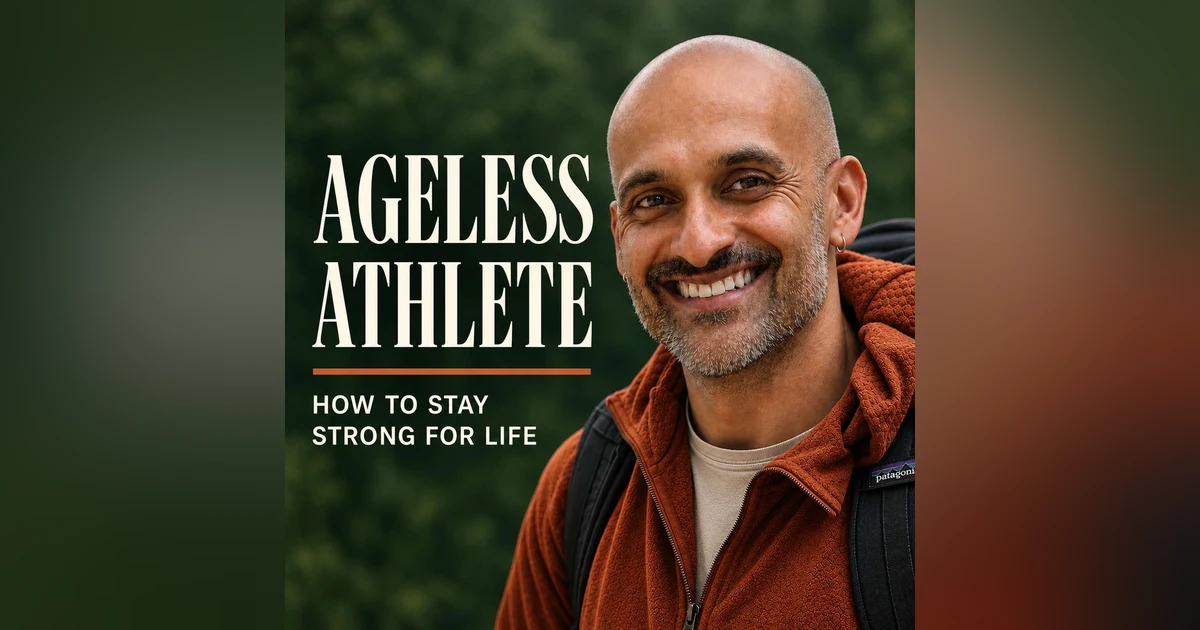
Seven Things 70-Year-Old Athletes Understand That Most of Us Learn Too Late


A few weeks ago, I attended Vitalist Bay in Berkeley, surrounded by scientists, doctors, founders, and researchers exploring the future of longevity.
A few days later, I was in the Eastern Sierra, recovering from ankle surgery, mountain biking instead of climbing, soaking in hot springs, and thinking about a different side of healthspan: the lived side.
In this solo episode, I share 7 lessons from 70+ athletes on what it really takes to stay strong, curious, and capable over decades. I also included one athlete in his 60s — Greg Benning — because his marginal gains system was simply too useful to leave out.
We talk about:
- why small gains compound better than giant reinventions
- why rest is not weakness
- why curiosity beats comfort
- how community supports long-term health
- why strength training becomes foundational as we age
- what injury teaches us about resilience and identity
- how purpose creates energy and vitality later in life
Featuring lessons and stories from Greg Benning, Doug & Joan, Jock Sutherland, Bob Babbitt, Steve Swenson, Jack Tackle, Loree Bolin, and more.
Related episodes:
- Still Getting Faster in his 60s — The Marginal Gains System | Greg Benning, 64
- Winning in Their 70s — What Most Athletes Learn Too Late | Doug & Joan, 75
- At 77, He Still Chases Big Waves — Why Curiosity Beats Comfort as You Age | Jock Sutherland
- Racing Strong at 73 - Daily Rituals For Recovery, Energy, and Clarity | Bob Babbitt, 73
- Why Some People Stay Capable Into Their 70s — And Others Don’t | Jack Tackle, 72
- “You’ll Never Run Again.” At 70, Loree Bolin Reversed Her Arthritis, And Finished Her 11th Ironman
- Stay Strong Into Your 70s — Lessons From Five Decades on the World’s Highest Mountains | Steve Swenson, 73
- You Start Losing Muscle After 50 — Stop Making These Mistakes | Joe Friel, 82
🎥 Longevity insights + behind-the-scenes.
Ageless Athlete on Substack - 1-2x / month. No spam.
🎥 Want the full experience?
YouTube — full-length video. free.
📍More clips + behind-the-scenes
Ageless Athlete on Instagram - follow along.
🚀 Love the show? Here’s how to support it
If something you’ve heard here has stayed with you, made you smile, or helped you keep going, I’d be honored if you’d consider supporting the show. 👉 https://buymeacoffee.com/agelessathlete
Topics: longevity, fitness over 40, endurance training, aging athletes, recovery, injury prevention
7 Lessons From 70+ Athletes That Longevity Science Is Still Chasing
===
[00:00:00] hello, friends. Welcome back to the Ageless Athlete Podcast. This is going to be a slightly different kind of episode. Most of the time I'm interviewing guests, but every once in a while, something starts bouncing around in my head long enough that I feel inspired to sit down and do a solo episode, and this is one of those Two weeks ago, I found myself in Berkeley, California, surrounded by people thinking very seriously about aging.
I had gone to Vitalist Bay, a gathering of scientists, founders, longevity doctors, health companies, researchers, and builders trying to understand how we can live healthier for longer. There were talks and conversations about biological aging clocks, telomeres, biomarkers, sleep, hormones, body composition, DEXA scans, yes, I got one of them, blood testing, I got one of them as well, cell [00:01:00] regeneration, inflammation, organ preservation, AI-driven medicine, and some ideas that still feel very futuristic.
The whole place, the whole event took place at this lovely venue, this campus called Light Haven. Yeah, there were lecture halls, outdoor spaces, places where folks could gather, congregate, talk about ideas, concepts, catch up. I met some incredible people. There was also this whole track around health and wellness.
There was, uh, a gym on site at Light Haven, and ~there were, ~there were a couple of, uh, dedicated trainers helping us through workouts. There was some really interesting things going on which I was actually quite excited about. there were sound baths happening. There were yoga classes. So the whole thing felt really well put together, really well-balanced.
Yeah, deeply appreciate Vitalist Bay [00:02:00] for inviting me and for bringing community of leading researchers, leading scientists and, people like me all in one place. I loved it. Well, I don't want this episode to sound like I went to a longevity conference and came back skeptical. That's not how I felt.
I came back excited. There is real science happening in this field. There are people asking serious questions. There are people trying to make health testing more accessible. Like I mentioned, I got a DEXA scan done. I had blood panel to, understand my biomarkers done on site as well.
And people are trying to understand the biology of aging, trying to help people preserve muscle, bone, sleep, cognition, metabolic health, and function. So I want more of those conversations on this podcast to balance out everything else that we are doing here. [00:03:00] Soon I'll be talking with people like Dr. Bill Andrews about telomerase, such a fascinating subject.
I'm also hoping to bring on more scientists and clinicians who can help us understand sleep and aging, recovery, cellular aging, and the parts of longevity science that may eventually become useful to everyday people. So I don't see this as science versus lived experience. I see it more as two worlds that need to talk to each other.
The science can help us measure things. It can help us understand risk. It can help us see what's happening beneath the surface. But then there is the lived question. What do you actually do with this body as it changes? How do you stay capable? How do you keep moving when the old formula, it won't work anymore?
How do you recover from injury, which I am personally grappling with, and I know many of you are [00:04:00] as well. And then how do you stay connected? How do you keep purpose alive? A few days after White Cliffs Bay, just this past weekend, I was in the Eastern Sierra over the Memorial Day holiday and with friends I've known for decades.
Some of them have been doing the same annual camp out this weekend for 17 years. So I am still recovering from ankle surgery that I went through,~ uh,~ almost two months ago now. So I wasn't able to climb. Well, that part was hard. I was in one of the most beautiful climbing areas in the country around people I love, in a landscape that actually makes me want to pull on rock immediately that I've been doing for all these trips I've been coming here.
I couldn't really do that. But I did something different. I brought my mountain bike this time, and for the first time in, again, 20 years of coming here, I got on my mountain bike and discovered some [00:05:00] fantastic riding Around there, there are all these trails that have been maintained and kept over the years.
And yeah, the landscape and the - surrounding is absolutely majestic. If you guys haven't had a chance yet, I encourage, if you have the opportunity, do visit the Eastern Sierras around Bishop and Mammoth. It truly is a gift from nature to us. Well, biking has become really good therapy for my ankle. It, um, yeah, it gives me movement, it gives me fitness, and it lets me be outside, have a bit of adventure.
And well, frankly, it also keeps me sane. Yeah, it's been good for my mental health to be able to do one sport while I cannot climb and, and do some other things. So that is when this episode started forming in my head, because over the last two plus years, I have interviewed so many incredible athletes in their 60s, [00:06:00] 70s, and even the 80s.
Well, actually, one of the people I will mention today is not over 70. Greg Benning is one of them. He's in his mid-60s, but I am including him because his lesson about marginal gains and systems is just too useful to leave out. The broader point is not a strict age cutoff.
The broader point is this: what do people who stay in the game for decades seem to understand? Not just in theory or, you know, a motivational poster, but in their day-to-day, in their actual lives. And after all these conversations, I have started noticing these patterns. These are not hacks at all. There are no miracle protocols.
There is, yeah, there is no weird trick But we have patterns. So today I want to share seven things older athletes have taught me that longevity science is still trying to [00:07:00] understand more fully. So let's get into this. The first lesson, small gains compound better than giant reinventions. I repeat, small gains compound better than giant reinventions.
The first lesson is about these small gains and how they can have an enormous impact over time. So the athlete I think about here is Greg Benning. Greg is a rower and has been dominating his sport for decades, often beating competitors half his age. What struck me in our conversation was not that he had discovered one secret workout or one miracle supplement.
It was the way he thought. Greg is an investment banker by profession, really smart guy, and he has built this entire system around marginal gains. And I know that phrase can sound a little business bookish at this point, [00:08:00] but in his case it was very practical. He was looking for tiny pieces to improve. A little more efficiency in the boat, a little better recovery, a little better attention to sleep, a little more awareness of nutrition, a little better pacing, a little better understanding of what actually moved the needle None of these things on their own sound dramatic, but that is the point.
Aging well may not come from one dramatic act of reinvention. It may come from hundreds of small decisions that reduce friction and increase consistency. That's what I loved about Greg's approach. He was not waiting for a breakthrough. He has been building the system, and I think this is where longevity science and athletic wisdom actually overlap beautifully.
Science can measure body composition, sleep, blood markers, inflammation, and recovery. But then the question becomes: What do you do [00:09:00] with that data? Greg's answer is, at least as I heard it, was you look for the small places where your life and training can improve, and then you keep stacking them. That's a very different mindset from the way many of us approach health.
We often wait until something breaks, then we go looking for the big fix. But the older athletes who last seem to ask a different question, and they ask it much earlier. What can I improve by one or two percent now? And that honestly feels like one of the most practical lessons in this entire episode.
Greg shares so much in the full conversation. So yeah, if you haven't heard it, I encourage you guys to check out the episode with Greg Benning. We spoke about a month ago or so, so you can find it in the podcast. And Greg shares so much about training, which applies [00:10:00] across endurance sports, and he actually also talks about how he leveraged ChatGPT in this really effective way.
So we all use AI these days, and this way you can, um, use AI to build yourself this great coach. Moving on. Lesson two: Rest is not quitting. The second lesson is that rest is not quitting. And for this one, I keep coming back to Doug and Joan, who I spoke with several months ago. Doug and Joan are in their mid-70s, and they are still racing, training, swimming, running, and competing.
They are a marvelous couple. Doug has this wonderful long-term goal of running a marathon every year until he's 100. He ran his first marathon back in 1984, and he's done one at least every year since, along with all the other [00:11:00] ultramarathons he runs. That alone is wild. What I found even more interesting was not just the streak.
It was the way they have learned to manage themselves. Joan is incredibly curious and analytical. She is a swimmer who didn't even start swimming until her 60s, and . Now she swims these huge open water distances and is really defying what it means to age as an athlete
She is also so curious. She researches nutrition, she researches gear. She researches training. She went and found an Olympic swimming coach to help her improve her swimming, and she just took the initiative to do that. She's constantly looking for ways to help them keep going. Doug, meanwhile, brings this steadiness.
Joan [00:12:00] described him as the rudder to the boat. He shows up, he does what he says he's going to do, and he has this calm, focused presence. So there is this line from Doug that I loved. He talked about Being lazy. Yeah. He talked about being lazy almost jokingly. But what he really meant was not laziness in the way most people use that word.
Because when I asked him what has allowed him to stay so consistent over the decades when many of the people he used to race with have faded, what he said was that he had learned to do less, to rest more, to not turn every day training, to not turn every training day into a test, to not constantly prove that he still had it.
And that feels almost radical in a performance culture that keeps telling people to do more, more volume, more intensity, more tracking, more optimization. Doug's [00:13:00] lesson is almost the opposite. If you want to last, you have to stop treating exhaustion as some kind of proof of your commitment to your sport.
That is not weakness. That is strength. That is wisdom. Because at 75, the goal is not to win Tuesday's workout. The goal is still to be training next month, next year, maybe even decades from now. That lesson,~ well,~ it hit me hard because I am recovering from a couple of injuries and there are days when I want to push harder and there are days when I want to test the ankle just to prove to myself that I am still an athlete.
But recovery keeps reminding me that proving is expensive. And sometimes the best training decision is the one that feels underwhelming in the moment. That may be one of the least sexy lessons in longevity. And but it may also be one of the most [00:14:00] important. Rest is not quitting. Sometimes rest is how you keep the story going.
Moving on. Lesson three, keep your world big. The third lesson is to keep your world big. And This is where I want to speak about Jock Sutherland. Jock is in his early 70s, and he is a legend in big wave surfing. When I think about Jock, the lesson is not about training plans or protocols, it is about curiosity beating comfort.
Surfing, especially big wave surfing, requires a very particular relationship with fear, uncertainty, timing, nature, and humility. You don't control the ocean. You prepare, you watch, you learn, you wait, and then when the moment comes, you commit. What struck me about Jock was that he still seemed so alive to the [00:15:00] world.
He surfs every day. He still works as a roofer in Hawaii. He goes out and picks fruit from trees and trades them for different things. So his eyes sparkle up when he talks about his next trip coming up. He was about to leave for a trip down to Scorpion Bay in Baja California, and he was just excited to go there and explore this place he's never been.
And he talks about his local break the same way. What is the swell going to do? What are the conditions going to do? How is he going to surf the next morning? So he is just, very curious about what comes up next and yeah, he is so connected still to the ocean and still engaged with the feeling of being part of something bigger than himself.
His energy is just infectious. So I think that [00:16:00] matters because one of the quiet dangers of aging is not just physical decline, it is the shrinking of the world. You stop going places, you stop trying things, you stop entering environments that humble you, you stop being a beginner, and slowly life becomes smaller.
A lot of the older athletes I've interviewed seem to resist that. They keep their world big. Maybe it's the ocean, maybe it's the mountains, maybe it's a race, maybe it's a new training method, maybe it's a new country, maybe it's a new community, maybe it's a new hobby. It could be something unique entirely.
But they keep reaching outward, and that's why Jock belongs in this episode. And that's not because he gives us a clean little protocol, but because he because he represents a way of staying in relationship with challenge and mystery. And honestly, that may be just as [00:17:00] important as discipline.
Discipline keeps you consistent, but curiosity will keep you alive All right, on to the next. Lesson four: community makes consistency possible. The fourth lesson is that community makes consistency possible, and the person I want to highlight here is Bob Babbitt. Bob and I spoke sometime last year, and Bob is not just an athlete.
He is one of the great community builders in endurance sports. He has spent decades around triathlon, endurance racing, storytelling, and bringing people together. When you talk to someone like Bob, you realize that endurance sport is not just about individual willpower. It is about ecosystems, races, training partners, clubs, volunteers, stories, [00:18:00] rituals, people who remember your name, people who expect you to show up.
So that is powerful, and I felt this very directly over Memorial Day weekend. I was not able to climb, and that could have made me feel separate from the group. But because the weekend was not only about climbing, I could still belong. I could ride bikes, I could sit in hot springs. I jumped in Convict Lake with my buddies, ate and cooked meal with friends.
So I was able to stay with the tradition, and that matters because if your only identity is performance, injury can exile you. but if your identity is also community, you still have a place. This is one of the reasons I think sport can be such a powerful longevity tool, and this is not because it makes your heart stronger.
It does. Or your muscles [00:19:00] stronger, and it will do that, too. But more because it gives you a social world organized around movement, and that may be one of the most underrated forms of healthspan. Community doesn't just reduce loneliness. It gives people a reason to keep showing up Okay, I hope you guys are with me so far.
We are halfway through. Lesson five: injury is not an interruption. It becomes part of the education. So the fifth lesson is that injury is not an interruption. Eventually, it becomes part of the education. The athlete I'm thinking about here is Jack Tackel. Jack and I spoke earlier this year. Jack has lived an extraordinary climbing life.
Alaska, big mountains, serious routes, the Himalayas. [00:20:00] A life organized around adventure and risk. But one of the most powerful parts of our conversation was not just about climbing, it was about Guillain–Barré syndrome. Jack described being in the mountains, getting the first symptoms, and then eventually becoming so weak that he couldn't walk.
He had to be helicoptered out, ended up in an ICU. He spent fifty-three days in the hospital. For a period of time, he was mostly paralyzed. He had to come back from essentially not being able to do anything. That is not a normal sports injury. That is a life-altering event. What struck me was that Jack did not talk about recovery like a simple comeback montage.
It was long and it was scary. It required help. It required family. It required doctors. It [00:21:00] required the climbing community. And that's the real lesson. As athletes, we love clean comeback stories. We love the idea that you get hurt, you work hard, and then you return stronger than ever. But aging athletes know it is often messier than that.
Sometimes you don't come back to the same body. Sometimes you don't come back to the same identity. Sometimes the injury changes the whole path. And yet people like Jack show that the path can continue. Maybe differently, maybe more humbly, maybe with more help than before, but it can continue. That matters to me right now because my ankle surgery is tiny compared to what Jack went through, but even injuries teach you something about control.
They remind you that the body is not just a machine you command, it is a relationship you maintain, and sometimes that relationship can get very honest [00:22:00] Lesson six: purpose keeps the body moving. The sixth lesson is that purpose keeps the body moving. And for this one, I want to talk about Lori Bowlin. Lori's story is different than some of the other athletes in this episode because the lesson is not just about racing, training, or staying fit. It's about what happens when your skills, your experience, and your energy get pointed toward something larger than yourself.
Lori could have retired into a very comfortable life. She had already had a full career in healthcare, dentistry, and genetics. She had raised a son. She had already spent decades doing endurance sports. At 60, the conventional story could have easily become slow down, travel a little, get that beach house, relax, enjoy comfort.
And honestly, there is nothing wrong with any of that. But Lori did something very different. She built a nonprofit, and then she built more than that. She started Health and Hope, which has [00:23:00] supported healthcare, nutrition education, and girls' education programs in rural Tanzania. She helped launch a tutor school for orphans.
She helped build safe houses for girls fleeing early marriage. She trained widows to become business owners, and she helped create mobile medical outreach that could reach nomadic communities, even by camel. I love this story because it completely disrupts how we talk about aging. We often treat the years after 60 as a soft ending, a winding down, a gentle fade, a time to become someone smaller.
But Lori's story suggests something else. What if those years are when your skills, your confidence, your relationships, and your hard-earned wisdom finally converge into something deeply useful? What if 60 is not the end of relevance? What if for some people it is the beginning of their most useful chapter?
And [00:24:00] this is the part that really connects back to sport. Lori did not put endurance on hold to do this work. She used endurance to fuel the work. She told me that long runs were where she solved problems. The training gave her clarity, that sport gave her resilience for fundraising challenges, cultural barriers, hard logistics, and moments of discouragement.
She was doing this work while still training, still strength training, still running, still preparing for Ironman. And at 70, after dealing with osteoarthritis in her knees, she finished her 11th full Ironman. That is wild. But the deeper lesson is not just that she finished an Ironman at 70. The deeper lesson is that purpose seemed to give her energy, not fake motivational energy, real energy.
The kind of energy that makes you want to take care of yourself because your life is still asking something of you. The kind of energy that makes [00:25:00] training feel connected to service. And I, and I think that's a very different kind of purpose than just having a race on the calendar. A race can be powerful, a summit can be powerful, a goal can be powerful.
But Lori's story reminds me that purpose can also come from contribution, from hearing some version of someone needs to do something and realizing that maybe that someone is you. And maybe that is one of the things older athletes understand so well. The point is not just to preserve youth. The point is to stay useful, to stay engaged, to have enough strength, stamina, clarity, and resilience to answer the next call of your life.
And sometimes that call is a race. Sometimes it is a mountain. Sometimes it is a community on the other side of the world. Lesson seven: strength becomes infrastructure. strength becomes infrastructure, and this might be [00:26:00] the most important one of all of them. One athlete who really made me think about this differently was Steve Swenson. Steve is one of the world's great Himalayan mountaineers. This is someone who has spent decades operating in extreme environments: high altitude, heavy packs, cold expeditions, big objectives, no oxygen that many people take over eight thousand meter peaks.
Steve was one of the first people to climb Mount Everest without supplemental oxygen. And one thing Steve talked about very openly was muscle loss. And he did not say that in a dramatic way or in a fearful way. He was just honest about it. He talked about how aging changes the body, how strength declines, how muscle disappears faster than it used to, and how intentional he now has to be about maintaining it.
And honestly, I appreciated that because sometimes when we talk about aging [00:27:00] athletes, we subtly pretend decline isn't happening. But Steve did not do any of that. He acknowledged reality, and then he adapted to reality He talked about strength training becoming extremely important for him. It was not optional, not supplemental, it was foundational.
And that word really stayed with me, foundational. Because at some point, strength stops being just about performance. It becomes infrastructure, the ability to carry loads, the ability to stay balanced, the ability to recover from falls, the ability to continue moving forward through the world confidently.
And interestingly, this was echoed all over Vitalist Bay as well. Muscle mass kept coming up, strength kept coming up, resistance training kept coming up, not because everybody wanted six packs at seventy-five, but because muscle is deeply tied to health span itself. Mobility, resilience, bone [00:28:00] density, metabolic health, independence.
And I think many younger athletes underestimate this. When you are younger, fitness often feels automatic. You can stop training for months and still feel reasonably capable. But many athletes become deeply disciplined about maintaining the basics, strength, mobility, balance, recovery. Not because they're obsessed with optimization, but because they understand the cost of losing those things.
And Steve embodied that lesson beautifully that is much stronger than just older people should lift weights.~ Lesson seven: winning changes shape. Yes, it sounds abstract, but the seventh lesson is that winning changes shape. And the athlete I want to use here is Rob Matheson. Rob and I spoke last year.~
~Rob had just climbed this iconic route called The Bells, The Bells at age seventy-four in the cliffs, in the sea cliffs of Wales. For listeners who are not climbers, you know, that is not just pretty good for his age. This is serious climbing where consequences, if something goes wrong, can mean injury or worse.~
~It is bold, traditional climbing where risk, judgment, movement, experience, and mental control all matter. And what I find so interesting about Rob is that he is not just preserving some gentle version of activity. He is still operating in a demanding world. But the meaning of achievement at seventy-four is different than it would be at twenty-four or thirty-four or even forty-four.~
~At twenty-four, you might climb a hard route and think mostly about the grade. At seventy-four, a route like that carries a much bigger story. It represents decades of skill, decades of judgment, decades of knowing how to manage fear, decades of keeping the body capable even capable enough to even try. And that is a different kind of winning.~
~It is not about beating someone else. It's staying in relationship with something difficult for long enough that you can still meet it honestly. And this is where I think older athletes can teach us something beautiful. At some point, winning becomes less about domination. It becomes continuity, capability, participation, mastery, aliveness.~
~And you know, that connects me back to Doug and Joan as well. Yes, they're still racing But the deeper victory is that they're still building a life around movement, partnership, humor, learning, and shared ambition. That is winning, not in the narrow podium sense, in the much bigger life sense. ~There you go, guys.
We have these seven lessons that I keep thinking about. I'll just repeat them one more time. Small gains compound better than giant reinventions. Lesson two: rest is not quitting. Lesson three: keep your world big. Lesson four: [00:29:00] community makes consistency possible. Lesson five: injury becomes part of the education.
Lesson six: purpose keeps the body moving. Lesson seven: Strength becomes infrastructure I just handpicked seven athletes, or in one case a couple who are athletes, to highlight in these lessons. But honestly, most, if not all the athletes that I have spoken to, over one twenty of them, they embody all of these lessons in one form or the other.
When I came back from Vitalis Bay, I felt genuinely excited about the future of longevity science. I still do. I want to understand biological aging. I want to understand sleep. I want to understand biomarkers. I want to understand muscle, bone, inflammation, hormones, and the signs [00:30:00] that may help us stay healthier for longer.
But when I think about the masters athletes I've interviewed, I am reminded that healthspan is not only something we measure, it is something we practice day after day, year after year, through injury, through adaptation, through community, through curiosity, through goals that keep calling us forward. And that maybe is the long game.
It is not defeating aging, but staying in relationship with life as we age, staying useful to ourselves, staying connected, staying curious, and staying capable. And well, maybe if we are lucky, still finding new ways to win Thanks for listening. If this episode resonated, send it to someone who is thinking about what it means to age well, stay active, or keep going through change.
And if you have thoughts, I always [00:31:00] love hearing from you. You can email me directly at kush@agelessathlete.co. We are also quite active on Instagram, where we post news, updates, and interesting things daily which don't always make it into the podcast. You can find Ageless Athlete Podcast on Instagram. And yeah, come and join the community over there as well.
Thanks again for joining me today, my friends. See you next week [00:32:00] [00:33:00]


