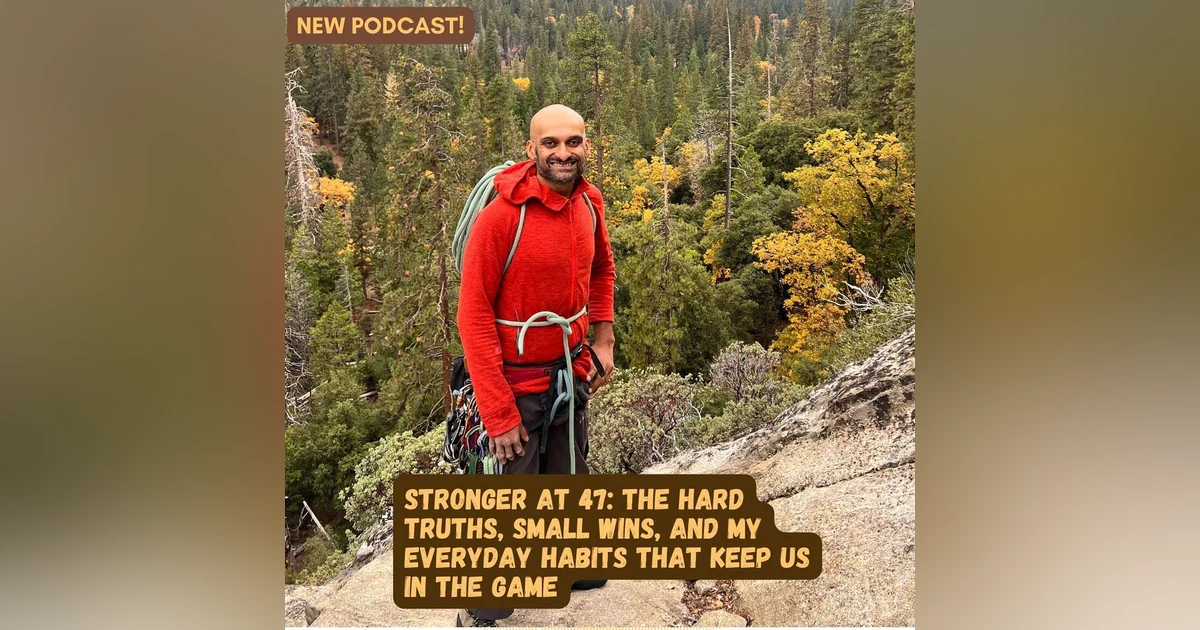
Stronger at 47: The Hard Truths, Small Wins, and My Everyday Habits That Keep Us in the Game


This week’s episode is a little different.
Instead of interviewing a legendary athlete or coach, I was invited onto the Adventure Sports Podcast to talk about the questions that many of us — everyday athletes, weekend warriors, late bloomers, and lifelong learners — wrestle with as we get older.
If you come to Ageless Athlete for honest conversations about aging, movement, and staying curious in a changing body, this episode is very much in that spirit.
We recorded this conversation back in May, but the themes feel even more relevant now:
How do we keep doing the outdoor sports we love?
How do we adapt with age?
And how do we stay connected to joy when progress shifts shape?
In this episode, we explore:
- what aging actually feels like for an an everyday athlete
- why our relationship with our sport changes over time
- how to stay motivated when improvement slows
- the role of curiosity in lifelong performance
- how community shapes longevity in outdoor sports
- why reinvention is normal — and sometimes necessary
These aren’t lessons from the mountaintop — they’re observations from someone who’s simply been asking these questions alongside you, year after year, conversation after conversation.
If you’ve ever wondered:
- How do I keep climbing, running, biking, surfing as I age?
- What do I do when my body surprises me — in good or difficult ways?
- How do “regular people” stay active for decades?
This episode offers perspective that’s honest, relatable, and grounded in real experience — mine, and the many people I’ve learned from.
⭐ THANK YOU & CREDITS
A big thank-you to the Adventure Sports Podcast for the invitation and for allowing us to share this conversation here.
You can find their show at:
https://adventuresportspodcast.com
And thank you — truly — for sticking with Ageless Athlete through 103 episodes.
This community means more than I can say.
---
🚀 Love the show? Here’s how to support it
If something you’ve heard here has stayed with you, made you smile, or helped you keep going, I’d be honored if you’d consider supporting the show. 👉 https://buymeacoffee.com/agelessathlete
📰 Subscribe to the Ageless Athlete newsletter !
1-2x a month, no spam. We share behind-the-scenes reflections, longevity tips, and athlete wisdom you won’t find anywhere else. You can sign up at https://www.agelessathlete.co/newsletter/ 📩
32:26 - [Ad] Resilience Podcast Series
32:50 - (Cont.) Getting Stronger in My 40s Isn’t What You Think — Here’s What Changed | Kush Khandelwal
Adventure Sports Podcast Interviews Kush Khandelwal
===
Curt : [00:00:00] Hi, friends. Thanks for joining us on the Adventure Sports Podcast again today. Today I have Kush Kal with us and I, I did my best. I don't know how close I got on that last name, Kush, but, um. Kush is the host of the Ageless Athlete Podcast, but he is an adventurer of his own right rock climbing, biohacking, surfing.
He does, uh, worldwide travels and adventures. And Kush, welcome to the program. Good to be here, Kurt. Thanks for having me. Oh, you bet. So one thing that I really want to dive into this, this show is the idea of aging. As an adventure athlete, and of course that's, it's a little close to home for me. I always joke that I'm 23 years [00:01:00] old and the reason I think that is Kush is 'cause I feel like that's where my heart has been for many, many years, right?
My 23rd year was probably the first year that I was truly on my own adulting after college, and for some reason that age stuck. So I always tell people I'm 23 on the inside anyway. But the reality is I'm more than double that age now. And I am finding that adventure sports are a little different now than they were then.
So I would love to dive into that with you, especially because I think you're perhaps somewhat of an expert here, the ageless athlete.
Kush: I'm a learner, I'm a, I'm a, I'm a curious, motivated learner on yes, how aging hits all of us, but how we can keep doing. The things we love. Mm. Despite, uh, whatever the, the years may bring to us, despite, uh, the changes that happened despite what society tells us.
And, uh, and yeah, if we stay 23 inside, then. [00:02:00]
Curt : We are already halfway there. Yeah, that's wonderful. And you know, adventure sports have been such a huge part of my own life and my own health, you know, both physically and emotionally. And also I would say even in, in the way it's informed my life. Right.
Adventure sports have informed my life, and when I began to realize that my body wasn't necessarily keeping up like it once did, then it was a bit of a shocker to me. But it's no reason to stop. And so learning how to adventure in a body that doesn't get strong as quickly, doesn't heal as quickly is a little bit more prone to injury, you know, those sorts of things.
I think learning how to work with that process allows us to continue on. For decades longer than a lot of people might. So that's where my mind is. What Kush has been your experience. And, uh, well, let's just take rock climbing, for example. Um, tell us the story of, of [00:03:00] rock climbing as a young man and how now rock climbing has impacted, or, or how father time is treating that endeavor anyway.
Kush: Yeah. Yeah. I, yeah, it's a good starting point. I was lucky to have discovered. Climbing in my teens, and then I took. It, uh, with right earnest, when I left college and life placed me in a situation, placed me in a part of the world and this country where I had world class rock climbing at my fingertips.
Sure. So, yeah, some of the, uh, most obsessed times of my life, uh, my mid to upper twenties, but you know, aging is not just about. The body, it's all also about the mind. I'm sure as you know, you have been doing things for a while and uh, you know, I think at the core of it, uh, as humans, we are addicted to growth and progression.
And it is amazing when we are learning and growing into any new thing. And in this case, it's a sport, and [00:04:00] at some point you hit plateaus and your mind starts to unravel. Because what obsessed you in the past, you know those leaping through the grades, those are, those don't come by as easily. So I hit some of those plateaus maybe a decade ago, and the body kind of followed.
And in my case, I think, yes, I think aging physically effects those different ways. I had maybe, yeah, I hit my forties, I started getting hit by. Injuries and my, my motivation took a, took a drop. And I think there is a strong mind body connection. Sure. If you have this strong mind, you can will your body into doing unimaginable things.
Hmm. And I hit. This stopping point, I had a moment of reckoning a couple of years ago with a really bad shoulder injury. Yeah. I couldn't raise my arm above my neck. So rock climbing became very [00:05:00] difficult. And I had, yeah, I saw all kinds of experts. They all told me to stop if I wanted to preserve shoulder health, and that was not the answer I was looking for.
Right? So I became my own advocate and I started looking for answers. And how to heal my body, but also heal my mind. And I found some great advice and I worked hard and I'm at a great place now where, uh, I am almost rediscovering the joy I had where climbing with being outside, I reoriented my life. A couple of years ago, I used to have this.
Let's say more, uh, mainstream career around tech. I used to live in San Francisco and uh, I started this podcast and this platform around helpful aging and being able to continue doing these sports that we love. [00:06:00] As we get older and uh, I was able to, you know, tap into, let's say the minds and hearts of some great adventure athletes and ask them these questions.
And I think those questions have come back and have informed my own journey where I now am going through this, uh, this fun, let's say life pivot. I am, uh, living out of a van, traveling through North America. And, uh, as we speak, I am in Wyoming, a great place to be in the summer, heart of the Rockies. And, uh, yeah, uh, I'm, I am, I've been climbing a good bed.
I've been training a fair bit as well, and, uh, yeah.
Curt : Life seems to be on the up and up. I wanna make a kind of a public service announcement. Kush, even if you think you're 23 on the inside, and maybe you really are 23 right now, this [00:07:00] podcast, this episode is still for you. And I say that because time spares no one, as we've already said.
And if you can learn in advance ways to care for yourself, then I think you'll be better equipped to continue enjoying the things you love to do for decades and decades more. And so hopefully if you're young and you're strong and, and. Invincible, bulletproof like we all are at that age, then you'll say, well, I'm still gonna listen to this one and I'm going to put that on the shelf for when I need it later.
But I think one of the things I learned Kush through my life experience is that the way that I treated or mistreated myself when I was younger eventually did catch up with me. So there are things that you can do as a young person, a young man, a young woman, that'll make sure that you'll have a better experience later.
And so. What do you know about that approach? The idea of how do we care for ourselves over the decades to maximize longevity in the sports we enjoy?
Kush: Wow. That's a big question. Well, I'll, [00:08:00] I'll start, maybe I'll talk to this part about what are some things we can do when we are younger? Sure. The, the honest truth is a lot, a lot.
Of it. We cannot do when we are in our twenties, life feels invincible. We are surrounded by like-minded people and we can get away with Yeah. All kinds of, uh, transgressions of our, of our body. We can push us and I think, I think some of that pushing is healthy. I mean, I thi actually, I think most of it is healthy.
I think that's what creates the skill. That's what creates the temperament. That's what creates the love of our sport.
Curt : Yes.
Kush: Some of us. Can get away without getting injured. And some people are just gifted with, uh, let's say, incredible connective tissue. And, and maybe some of us also are intuitively self-aware on things we, things we need to listen to and either, you know, start doing or stop doing with our bodies.
I think the rest of us usually [00:09:00] have. A moment where life kinda punches us in the face and we realize that all those, you know, little niggles squeaks, uh, impingements pains that would go away quickly in our twenties would go away a little slowly, but would still go away in our thirties, no longer seem to disappear.
Our forties, in fact, things which had disappeared, get, you know, sometimes come back. Yeah. And I think it is to almost develop this. Skin aesthetic sense and how to listen to our bodies and how to know when to stop, how to almost, um, talk in this language of love with this machine that we are given. Mm-hmm.
And learn to take care of it. And, you know, there's so much information out there, but I do think it makes sense to listen to experts and even even get help from coaches, from, uh, others. More practiced. In [00:10:00] our sports on what they have been able to do to be able to keep this fine tuned machine running for the long term.
I, I don't want to sound too vague, but I think yeah, the most important thing is. Never forget the reason why we started doing this sport in the first place. You know? Yes, it could be. It could be, you know, it could be any D, it could be cycling. It could be surfing, it could be mind biking. We started that because we wanted to be outside.
We wanted to feel that rush. We wanted to feel the air on our faces. We wanted to be in beautiful, majestic phase, majestic places. And I think that is something we need to remind ourselves is to, you know, turn around and check the view when we are the anchors of a climb. And I think that's something I forgot and I think that is so important to keep our mindset.
Intact because at some point, you know, one is not gonna be able to go faster or, uh, climb higher [00:11:00] grades or surf bigger waves. But if we get back to this is what I love about Yeah. The sport I'm doing, I think it helps us, uh, overcome almost anything out there.
Curt : Mm. You know, I had a bit of a wake up call and I, I don't want this to be about me, but.
I'll give this as in way of example, and then you can comment on it. A year and a half ago I was skiing and I was going about 40 miles an hour on, on hard pack snow, and, uh, someone cut in front of me and I, I put on the brakes as best I could, but what ended up happening is they skied over the top of my skis and then I came to an instant stop, which of course catapulted me off my skis into a perfect swan dive onto the ice.
And so I ended up with a severe concussion. Um, it took six to nine months to be able to function normally again. And now I, I still realize I have some lingering symptoms, but the funny thing is, Kush, this is the point of the story. I went to an occupational therapist to try [00:12:00] to aid in my recovery, and she says, you can still do the things you love, but you may need to do them in a different way.
I wasn't ready to hear that. I still wanted to be the guy that was, you know, careening down the mountain a little bit too fast, but as I've pondered it more. I've realized when you get injured and you're sitting on the bench, you're not doing the support you love. And if you do the support you love in a way that you can avoid the injury, then you don't have to sit on the bench.
I mean, that's pretty easy math, right? Pretty easy math. And the other point of that story, Kush, is she says, well, how many concussions have you had? And and I was like, well, I, I've never been diagnosed with one before. She goes, yeah, but how many times have you had these symptoms? And I looked back over my life and I was shocked.
I had no idea. Eight times. So I had suffered eight concussions prior to the big one. And they're cumulative in their effects. So this is about aging and about making wise decisions when we're younger. One of the reasons why this experience lasted as long as it did was because I had had so many other minor concussions previous, [00:13:00] right?
So it was a lifetime of accumulated injury and. I'm saying this for the, the people who are younger. When I was young, the question I usually ask myself was, I wonder if I could do that. And I'd try it. Now. The question I ask myself is, I wonder if I should attempt that. And I don't try it because I've realized that we, we do, we do end up paying for the injuries that, that stick with us.
So all of that said, um, what advice do you have to people. What's the right, the right decision matrix or, or the right way to approach the sports we love?
Kush: I think the right way is, is kind of what you said. Do all of the things you can to continue doing the sports we love, and also being strategic and stop doing those things that keep us from getting benched.
I actually, uh, listened to [00:14:00] Alex Hud. Speak recently. Right. And Alex is known as, let's say, the foremost free soloist of our generation. Yes. And you would think that the guy, you know, he can climb anything no matter how high. And he was talking about how he was recently at a climbing gym in San Francisco, bouldering and the walls in these bouldering gyms over the decade.
Don't ask me. Why? Because, I don't know, they just keep getting taller and taller, which means that you're risking bigger and bigger falls. Right. If you come undo at the top. And Alex was saying that he got to the top of a couple of Boulder problems and it had, it had committing moves to the top out, and he is maybe 15 feet above the ground at this point.
And he decided not to finish. He decided to, you know, uh. Humbly climb down back to the ground. And I think the lesson here is that we need to be self-aware and Right if the world, yeah, if, if somebody like Alex decides that this is a [00:15:00] risk that's not worth topping out, we can also build that awareness on us.
Should we really go down over this, I don't know, huge black diamond hill in front of us, or in maybe your case. Do we really need to go and. Ski down this heart back eye shoot. And I think life has this way. Like in your case, you know, you had multiple concussions before the this last one delivered, like, let's say this wake up call.
And we just need to listen to that and be strategic. I think the best athletes out there are nothing, if not extremely calculated about the things they choose to do and things they will not do. And I think we need to, we need to look, be, be behind the headlines and look into the stories. And there are many things people will not do because they, those things will not help them continue doing their
Curt : activity on this sport.
There's a lot of wisdom there. Kush. I'm with you. I people say, look, before you leap, and I tend [00:16:00] to think this is. This had to be beaten into me. Okay. 'cause this was not my natural inclination, but I had to be, begin to think about the what ifs a little bit. You know, what if I don't make this difficult move?
What's gonna be the, the consequence? Sometimes you don't want to think that way because it feels like limiting thinking. It's like, well, if I start worrying about what's gonna go wrong, I won't be able to do anything. Right? And I, I totally get that, especially with sports like technical rock climbing. But I've had to start.
Reminding myself that sometimes the consequences aren't worth, you know, that next thing. And so it's a matter of not just thinking, you know, looking before you leap. It's a matter of thinking a little bit further down the road. How many months am I willing to be on the bench? If I don't make this move, how long am I willing to sit in a chair with my leg propped up because I snapped my fibula or whatever?
You know, it's, it's like, oh, that's not worth it. So that's really been a help to me, actually. So,
Kush: I mean, and you know, not to be a Debbie Downer. I mean, risk is part of. Part of adventure sports, you know, you can be the healthiest doing [00:17:00] things that you do successfully every day, and you can trip over the curb on the way to the bike park.
Right? So it's not to always be pessimistic, it's to just be a little self-aware. And sometimes you have to listen to your heart and sometimes you have to listen to your brain. And there are days when you can get away with like doing a difficult maneuver because everything seems right. Yeah. But then there are days when, when.
You could fail at something which seems really simple and something you would not fail at. And I think developing some sort of a, a mindfulness practice or something that allows us to tap into that flow state where we are executing and we'll be successful versus those other times when we are. Not executing because we haven't found, we haven't found flow, and I don't mean to introduce the concept of flow when it comes to again, uh, let's say looking after ourselves.[00:18:00]
I bring that point up where if we, if we are able to subconsciously tap into flow more often than not, then we are less likely to also. Get heard and we are also more likely to have a good time. So, so yeah. I think that's what I want to leave us with here is, uh, is self-awareness and strategic thinking and mindfulness.
That allows us to find flow as much as possible, because I think end of the day, all of us doesn't matter what our sport is. I think we're chasing flow.
Curt : Yeah, that's, that's good. I, matter of fact, I, I heard Alex say something about that in the interview years ago where he was talking about there are days when it's, it's just not right.
And those are the days when I'm, I'm like, not today. You know, and we need to listen to that. Yes. But how Kush, how do we become self-aware enough to be able to say. No, this is not the day. It's not that I can't do this, I've done this before. It's that today is not the day to try. [00:19:00] Uh,
Kush: for sure. I mean, people like Alex and others, you know, they also spend so much time and energy.
In that practice of their sport. And I think you do something that much, I think you do develop that ability. Mm-hmm. And I'm know Alex, but I, I think I also have that, and I'm sure you have that as well. And. You know, Alex, for all his, um, you know, huge accomplishments, he has such a high base level because people think that yes, he is, you know, he has this altered mind state.
He's got, he's genetically, yes. He, he is genetically gifted, but he has also put in, you know, those. 10 million hours exaggerate. But he's put in that time where his, yeah, base level of being able to, able to solo, like, let's say, uh, easy to moderate grades for him and, and for us that would be like climbing a ladder.
So I, I, I think, I think that's what allows us, it's like you have to just do your [00:20:00] sport and not just do. You know, not, not just climb the hardest climbs or go down the, you know, the, the most epic, uh, ski runs, but also do things which are, you know, what they call, um, what's that expression they they use in cycling?
Um, zone two stuff. Like you just have to do a ton of zone two stuff. And I think that's what allowed us to flow. That's how we built that foundation. That's how it allowed us to then find those moments when we exceed that. And, uh, you know. Uh, do a really hard rock climb or something similar in your chosen sport.
Curt : There's a lot to be said for that. I encourage a lot of athletes, especially people that like the skiing, snow sports, that sort of thing, that are not from Colorado, but they come here and they've been watching all the epic snow skiing, skiing films from all over the world. They think I wanna do that, and they see the perfect slope or the, you know, the ski run that just looks so epic.
And the reality is that until you've put in those base hours, like you're talking about. Maybe it's not time to jump into that yet, [00:21:00] especially if you're in the back country because learning how to judge the conditions for safety and avalanche awareness of those sorts of things is so uber critical. But this applies to all adventure sports.
When you see the Red Bull athlete doing something totally amazing, it is amazing, and I celebrate that. But. The amount of time that they put into their skill and their sport and learning how to do it, and the strengthening that's required for that to, to be successful. I mean, until you've put in those hours, don't try the thing, right?
So sometimes these amazing athletes show us what's possible, and that can be a long term pursuit for us. But I, I'm just, I'm just trying to. Forward the idea that just because someone can do it doesn't mean you should do it. You might not be ready for it. Well, Kush, let's, let's go into a little bit more of your story.
I wanna hear more about rock, rock climbing and, and what you do with that. I saw somewhere that you began exploring the Himalayas before you came to the us. Is that right?
Kush: Yeah, I grew up. In [00:22:00] a large city, in the shadows of the mountains in India, uh, grew up in Delhi and, uh, my family would take us, uh, backpacking.
And, uh, exploring hill towns in the Himalayas as a kid. And I think that is what created that early love for both the mountains and also for adventure. And, uh, I took that and started doing some mild to moderate mountaineering, mostly self-taught. And at some point I realized that I wanted to acquire the.
Technical acumen, learn how to rock climb. Sure. So I could, I could go and do like big objectives because that's what I dreamt about. I used to devour mountain literature and uh, I was absolutely fascinated by the idea of albinism and big mountains. But when I started rock climbing. Uh, in right earnest.
After moving to the States, I realized that I, I just loved moving my body over [00:23:00] stone. I just love climbing so much that I was okay just focusing full time on rock climbing and, and I was getting, let's say, all the, uh, benefits of, in my mind of adventure and movement with less risks that. Are present in big mountains, big objectives where the exposure over time can often be catastrophic.
Yeah, I haven't completely given up on those ideas. I do a bit of alpine climbing, but just rock climbing and uh, who knows, maybe a decade from now I'll get back into the bigger mountains. But for now, I am. Yeah, I'm totally stoked on, on climbing. I still love getting out. Uh, I actually went on a, on a bouldering expedition to do some, uh, discovery stuff in the upper reaches of the Northern Himalayas and got away with some, let's say, high altitude tracking and that was great.
So yeah, technical rock climbing [00:24:00] combined with safer type of monitoring seems to be my, uh, my jam these days.
Curt : Hmm, that's fun. So. Just as an overall, how has rock climbing contributed to your life? How has it made your life better, would you say?
Kush: Ooh, geez. It's given me so much. It's, I think at the outset, like I mentioned, I came to the US as, you know, this pushy tail.
Young, uh, grad student and I didn't know anybody and climbing gave me community at the right, you know, at the, uh, right at the outset. I was able to connect with people I met in this country and bond with them at a level that I would bond with anybody from any part of the world. You know, being in love with the same thing.
Practicing the same thing going on long trips, car rides, camps, trying the same, uh, let's say [00:25:00] puzzling sequence high above on some obscure rock wall in West Virginia. I mean, those are, those are some foundation experiences I had that I will cherish forever. I think another thing that climbing has been amazing.
Like I was never a. A gifted athlete like I was the, uh, you know, the, the maybe the last kid they would pick when choosing soccer teams in right, in junior high. Like I, I, I was just not very good at, at sports and I think climbing allowed me to excel and I think it gave me a newfound love and appreciation for sports of being, being.
Good at something in a physical way that I didn't have before. So, and now I think at this point in my life, it's given me this beautiful new di direction. I mean, I am, I was able to find the, I guess, the purpose and the resolve to take whatever I've learned from both the world of rock climbing and surfing and other sports [00:26:00] and what I learned from the world of business and maybe, I don't know, bring that together in a way in.
Creating this podcast and this community, and I just think that it's something that I will have for life. I mean, who knows? You know how our bodies are gonna fare, but I think I'll always be able to get joy from some kind of movement and I will be able to. Rely on this community and the sport and these experiences for
Curt : the decades ahead.
Hmm. I think that's a beautiful example of what it's like to find the thing that you love to do. You know, it, I'm always encouraging people to, to find their adventure sport because it'll give back so much to their lives. But like you mentioned, the, the traditional team sports weren't your thing. That didn't really work out for you.
But then you found the love of the physical activity of, of sport again when you started rock climbing. So what a gift it is. To find your thing, whatever that might be. It could be bicy, bicycling, rock climbing, mountaineering. It could be [00:27:00] running, it could be skiing, it could be, I mean, scuba diving, it, whatever the sport is that gets you out there and gets you engaged will give back so much to your life.
And for you it was climbing. But you know, for those who aren't familiar with climbing, let's do a quick little tutorial so that, so that they kind of get a feel for it. Um, will you explain what the. The rating system is for the difficulty of climbs the class system. Oh, geez.
Kush: Well, great question. I think that the moment you start using Allems, I think that's when you get into the five point x territory in the Yosemite.
Decimal system grading scale. There are different grading systems and I think, yeah, I think it's kind of a confusing concept when you are new to the sport, but let just stick to the us. So we use something called the YDS. I think it came outta Yosemite and uh, most people, I think with some reasonable level of [00:28:00] fitness can start either outside or inside, start climbing five.
Point two, 5.3, 5.4 maybe on their first day. And as people start getting better and start spending more time, they will progress to what they call easier climbing rates or climbing rates as a new climber, which could be in the five, six to five nine type of range. And then after that, yes, with more time or application, you start ascending through those grades, literally and figuratively.
One difference. In the world of climbing, I mean all, all adventure sports, you know, they be, they're so layered. Climbing has different aspects. You can go bouldering, which has its own type of creating system, uh, where you, where the difficulty goes up and the scale of V grades. Right, and those grades can go from like, let's say V zero, which being like, let's say the easiest boarding problem all the way to these days, people are [00:29:00] doing, people have done up to V 17.
And when you're climbing on the rope, you can either go sport climbing, where you're clipping pulse with quick draws and a rope, which is usually um, yeah, which is, which allows a margin of safety because bolts don't. Normally fail. So when you fall, you will often not impact an object. You might, you might swing into the wall, but that fall will be, uh, will be cushioned because you're using a dynamic climate system with a soft belay, a dynamic rope.
But then there's this other kind of climbing, which is called. Traditional climbing, which is the oldest type of climbing, where the goal is to go from the bottom to the top on. A mountain outside, the grades are still the same, but let's say a five 10. In sport climbing, when you're clipping bulls would be considered an easy-ish grade.
A five, 10 [00:30:00] grade outside in the mountains in traditional climbing would be a more. Serious grade for experienced climbers. And the reason it would be more serious is because in traditional climbing, you are responsible for creating your own safety by right placing gear in the rock by by being creative with, with seizing opportunities to add gear, which will protect you if you fall and.
You know, as, as it seems apparent, if you don't place that gear well or if you miscalculate the type of rock or maybe the angle of the fall, things can go south quite quickly. So that's setting the, the route for you. They are, nobody's setting the route for you. I mean, they are lines, the lines are often identified.
Like you will be looking at, let's say, uh, a rock face in Yosemite. And you know that that particular climb could have [00:31:00] like four or five pitches and you would have a general sense of where each pitch will start and stop. But how do you get to the top of that pitch and to the top of the entire climb is entirely up to your competency and.
Your creativity, actually the last type of climbing. I know you, you, your question was just about grades, but I felt I couldn't really do justice. To your question without, no, this all great about different kinds of climbing. The, the most fun type of climbing in my mind is, is, uh, called DWS. Or deep water soloing, which is, let's say the most rule free or perhaps the most pure type of climbing out there because you are moving your body.
Over a body of water on a rock face mm-hmm. With nothing on you besides maybe, uh, you know, uh, swimming shorts [00:32:00] and climbing shoes, and maybe some jock. And you kind of find your own line. And when you fail at a move, you hit the water, you fall in the water, which makes for a softer catch than hitting the ground.
And I find that to be the most expressive, beautiful, and fun type of climbing out there. I don't get to do it often enough, but when I do do it, I do feel like a giddy young kid discovering climbing all over again.
Curt : That was an excellent overview of the sport. And I guess my next question is more along the lines of it.
It's not really why rock climbing is fun, but more along the lines of the, the unexpected aspects of rock climbing. For instance, when you were talking about. Finding a route, figuring out a difficult move or setting the protection in a difficult place. There's a real problem solving element to it, and I think a lot of people don't realize how, how mental of a game it is.
[00:33:00] Can you describe what that's like? Absolutely.
Kush: It is. Yeah. In traditional climbing, finding protection and being able to place gear is, is vital because that is what can keep you from making, or that, that, that is what's gonna allow you to get home for dinner if you do it, if you do it badly. And, and you fall during that pitch, it could lead to disastrous consequences.
So you have to evaluate a, a number of things. First and foremost, you have to be climbing a route that allows for gear placements. So before you leave the ground, you do an assessment, whether they're gonna be. Crack systems or other places where you will have to place gear, then you wanna make sure you have that type of gear with you, either active cam devices or passive gear that you will, you will use to protect yourself.
Thirdly, as you are climbing, you wanna find those right stances to be [00:34:00] able to, to place that gear if you allow, if you arrive at a place. Where you can place gear, but you are too pumped or too tired to fiddle with your harness, get the right type of cam or not out, you could fall while doing that. Another type of assessment you wanna make is being conscious of the type of rock.
So hopefully when you go climbing most, most of your, most of the rock, or let's say establish areas, the rock is mostly gonna be solid. So if you place a piece of protection when you fall, the rock is going to be able to absorb. That impact because, because when you fall, it introduces multiple times your body weight and fall force, so it can shatter rock that's already weak.
So you wanna assess that as well. And then what else? You also have to be careful about the amount of amount of gear you have if you use up. In, let's say a a 200, uh, foot pitch. If you use up all your gear in the first a hundred feet, then you're pretty, you're like literally free [00:35:00] soloing, free soloing, uh, the rest of that.
So there's a lot of, uh, calculation strategy and the way to do go about. Learning that system is to be very, very slow and methodical. Like I have friends who started climbing and I advise them to learn from, let's say, my mistakes when I started climbing, maybe to share a bit more. Good. I was already a fairly decent sport climber.
Okay. Before I got into drag climbing. And those were, let's see, you know. Maybe the slightly bullheaded years, you know, my, my early thirties and I went and did this, um, this long multi pitch in, at a place called Love Sleep in South Lake Tahoe, where I made some really fundamental mistakes because I hadn't gone through the proper, let's say, apprenticeship process of all of those things I talked about.
Oh, yeah. And, and actually one more thing to add is one should always think about the weather and conditions because. In a single [00:36:00] pitch or maybe more simple sport climbing experience, you can, you know, if, if conditions turn sour, you maybe just one pitch off the ground, you can just bail and get out. But then, but, but, but with traditional climbing or big mountain climbing, sometimes retreat becomes very difficult.
And in my case, I ended up having to climb through a blizzard and I took a, I took a big fall, an unexpected fall, and, uh, nothing happened. Everything ended mostly well, but things could've also ended with, ended with worse, uh, consequences, injuries, and whatnot. Right. And I always think that, you know, um, those mistakes that you know, that don't hurt you or leave permanent scars are so important because they gifts, because then they allow us to be better prepared.
So, so yeah. Uh, uh, I think anybody listening to this who is interested in exploring. Climbing outside and. [00:37:00] They're excellent clinics, excellent guides, available all over this country and outside. Take advantage of those resources and learn things the right way because those fundamental lessons and habits may ultimately save your life.
Curt : Yeah, those are good words. Thank you for that. You also do a lot of surfing.
Kush: I, for a long period, for many years, surfing was my primary sport. I moved to San Francisco a couple decades ago and driving to Yosemite every weekend was, uh, becoming this long, tiring nine hour long round trip commute, and the ocean was 15, 20 minutes away, so, oh, there you go.
Yeah, I, yeah, so I got into surfing some of the best. Years of my life. Uh, I did not grow up by any body of water. So for me, this, it was this whole dynamic magical experience being out in, in the open water [00:38:00] and finding rhythm with the ocean, with the swells, catching waves, learning how to catch waves. And by doing that, as you know, as an as a wonderful bonus, getting exposed to our.
Beautiful coastline, seeing amazing life in the aquatic, and then. Maybe also just like climbing, getting to travel all over the world and surf in some extraordinary places.
Curt : Hmm. Surfing, I think holds a, a little bit of romance that a lot of adventure sports just can't quite approach. There's, there's something about the ocean and I guess the, the true wildness of it, the undulating surfaces and so many of the unknowns and the skill required just to catch a wave and stand up.
That first step. It's a big, that's a big learning curve right there. And uh, but there's something so romantic when you see one of those videos of. Someone perf, you know, surfing the perfect [00:39:00] wave and maybe they're inside of the curl and you know, they put their hand out against the wave and they're brushing the surface of the water while they slip right through.
I mean, there's something, some, some amount of beauty to that, that other sports just probably are jealous of. Franklin.
Kush: Well, look, look at you getting, uh, swept away by that romance.
Curt : Yes.
Kush: Sounds, sounds like you have also dabbled in some surfing. Good.
Curt : Oh, very, very little. I, I have surfed, mostly body surfed, but I've always been landlocked.
So on vacation, grab aboard, rent aboard, try not to kill myself with it. That's about my, that's the degree of my surfing right there.
Kush: Somebody, uh, somebody, uh, far more skilled than me once said on this podcast, if you have been in the ocean and you have been caught by a wave and being. Carried by it, you have surfed.
So it doesn't matter if you were on a board without a board, if you have felt that rush of the current take you, you have surfed. [00:40:00] So I encourage a lot of us, if you go to the ocean, get on a boogie board or just go out on the, in the water and like feel that beauty of that wave taking you.
Curt : Mm. It's a beautiful, beautiful thing.
So as you have aged, how did that change your surfing?
Kush: One thing that Yes. Yes. You remember I was talking about being strategic? Yeah. With choices as we get older, I have taken a break from surfing I, I I, the, the shoulder range injury that I spoke about. It gets aggravated by overhead sports. I can get away with certain types of climbing, but surfing, whether it's.
Repetitive motion of over the head paddling. Yes. Really annoys my shoulder. So I have taken a break from surfing. I, I think the last time I went surfing, I was in, let's see, I was in El [00:41:00] Salvador I think a year and a half ago, and I took out a longboard and I, uh. I caught a couple waves, but no, I'm going through this maybe long-term, um, rehab process and I'm just biting my time because I know that there are waves out there and I'm not close to doing other things to feel that joy of, of being in the water.
So I think I'm going pick up some other things. I tried something called wink foiling, uh, last year. On a trip to cab in the Dominican Republic, amazing sport and maybe, maybe a great sport for, uh, you know, people who are, who are having to contend with, uh, tweaky shoulders because, you know, you, you hold that vink foil up in your head, above your head, and that's kind of all you do.
And the rest of it at just scale. And, uh, so yeah, I'm, I'm, I. Super stoked for like checking out, doing more foiling, uh, sometime in the future and maybe even doing other things like, uh, stand up, paddleboarding and I, those are things that I used to not be open to. I used to look down upon. I'm like, Hey, the purest [00:42:00] form is being on a board and catching waves.
But you kinda have to redefine your parameters as you get older. You know, you have to think about like some doors. Yeah, you think about what doors are closed, but then what other doors may still be available and you have to go out and seize them.
Curt : You've heard it said, I'm sure that the best time to plant a tree might be 20 or 50 years ago.
And the second best time to plant a tree is today. So I, I want to say that to our guests. You know, it doesn't matter your age, the best time to have started your sport that you're interested in. It may have been 20 or 30 years ago, but the second best time is today. You might have to approach it in a slightly different way, but that's all right.
You can still get all the joy. It's still there for you.
Kush: I. I interviewed this incredible adventurer, uh, yesterday. His name is Buzz Barre. Big, big, big name in the world of, uh, running and adventure sports, and he's 73 now and he just started learning how to e foil at 70 age of 70. He's learning how to e foil.
So people out there are doing it. Don't you know, age? [00:43:00] I mean, yes. Age is more than a number. Anybody who says age is just number has not crossed the age of 50. I haven't yet, but I know that, I know that age is not just number, but I think it's just being open to new things. I think it's being open, open to, like trying new things.
And uh,
Curt : the door
Kush: to that
Curt : is always a, there's another thing that I've noticed and. I don't want this to be bad advice, so take it with a grain of salt. But as you age, when you stop is when it gets harder to start again. If you keep doing the thing you love and you do it in a safe, reasonable man manner, then you can do it forever.
But if you stop doing it, the time on the bench can set you back very, very quickly. I'll just say it that way. So I think if as you age you, you need to continue to do the things you love, don't say, I'm too old. Don't ever say I'm too old. Maybe say, I'm gonna do it this way instead. So I can still have fun.
But I, I would encourage people, don't stop, keep at it.
Kush: You are a hundred percent right. Occurred and don't s. Don't tell yourself you're told. Don't let other people tell you the same [00:44:00] thing. The last thing I think we haven't touched on is, uh, just to mention is the power of community. Yes. You know, if you surround yourself by like-minded people, like-minded, let's say young at heart, uh, adventurers, I think if you learn with them, do things with them, I think they are gonna allow you to keep.
Going longer because hey, even if, yeah, even if you're hurting one day, maybe going on this incredible, I don't know, surf trip to Sri Lanka with your buddies. Mm. It's still, it's still amazing. It's still better than like most things you could do. So hang on to your friends and do things with your friends and find other people like your friends.
Curt : That's excellent advice. There's one other thing that I learned a few years ago. I was trying to keep up with my sons on the mountain bikes. They had better bikes than I did, and I was getting frustrated because my bike just couldn't perform like theirs did. And I didn't know how much of it was age or how much of it was my equipment.
Right? Of course, you wanna blame the equipment, but one day I took a ride by myself and I came back home and I said, you know what, guys? My bike's not too slow. It goes exactly the same speed [00:45:00] I do. And love it. What I was trying to say was the comparison game doesn't really help. Right? You can enjoy going exactly the same speed you do, and maybe that's, that's where more joy is located.
A hundred percent. Well, hey, how can people keep in touch with you, Kush? We already mentioned your Ageless Athlete podcast. Love the name. I think that's awesome. But how else can they find you?
Kush: Yeah, I think the podcast is where people should start with and if they continue being curious, I'm available in the usual places.
Um, on Instagram, it's Ageless Athlete Podcast. And the website is ageless athlete.co. And no, I think, I think the best way to maybe get any benefit from listening to this podcast is go out there and, uh, keep doing your thing.
Curt : [00:46:00] Hmm. That's fantastic. So Ageless Athlete Kush. Kal. Did I say it right? That time You, you can doled.
Great. Anyway, thank you so much Kush for being on the Adventure Sports Podcast. I had a lot of fun and you're an encouragement to me, so keep it up Until next time. Get out there and have some fun. Take care. Thank you.