The Movement Optimist Returns: Strong Hips, Stable Ankles, Happy Feet—Extending Performance and Moving Without Fear
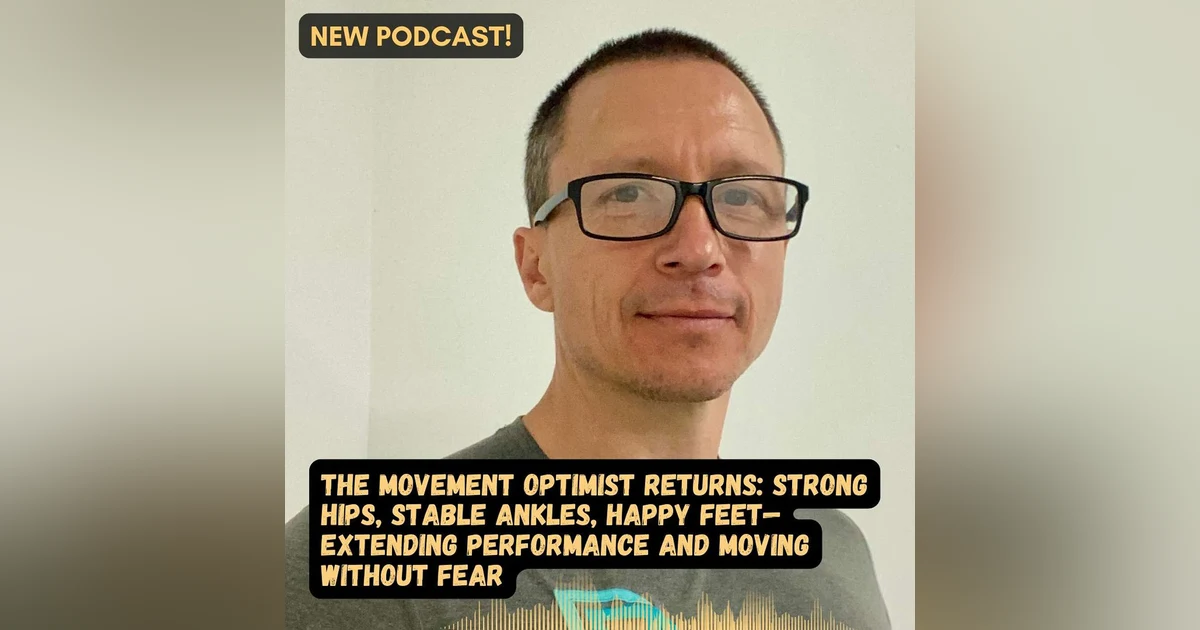


Physiotherapist, coach, and lifelong climber Andy McVittie is back for the final chapter of our three-part deep dive into aging well, moving well, and living without fear of injury.
If you haven’t listened to Part I (The Movement Optimist: Knees, Shoulders, Elbows, Hips, Bulletproof Yourself! Never Late to Get Strong!) or Part II (Aging Joints & Grateful Bodies: Elbows, Fingers, Sleep, and the Stories We Tell Ourselves), I highly recommend going back. In those episodes, we tackled the myths about aging, explored upper body resilience, and broke down joint-by-joint strategies for staying strong.
In Part III, we turn our attention to the often-overlooked foundation: hips, ankles, and feet.
We cover:
- Why hips, ankles, and feet are often neglected—and why that’s a mistake
- Early warning signs your hips or ankles need attention
- Simple self-tests for hip mobility and ankle strength
- What to do if you’ve been living with old injuries or imbalances
- Strategies for preventing long-term issues and keeping your lower body strong for decades
- How to return to activity after injury or time off
- Andy’s take on recovery tools—what’s worth your time and what’s just marketing noise
- How to structure a realistic, sustainable weekly maintenance plan
- The mindset shift that keeps you moving confidently for life
This is practical, encouraging, and packed with the kind of wisdom that comes from decades of helping real people—not just athletes—move better, heal better, and age with optimism.
Resources & References
Andy McVittie
- Andy's Website
- Andy's Instagram
- The Self-Rehabbed Climber
- Level Edges Pulley Splints: leveledges.co.uk
Relevant Past Episodes (look for these titles in your podcast app)
- #65 The Movement Optimist: Knees, Shoulders, Elbows, Hips, Bulletproof Yourself! Never Late to Get Strong!
- #68 Aging Joints & Grateful Bodies: Elbows, Fingers, Sleep, and the Stories We Tell Ourselves
Tools & Resources Mentioned
- Calf Raise App on iOS – for testing ankle strength and endurance
---
🎯 Support this podcast and try Nutrisense
Personalized health data can help us age better and feel stronger. Track your glucose 24/7 and work 1:1 with a certified dietitian to build habits that last. 👉 Get 33% off your first month at https://nutrisense.io/agelessathlete
🚀 Love the show? Here’s how to support it
If something you’ve heard here has stayed with you, made you smile, or helped you keep going, I’d be honored if you’d consider supporting the show. 👉 https://buymeacoffee.com/agelessathlete
📰 Subscribe to the Ageless Athlete newsletter !
1-2x a month, no spam. We share behind-the-scenes reflections, longevity tips, and athlete wisdom you won’t find anywhere else. You can sign up at https://www.agelessathlete.co/newsletter/ 📩
30:03 - [Ad] Resilience Podcast Series
30:27 - (Cont.) The Movement Optimist Returns: Strong Hips, Stable Ankles, Happy Feet—Extending Performance and Moving Without Fear | Andy McVittie
Ageless Athlete - Andy McVittie -Part III
===
Andy: [00:00:00] Andy, it's been such a pleasure having these conversations with you. and the response to the first two episodes was incredible. Cool. We have, already covered so much from join specific challenges to Tendon Health to recovery and some of the mindset shifts that, uh, come with aging today. I would love to round things out a bit.
Mm-hmm. There are still a few areas we haven't touched on much like hips and ankles and and feet. And I also want to get your take on returning to activity after injury or time off. And, uh, what recovery looks like after, you know, the ripe age of 40 or so, and how people can [00:01:00] structure their weeks to stay strong and resilient for the long haul.
how does that sound for, broad agenda for today? And if you have any comments or things you would like to, uh, also bring up? No, sounds, yeah, sounds interesting. Sounds good to me. It's always, uh, it's just been really good to have the opportunity to get not well my thoughts I suppose, but not just my thoughts, you know, what the literature suggests out there.
And hopefully push back a little against the societal messages that we're all done for once we're 30, even nevermind 40. So, yeah. And one thing that I've loved about a chats Andy, is how you also. We talk about the body, you also keep, uh, reminding us how important mindset is about aging. So [00:02:00] okay.
To let the combination drift into that realm as well with your permission. Yeah. Let's, uh, jump in. In the past we spoke about shoulders and elbows, and we spent time on knees as well, but I feel in general, hips and ankles, you know, they are neglected. And so what's going on with these joints as, as we age?
And uh, yeah. What kind of issues do your clients bring up? How do you approach them Hmm. In your world? So. Often with ankles, I find people who have had a history with, you know, maybe one ankle in particular quite often. And it can often go back [00:03:00] to, you know, may maybe a, a fairly major incident 20 years ago, something like that where, you know, they will say they were on crutches for a while and you talk through, actually had a patient today, although this, their, their incident was only two years ago, um, bad enough that they, they went to hospital.
The hospital was surprised. It, it wasn't a fracture, nothing was broken, a really bad sprain. They were on crutches for weeks. Um, and when I, I said, okay then, so what was the follow up? What was the rehab? They got it pain free and learned how to stand on one leg and then. That was it. Um, and this is the, the, the common thing that we see, and it really sounds like physical therapists or physios are banging on about this message sometimes, or, and people, I think take it in the wrong way thinking that we're just trying to get an extra appointment out to people and trying to get more money in this gonna, is to do a proper rehab.
You know, [00:04:00] I think anybody in that example can see that was not gonna take that athlete, that person back to Boulder, you know, catching a bouldering fall or, or whatever it, it might be. Um, it's just not at the, the correct level. And so often what I see is a, a history of that and it might be somebody has that in their ankle, um, and it's bothered them for a long time.
It has maybe had some residual either inhibitions or um, weaknesses in their. That have actually then caused true joint problems over time. Um, we do know, you know, if you have trauma to a joint, there is a greater chance over time, um, of that developing, you know, inappropriate levels of arthritis that will, you know, cause us joint restriction, pain, stiffness, that type of thing.
Um, so [00:05:00] it's obviously, it's, uh, often rather it's, it's actually coming across that and there's a, there's a history with it rather than it being, I've just sprained my ankle, you know, the other week. Um, there'll be a a yeah, a story behind it. Um, and so yes, you can get somebody coming in and saying, I've not had a recent injury to my ankle, but it's just been getting worse and worse and worse and now it's in this condition.
Um, and sometimes that is. A referral, you know, orthopedics, we, we think something might be going on in there. We need to have a look, a scan, see what the, the, the, the joint health is like. But even if the joint health is, is not where we would like it to be, we aim to strengthen it. Even if it requires, I'm making a big jump.
Even if it requires an operation, we want to strengthen it because we know the outcomes of an [00:06:00] operation are directly linked to how strong and function all that joint is. When you go into the operation, and not just the ankle, we wanna look at the knee, we wanna look at the hip. If somebody's been carrying something for a long time, they're probably moving differently, which sometimes leads to the, the joint issue.
Um, I. You know, if they've been moving differently for a long time with restricted patterns of movement is what we often see. So instead of the joint surface as a whole, taking the load in lots of different ways with lots of variety and variability, the joint gets impacted in the same place over and over and over again.
yeah. But my answer a lot of the time is find the right level to come in at where we can start strengthening and to build some confidence. some people the rehab finishes with hopping, leaping, bounding, you know, very plyometric, this, that, and the [00:07:00] other. For other people, that's potentially not gonna be possible, but we work with what we can.
And the idea of strengthening the whole leg or the whole side sometimes even is about sharing that load if the ankle can't take as much load anymore. Then let's share some of that load through the knee and the hip and make sure that everything's moving as well as it can there and everything's as strong as it can be there.
Um, so whether, yeah, we talk about the hip and such side shortly, but I always come back, always most often come back to strengthening, starting at a position that we can tolerate and we can get some, um, input into it, but then address the whole leg, not just that joint that they come in with
and is very helpful. Your point about people having some history often before it becomes [00:08:00] something acute. I, I think it rings home for me. I sprained my ankle a few years ago and I. The sprain happened somewhat accidentally in a, in a very, uh, let's say nondramatic way. I was just climbing and I normally just, I, I over torked it.
I just over pronated and, uh, anyways, but then I realized later that my ankle on my right ankle had been weak for a long time. I would sometimes have, you know, my foot almost give out when I was running or walking fast, and I kind of ignored it. And I think, of course, you know, the body, uh, you know, warns you, and then when it cannot warn you anymore, then it like does something more, uh, dramatic in my case with the, with the, uh, with the ankle spin.
So are there, are there any signs or symptoms people can look for when [00:09:00] they know that, okay, my ankle is having issues. If I don't attack it now, it might lead to something worse later.
I don't think there's anything in particular to look out for. If you have recognized that one ankle is different to the other, you need to do something about it. even if it's not actually giving you pain at the time. You know, the, these are the, yeah. As soon as you start to feel, you know, that, you know, I, I can do something on my, on one leg that I count on my other, you know, whether that's the ankle, knee, hip, or whatever it might be.
That's restricting that. This is, goes back to what we said in the previous episode that, you know, if you start noticing that you always get up from the floor in a certain direction, think what, why, you know, do something about that. If you are changing the way that you are doing something, if you're cutting a corner, if you're not, you know, in, in how you move.
Notice that we are very [00:10:00] fortunate, I think, as climate is, that we're pretty in tune with ourselves. We're looking and, and analyzing our movement and ourselves quite often, or we should be. And yeah, if you notice something different, don't, don't wait. Do something about it, because at that point it will be a small task to do something about it.
Um, easy to say, not so easy to do. Uh, human nature is also, you know, we don't prioritize something until it becomes a priority. Um, so yeah, no criticism of people, myself included, who, I wouldn't say stick your head in the sand, but we, we maybe don't pay attention to the things that we should. Um, you know, how important is overall ankle mobility for Yeah.
Not just for hikers and climbers, but for, I think many of us, myself included, I. We never think enough [00:11:00] about it. I think we think about, mm-hmm. Mobility with hips, with shoulders, but I think ankles don't get that kind of attention. No. Yeah. True. And they are the contact with the floor, I would say, you know, for, for us as climbers, they're, they're as important as fingers.
Um, you know, they are what is, they make the contact and they direct everything upwards from there, whether this be walking, climbing, whatever, you know. So if there is a, a restriction or a a difference there, then it will change things all the way up the chain as to how we move. ankle mobility has been correlated.
Uh. Quite strongly in, in, in a couple of pieces of research that I've seen with climbing performance in as much as those who climb higher grades tend to have greater ankle mobility. And if you think [00:12:00] about that then that you know the positions that you are able to get into, the changes you can make to your center of gravity from the same set of footholds that somebody else might be hanging out from and it's less efficient and that type of thing.
Or you know, yeah, slabs, slopey, footholds, all, all that type of thing to make maximum contact and get as much rubber contact as possible. But as a whole, if you've ever met anybody, for example, who's had something like ankle fusion surgery or even fusion of a joint within the foot or the toe, they will be moving.
You know, you won't need to be a physical therapist to spot that they're moving differently. You know, their biomechanics have been greatly altered. Um, yeah, it's a really important, and I suppose the reason we take it for granted is 'cause they don't go wrong all that often, to be honest. They're a pretty amazing piece of engineering, [00:13:00] um, and pretty robust.
And they do an awful lot. yeah. But if it, you know, if it comes to the point where something needs to be done within there, that can be quite, quite a change for people. Particularly climate ankles are an extra ordinary piece of, equipment that we are born with. Yeah. Because somebody pointed this out to me once, which was, unlike your knees, you know, ankles move in all kinds of directions.
Mm-hmm. And you support so much weight. Yeah. We don't need to go into ankle exercises, but is there maybe a simple, drill you can teach us, Sandy, on how to simply just test for ankle strength or ankle mobility on whether, you know, we [00:14:00] are doing fine with the, with that level of, mobility, or one needs to maybe just add some strengthening, uh, or, or stretching into one's routine.
There, there's a, there's a few, I mean the, the, the classic sort of, um, I'm, I'm within the ankle here. I'm, I'm going to include the, you know, the muscles above that of, of the calf, which are super important for Absolutely. How Yeah. Propulsion. Yeah. You know, that type of thing. So there are some absolute classics like the, the heel raise, you know, so you stand on your toe, very light amount of support into a, a point such as a wall.
And can you achieve the, again, the, the, the, the sort of standard thinking for numbers around about 25, uh, single leg calf raises, um, for somebody maybe who runs that type of thing. But they're actually quite hard to do and quite hard to measure. People will go at different speeds, you know, so they might smash out 25 in, in, [00:15:00] you know, a handful of seconds, you know, the 12 seconds or, or something.
Whereas it might take somebody else a minute. Well that, that's very different regarding endurance and strength if we, if we're looking at that. So they have to be sort of standardized often with a metronome reaching a certain quality with each repetition. People will do all sorts. When you ask them to raise their heel off the floor, they can lean forwards to make it happen.
They can bend at the knee to make it happen. And that's actually not loading the calf. Now, to me, looking at that, that tells me something about that person and you know, why aren't they wanting to go there? Why is the, the nervous system avoiding, you know, and such like, but you know, you, your calf raises in whatever way you choose to do them are a good measure of overall ankle function.
I suppose there are other things to look at. E-version inversion, you know, that it's a little bit tricky to be talking about measuring those. There's the need [00:16:00] to wall test. So if you place your foot at the bottom of a, a wall, uh, and lean forwards with your knee, how far can you take your foot away from the wall and still touch with your knee without the heel raising off the ground?
and looking at differences again, I would say is the main thing. You know, noticing it is, yeah. Is one much different than the other. Um, there are some norms for that. Roundabout sort of 10 centimeters is a, a nice, distance to be able to achieve. I've seen normal, you know, that that's not an issue with a lot less and I've seen yeah, much greater.
cause we're all, we're all, you know, on that curve somewhere. Uh, so it's, it's having a look at yourself and finding what's normal for yourself. It is quite a complicated joint. It's like saying, you know what, what are the things to look out for in the shoulder? Well, there's yeah, tons.
And, and some can be quite tricky to [00:17:00] measure as well. So it's, yeah, it's not, yeah. Yeah. But it, it's having a, a, a benchmark, having an idea, you know, can I do 25 good quality heel raises? Um, you know, and if you test again next year, oh, I can only do 15, you know, something's happened there hasn't it, that we, you know, we might need to address and look into.
so I, I think the, you know, the heel raises, I, it seems like that's, that's one really good benchmark because that was part of my physio program and then I've had other friends tell me the same thing. So, uh, just very quickly, so. This is just, just articulating the drill for people saying, please, please correct me.
I think it is. Yeah. Uh, balancing on one leg and using minimal amount of support. Yeah. With your hands, like a finger on a wall or something. Yeah, that's a good one. Finger on the wall. [00:18:00] And then starting from the heel on the ground. Mm-hmm. And then raising it all the way up as much as one can.
Yeah. And I think that's one rep and then doing it 25 times. Yeah. is there an indication on how high we should raise the knee? Oh, sorry. How high we should raise the ankle. And second. Second is, will it, will it improve the drill if we start from like an elevated surface, like a stair? Mm-hmm.
Like a step and then go down lower. Because when one does that, I know it also helps stretch out, you know, the cough a little bit. Yeah, yeah. And you're working through full range at that point. And that's super relevant for climbers. If I was going to work as an exercise, then potentially, yes, we [00:19:00] would go there with the heel being free and ready to drop down lower than the, uh, than the to are.
But for a standardized test, I would go from the floor most of the time, unless there something really specific I have just remembered. There is an app called Calf Raise. Oh. Um, which is free, I, I believe, I think, or certainly very cheap if, if, if not free. And it's an attempt to set up and film yourself doing it.
And it's one of these that uses, uh, but that's quite common now in, uh, weightlifting and Olympic lifting where people want to track the bar and track the bar velocity and that kind of thing. And it will measure your ankle and your height that you are gaining with each, because yes, you're quite correct.
One of the things to look out for is when you can no longer reach that high point. And that's [00:20:00] really, that's, um, I forget the correct term now. Is it functional failure or something like that? Or, you know, you've not actually failed. You could still probably do quite a lot of, uh, you know, quite a few more cal raises.
But for the purposes of the test, that's a fail. You know, the, the quality has dipped and so it is 25 good quality car phrases. But yes, that app had, I had forgotten about it. I've used it a few times now and it seems quite good. Gives lots of, of information for, uh, for physios and such like, as well. But, um, yeah, you can just use it, it will measure your height and it has a timer on it as well.
It's, it's recommended as well to use a metronome, you know, sort of One second up, one second down one second. So we've got that standardized approach to it, um, so that people don't cheat 'cause the body is fantastic at cheat. Yeah. This is brilliant, Andy. I, I did not, uh, yeah, thanks for, uh, uh, [00:21:00] pointing us to this app, uh, which seems to excel at this very specific purpose in helping us, uh, evaluate the, the quality and our scale.
Yeah, it's important doing these cough races. Anything, any last, uh, points on ankles before we move on to, uh, chatting about our sexy hips? Um, I would say if you have an issue with your ankle, or even if you, yeah, if you feel you don't have an issue with an ankle, but you are anxious about dropping off, about walking on unsteady ground, about walking with a pack, that kind of thing.
If you've got anxiety around something to do with the ankle, then get that seen to, that's your real sign that your nervous system is telling you, not when it's reasonable. You know, if you, if you are genuinely in, in some, uh, in, in some extremists, then fair enough. But [00:22:00] if, if you know what used to be a normal activity for you and you are thinking, I don't wanna do that because I don't trust my ankle, then go get some help.
That would be my biggest tip. Brilliant. Yeah. We have two real takeaways here. One is, one can use this app and test oneself right now, do that drill against a wall. And then second is yes, uh, any, any, uh, ongoing concerns with being able to walk on uneven surfaces or with weight or whatnot, then yes, uh, you know, uh, take, uh, don't delay.
Don't delay. Yeah. Take look at that now and, uh, yeah, address that. Awesome, Andy. So again, uh, that was great. Uh, moving on to our sexy hips. It seems that more and more people I meet now or hear, hear from in their, again, in their forties, fifties, or, or, or longer, seem to have hip issues [00:23:00] and seem to be needing hip replacements.
Mm-hmm. And maybe just, maybe there's some confirmation bias here, maybe because yes, I am listening for that kind of, uh, input, but I'm curious why are so many people, and maybe wondering if this is your experience as well, because other, I, I see all these normally healthy people, active people mm-hmm. Who are having hip issues.
Is that, is that, has that been, uh, your observations at all? Yeah. Yes. Um, so I come across, you know, a, a reasonable percentage of, of, of older, um, athletes who have had, yeah, hip replacements. why, um, there are definitely getting better now, but definitely lots of people who are undiagnosed with issues like hip dysplasia, [00:24:00] um, that, you know, that.
Can have difficulties through, through life and, and then certainly cause issues later in life. Uh, because we, we've had, you know, not the correct control of the hips throughout the life. so there's a, people that weren't screened, weren't picked up with underlying issues. then there's just the, the fact, the nature of the hip joints, I'm, I'm not going down the line of, uh, and tear.
Um, because we know, you know, people who are active generally have less joint problems and less arthritis and that type of thing than people who are inactive. But the shape of everybody's socket and the shape of the head of, of the, of the thigh, of the femur and the angle that it comes in at and such like are vastly different in, in everybody.
And you know, the, there are. [00:25:00] All sorts of weird and wonderful kind of things that can go on. It's also, I feel, because people used to get the advice was to leave it as long as you possibly could before you needed to do it. You know, you had to be in, in real severe disability through pain because it's a major operation and it would only last sort of 10 years if you have one when you're 50, well, you're gonna need another one when you're 60, and then 70 and then 80.
And these are all major surgeries and revisions, and that's very, you know, complex. And then it turned out that the ones that they, you know, were originally fitting that they thought might last a few years were lasting 25 years, 30 years. And it is like, oh, and that was, you know, 25, 30 years ago. So the technology, uh, you know, it's still major surgery.
But you know, I, I remember from my, um, training working in the, in the, in the British [00:26:00] NHS and such like that you get people outta bed the same day that they've had a hip replacement. Yeah. They, they really don't want to, they don't, they don't, they don't like you for it. Um, you know, I, because it, it, it's a, it's a sort of a, a six to eight week, you know, to not full recovery within that time, but certainly people can be back being reasonably active, you know, quite soon after hip replacement surgery.
So it's just not the risk maybe that it thought it would be, the revisions that have to be done are much fewer and far between now because they've learned so much. Because they've done so many. it's just not a big issue that it used to be. It's not like, well, if I have this done, I'll never be able to climb again.
It's like, I'll have this done and in a few months I'll be back to climbing harder than I was before I had it done. Hopefully it's not the same for everybody, but hopefully. Yeah. So I think that they're now seen [00:27:00] as a, yeah, let's get it done if you can. That's incredible. Funny. But yeah, I, had Tyler Nelson early on in the podcast.
Tyler Nelson is another, uh, well-known PT specializing with climbers, and Tyler spoke of his hip dysplasia. Yeah. And at that time, that was a new, new term to me. And then I've been having some HIPA issues, and a few months ago I, I, I went through some. Comprehensive imaging and turns out that I have hip display as well.
Right, okay. Okay. That explains a few things. You know, it, it's not just maybe my poor lifestyle or whatnot. There, there are some medical, uh, there's some medical pathology here. So are these people now who are finding out about, uh, hip dysplasia, is there somewhat of a [00:28:00] reasonable correlation between having these, like misaligned hip sockets and having hip issues later in life and otherwise, like, like you said, like healthy, active people?
Yeah, yeah. Essentially. I mean, hip dysplasia is a anatomical variance, a difference in the, the depth of the socket. So it's, it's shallower than it should be, so that, that ball is not. You know, securely within the socket. And so the control and the stability that's required to keep that hip, uh, under control and as it should be, is much greater and often greater than the person can, uh, apply.
So yes, we do get issues then later in life with people with hip dysplasia. The treatment for it, if it's, um, noted and, and, um, and, and diagnosed, you [00:29:00] know, earlier in life is yeah, increase the strength and control of the, uh, of the, of the, the pelvic girdle, you know, they, the hip as, as a whole, um, and to, to support the joint as much as possible.
And, you know, strengthening is, there are, uh, certainly in the uk I know there are, you know, hip dysplasia specialist physios, both, both private and, um, in, within the NHS, uh, who, you know, specialized. Within that, which is fantastic, um, because it's much more common than we previously realized. Um, oh, wow. Yeah.
Super interesting. Yeah. You know, for yourself and, and Tyler. Um, but yeah, it is, it does it like, does it mean you are more likely to have issues later in that Yes. You know, the, is that absolutely a hundred percent your destiny? No, but it, but it's much more likely, you know, it's on a, an individual basis, but yes, it, it's more likely increases the chances for sure.[00:30:00]
Beautiful. Yeah, yeah, for sure. I mean, I guess just getting it diagnosed, it may not, yeah, you can't really correct it in your later years, you know, surgically maybe as effectively, but at least having that awareness, uh, maybe give, may, may, might give peace of mind that, uh. There are some latent things and then maybe yes, then they can double down and meet specialists like the ones you spoke about, who can Yeah.
Do specific PT interventions. Okay. Having said that, just like we talked about with the ankle, what are some of those issues with hip strength, like thereof, hip mobility, hip issues that, uh, people bring to you, Andy, and what are some of the most [00:31:00] common, courses of correct corrective action that you have them go through?
I think probably one of the, the most common in and around the hips is, is, is probably a tendinopathy I. Related, um, either gluteal tendinopathy or, or lateral hip tendinopathy. So glute mead, that type of thing. or even issues like, you know, i it band syndrome, the tibial band syndrome. it's, it's nice a lot of the time 'cause people come in their, maybe their forties, their fifties, and they're like, I've got pain at the front of my hip.
You know, and, and you pick up on the fact that maybe they've got some anxiety that they're already thinking, oh, you know, this is the first signs that I'm gonna have to have a hip replacement. This is bad. You know, I've read the pain at the front of the hip is, you know, sign of arthritis and, and such like, and [00:32:00] thankfully a lot of the time it's.
Sometimes it is, um, but a lot of the time it's not. Um, and so tendinopathy, I would suggest actually around the hip are the things that I see most. I'm discounting hamstring, tendinopathy there, I'd put that as something else. Although it does, they do insert up there. Um, but yeah, for the, the actual hip itself, I would say, yeah, tendinopathies.
And that often comes from a medium to long term change that that has happened. That we go back to the angle, perhaps, you know, that they're, they're not waiting that side as much. They're not using it as much. They're changing. Their, their, their motion in some way. The classic is people will say that, you know, that they, they step down or, or rub, either be on a walkin or on a hike or whatever.
They will always use the other leg. They might not know they're doing it to take the step up and then the step [00:33:00] down, they will always use that leg to support as they drop down with the other foot because they're not trusting that foot or it's, it's sore or whatever it might be. And that decondition the whole, and we then start getting people reporting, you know, pain when they've been driving or sat for a time, and then they stand up and they're like, well, you know, they start making noises when they stand up is always the, uh, is always the sign.
yeah. And if that's where we are and, and, and that's what it appears to be, then it, it's noting that. And again, we come back to physio, can be very simple sometimes, is finding the correct way in that's pain-free and strengthening and increasing the function of that limb as much as we can. Um, but you know, getting some relief is often the, the first thing for people with hip pain.
Right on. And you yeah. You again, great observation that [00:34:00] people tend to then keep relying on the one leg that is working better. Yeah. And then when you do that, I think it just creates like a, like a, like a doe bloop, you know, the more, the less you use the, uh, the injured, uh, part of your body, the Yeah.
Really the more attenuated it gets over time. Yeah. Yeah. Absolutely.
Besides just, I. These signs people have of feeling any kind of weakness, pain in, in those hips. And in my case, I actually started hearing, uh, clicks, you know, on my hip the way one sometimes does with one's knees, when your knees are affected. Any other signs that people should look for Andy? Just to, you know, be again, be smart and preempt?
, If you notice or somebody [00:35:00] points out to you that you are making a ooh sound when you stand up, now you know that, that, that's not, that didn't use to be normal for you.
So go and get that looked at if it takes you two or three seconds to stand up. Right. Yeah. But having to unfold yourself slowly because you know your hips hurt as you stand up. that's, that's, yeah, again, that's, that's not usual, get that looked at. Um, and it's these societal messages that people will be like, oh, but look, yeah, I've got sore hips.
I'm in my forties, I'm in my fifties, or what have you, what do I expect? Um, you know, that's how it should be. That's what everybody says. and yeah. You know, you talk to your friends about it or whatever, and they're, yeah. Yeah. Same happens to me. Yeah. Same happens to me too. And yeah, so we, so we, we just accept it.
We sort of put up with it and think, ah, right. That, that must be, you know, that's just how it is. Um, but if there's, if there's a change, so internal [00:36:00] and external rotation of the hip, you know, these, these 90 96 that people do sort of pigeon stretch type things, uh, well, maybe not pigeon stretch, but the, the Yeah.
Where you. You hit your knees that way. I dunno how I'd do this On the, on the, and then you, you flip that way and yeah, the, the 1990, uh, sits and stretches and again, find what's your normal range. Don't try and copy other people's ranges as we've just, here, there's also the other variants of
is, is not too bad. My range laterally going in like side split type thing. It's dreadful. But I, I know from pushing that. That, that doesn't get me anything good than really sore hips. Yeah. That, that's feels to me like bone, pushing against bone. That's, uh, you know, my, my bony anatomy just doesn't let me go there.
so find what's normal for you if you have a, you know, a stretching routine, that kind of thing. Just, just notice if you are losing range somewhere. [00:37:00] Um, you can't drop knee. Yeah. You're suddenly finding it hard to frog in a, you know, on a, in, in a rest position and that kind of thing. That's your hips external rotation.
yeah. Drop knee is the, the, the internal rotation side of things, but the body's super amazingly adaptable. You know, I, I see people. With poor internal rotation, but can still deep drop knee because they will change what's happening with the angle of the hip and the, and the trunk, you know, to, in order to facilitate that, they'll just get it from somewhere else.
Um, so don't always rely on that, but maybe just, again, it's this, you know, does that side feel different than that side? If I drop knee that way, does that feel smooth and fluid? If I drop me that way, does a loud click or a calling c you know, and, uh, and it feels different, um, clicks and, and, and things and, and even noises.
There's, there's the awful term crepitus. Um, you [00:38:00] know, I, yeah, that, that I know if, if it's not associated with pain is harmless. Um, but. I very rarely do anything like press up because all I can hear are my elbows creaking away and it doesn't, and it just doesn't, it doesn't feel or sound nice. Uh, unfortunately, I, I don't think I really need to do many press-ups, but yeah, I'm aware that, that, you know, that that's harmless as such, as long as I say it's pain free, but it's not very nice.
But yeah, clicks and, and new noises and get 'em checked out, no reason why not. Yeah, there is, there is, uh, all sorts of, um, clunking hip syndrome, um, if you've ever come across that, which is the, um, oh gosh, I'm gonna try. And so it's to do with the, um, the ilio SOAs muscle, the hip flexor. Um, it can be, or it can be the, [00:39:00] uh, the muscle of the iliotibial band on the outside, but it's more commonly on the inside of the hip.
And people maybe when they do something like a straight leg raise or an L sit. You know, that kind of thing. And there's a real deep clunk within the, um, within the hip itself. And that can be both uncomfortable and quite disturbing. if it's new, if it's something you've had all your life, that's probably just how it is for you.
If it's new, that shows it's probably been a bit of a change. What it actually is, is, is the tendon of the ilio SOAs muscle flicking over something that I, I want to call it the ileoanal eminence. I might have got that wrong. I'll show myself what people will be pointing the fingers at me. But it's kind of, there's a, a small bump on the bone that the tendon now flicks over instead of being held in place.
And if that's changed, you know, it can feel quite drastic where people think, oh my gosh, you know, it feels like the hip's popping out or something, but it's this quite distinct [00:40:00] clunk of a muscle. But if that's not normal for you, get that checked out. Because something's changed somewhere. The control of your hip has changed.
Um, but yeah. Clunking, hip syndrome. Yeah. New, new term that I'm learning about. Yeah. A question I have for you is here is many, let's say longevity influencers and even specialists perhaps talk about this thing called the sit and rise test. Mm-hmm. Okay. Which relies, you know, on the whole lo lower body chain, but I think it relies disproportionately on one's hip strength and mobility.
Mm-hmm. To be able to bring one's body up from a sitting lotus position to standing without using one's hands or knees. [00:41:00] Are you familiar with the, what I'm talking about? Um, um, I have seen the online. Yeah, so, you know, can you do this then that means you are going to live till you are 80 or yes, you won't die.
You can still do this. There are some, um, ratified tests, the, the sick to stand tests. So getting out from a chair of a, of a certain height, uh, or, you know, compared to the person's height, um, so many times, either within a minute or how long it takes to do that. So many times, either without hands or gentle hand, you know, and that's all very quantified.
And jet again, as we've spoken before about that strength and that kind of thing. More in population, maybe that's in a nursing home or a care home or that kind of thing. Yes, it definitely makes a difference amongst that population, rising from the Lotus position. I don't think I could, I dunno. [00:42:00] I am obviously gonna have to try straight after this and I'll let you know.
I'll send you a message, but, um, okay. Yeah. What does that mean? Am I doomed?
Well, I, I think it, I, I think, yeah, I, I mean there could be many such tests, right? This is just one that seems to have caught people's imaginations. Yeah. Yes. And, um, all four, you know, and anything encourages people to take an interest in their bodies to notice something about themselves and to be a bit active.
And that's the kind of thing that maybe, you know, you do, don't just do it once. Whether it's the, can you get off the floor without using your hands, your grip strength, your whatever it is that you might, you know, choose to engage with. Do it every three months. If it's not part of your daily practice, and just notice, can I still do it?
That's the important thing. If I could do it three months ago, but I can't do it today, something's changed, [00:43:00] hasn't it? Yeah. And that's the key to tests is not to do it once and then go, yes, I'm gonna live till I'm 80. Um, you know, it, it's, yeah. It, it's to keep checking in with them and seeing what they're telling you now.
Well, one thing that I do, and I'm a terrible, I'm a, I'm a lazy note taker, but I do this with, with exactly these things. And it be, I, I do make these notes on some of these particular types of mobility and strength markers that I'm concerned about, and then I come back to them and I think maybe even sometimes using an app like the one that you pointed us to earlier, I mean, some of those apps also have.
Yeah. That note marking ability. So yeah, they can record, which, yeah, yeah, exactly. And they can tell us what's changed. I mean, people do that all the time with like [00:44:00] weight management apps, because again, people are very conscious about their weight often. But, uh, there other, other pieces of technology one can also employ in a quest to, you know, in a quest to, uh, stay, stay, stay healthy and fit.
Great. Andy, uh, we spent some time talking about, uh, uh, the specific joints with our low body. Any part there that you feel we haven't covered before we move on to the next? Oh, I don't think so. Okay. But if nothing that, that, yeah. I feel should be, I think we've done everything. I think we've done everything.
It's good. Let's move on then, Andy. Yeah. I thought we could spend a few minutes talking about, uh, recovery tools and which ones actually matter and help [00:45:00] us. Hmm. And again, in this hyper capitalism that we are surrounded by, there is no shortage of recovery tools that, uh, we see around us. Yeah. Massage guns and cold plunges and saunas and red light therapy, and even apps that we just spoke of.
So, yeah. Curious, uh, where do you stand on those? What, which ones in your opinion actually are useful? Um, which ones are just noise that we can want? Because yes, there's so much information out there. Sometimes it's confusing. Which should I be, you know, should I be doing these, should I be getting a, a super expensive cold plunge thing outside my house, even though it is just the most horrifying thing to actually use?
Should I just stick with my, with my lacrosse ball? You [00:46:00] know, like, what, what, what, what should people be doing? I'm totally with you. Yeah. So I, I tend to view this as, you know, if, if something has true merick and is easy to apply and is affordable, you know, it's, it's a real thing that can be out there for everybody.
It will be around and it will stay, you know, because it, it's like, it, it's the thing. It's good to do the, the best things, uh. Sleep, nutrition, hydration. Yeah. You know, reducing life stress, that kind of thing. But we, we know that I almost feel bad skipping over it. So I'm gonna say it again. The basics are, are what, you know, that's 90% of your recovery is the basics.
And without doing those everything else, you're, you know, you're, you're losing. But things like, for example, massage. I was, I was talking to somebody about that today. [00:47:00] it physiologically doesn't change things hugely. There is some fluid exchange that happens and some increase in, in blood flow and, and that type of thing.
So why is it so popular? Why do all the professional sports teams have, you know, kind of like a, a permanent marere on hand at any time for their, and mainly 'cause it makes you feel really good. and there's nothing wrong with that. Um, if, if we're not covering up an injury by changing how we feel, if that makes sense.
You know, sort of like taking pain relief in order to be able to, to do something we maybe shouldn't be doing then, you know, a, a massage, be it from a, a gun, a person, what have you, um, can make the difference between feeling I can't go again. Yeah. Or I can't go tomorrow. Um, you know, it needs to be a rest day.
Or maybe [00:48:00] getting, a a another climb. Um, this is why, you know, professional sports teams have them. It can make the player feel go from feeling non-covered unrecovered to feeling good enough and positive about themselves to get out in the pitch. And we do know there is a lag between being recovered and our subjective actually feeling recovered.
So this is all. Again, nuanced, contextual, this kind of thing. I'm not just saying have a massage and crack on if it's your eighth day of climbing in a row. You know, that kind of thing. That's obviously not sensible. Let's not cover things up and, and try and ignore things. but yeah, you know, a, a regular massage, you know, can, can be a, a great thing.
I've been experimenting recently with, um, taking the massage gun to the crack when I'm sport climbing. This is more last year actually as I haven't sport climbed much this year. I've been trap climbing [00:49:00] and just like, can I get an extra burn on this today? And you just thinking, oh, I'm not sure. Blast the forearms and I'd like, whew.
I feel, yeah, I feel zingy. I feel good to go again. Um, I've got some, I've had some strange looks at the crack. Um, but, you know, I, I, I've not seen a negative to that. I'm already talking about, you know, squeezing out. One more go. Maybe when I feel I could, but I would have to rest much longer and everyone else wants to go and that kind of thing.
Uh, so that can change things perceptually and make you feel okay to go. So a tool to be used with some thought, but definitely, you know, a powerful tool. sauna cold Baths that, you know, all, all this or even heat or cold to deal with swelling or an injury for pain relief. There's so much on either side that says cold is best, heat is [00:50:00] best, whatever it might be.
But they're all, or most that I've seen are a, a, a small way in this direction or a small way in that direction. There's very few that definitively say this is way better than cold or you should do. And essentially they, they both arrive at the same. Place via a different route. if you, if we look at applying cold to a, an injury, to a, to a swelling, that kind of thing, it constricts all the blood vessels, forces the fluid outta there and the swelling outta there.
And then when the blood vessels dilate again, once they warm back up to body temperature, that encourages new fluid and new blood and plasma and such like into the area, which helps the healing heat, violation of the blood vessels, encourages extra blood flow, et cetera, et cetera. Really the advice is go with which one feels better for you.
Some people like the [00:51:00] powerful feeling of cold, of ice, of overcoming, you know, jumping in that bathroom. You know, I'm, I'm doing a thing to myself. I can feel it. This is like super strong, super powerful. other people prefer this is me, prefer the, the comfort of some warmth. And, you know, that's nice for me.
I'd rather just lie down and, and yeah, be warm. Thank you. Have a nice warm bath rather than a cold bath. Or if I've got something that's sore that I want to apply something to, I'll go for heat rather than cold. But I wouldn't say to a patient, choose one over the other. They're both as effective as each other.
And the psychological side of it again, is quite important.
Well. I love Andy, how you started off by underscoring the importance of the basics. Yeah. Sleep, nutrition, uh, every day, man. Yeah. Every day. Every day. Yeah. I mean, exactly like that. That is really [00:52:00] the cornerstone. And everything else here is just, yeah. Just the last mile and yeah, people need to remember to again, focus on those things, get those right before one starts, uh, titrating on these other modalities.
But quickly, I wanted to, wanted to just, ask you this one, which is, yes, I get the point about using cold versus hot and just using the one that feels better for, uh, compression or for like some sort daily ritual. But what about the, the plunges are plunges, Andy, because I. It just seems like so many athletes seem to swear by cold plunges and maybe even, you know, doing that whole system of alternating the sauna with the cold plunge.
And, uh, I mean, that's been around for hundreds of years, man. Yeah. When, when I went to, um, Morocco earlier this year, you [00:53:00] know, we went to Hamam and the, the, you know, the hot room, the cold room, the, the, you know, all that. It, it's been in, in culture, Northern Europe, in Norway, in Sweden, and let's get in the sauna now.
Let's run out in the cold and roll around in the snow and whack ourselves with birch sticks and this kind of thing. Yeah, it's, it, it's been part of our culture for thousands of years, I would guess. Um, there's a roman fort near where I used to live in the, in the English Lake district or the ruins of a, a roman fort, and they had a sauna room in there, you know, uh, just off Adrian's wall thousands of years ago.
Um, so. Uh, I have seen studies that show it that the cold is very effective for recovery or effective for recovery. I've seen studies that show it depletes inflammation and actually inflammation. We might want that initially after training. That's part of the body's response to adaptation and how it changes things.
[00:54:00] so I've seen both sides of that. same with heat, uh, cold apparently I've seen, you know, can deplete testosterone and that not, I mean, that made a big thing outta that, especially in social media. Your my, you know, with similar age, I'm, I'm sure you get the same adverts that I do all the time on Instagram, and so I, I dunno where they come from, but it, it's, yeah, apparently I, I will have low testosterone and I need some.
Uh, so I keep getting told, um, whereas hot bath can increase testosterone. there, there's just, yeah, very similar findings on both sides, and I think that the biases are probably inherent within the testing. You know, people subconsciously, I'm sure most of the time, good quality studies and such like that, they want to go out and show that cold is better than, you know.
so, yeah, I'm, I'm quite relaxed about people knowing that what they're doing isn't the treatment. It isn't the thing it, it, [00:55:00] but it can be a nice addition. you know, don't do it instead of the basics. But if you want to add something in and that feels powerful to you, then you know, as long as you're otherwise in good health and able to jump in a sauna and then a cold pull and, and what have you, go for it.
I, I won't be joining you, but go for it. Yeah, I hear you go. I'm convinced that the, the, the only reason people feel great after, you know, cold water, plunges cold water baths and that kind of thing is because they're no longer in a cold water bath. That's why they feel so good. That's right. That's right.
And yeah, I mean, even if it's a placebo, you know, even if, it, yeah, if, if we are convinced it makes us feel better, then it probably does, because just mine is most powerful. Yeah. Awesome, Andy. Great. Great. No, thanks for sharing your perspective on that one as well. Um, okay. Finally, I thought we could [00:56:00] speak for a little bit about how does, again, the aging warrior come up with this, let's say this.
Plan this maintenance schedule, say on a weekly basis. Mm-hmm. So, so let's say, you know, we have a 50-year-old runner or climber who wants to stay injury free and strong, but isn't changing prs. Mm-hmm. Personal records. Uh, yeah. Yeah. Could you maybe speak to what should their ideal week of training and movement include?
Include, you know, which combines both like, uh, their, their sport mm-hmm. [00:57:00] And the other things. Yeah. And I think. Generally my advice would be before I, I do my usual caveat of saying, depends on the individual, their training history, what their goals are. Is, is that time limited? Are they pushing towards something or do they just want to keep maintaining and improving?
So all, all of that. Um, absolutely. Yeah. But what, what we really know that is going to help both health and your performance is improving your capacity, your strength, you know, general strength training, which for the climbers out there, and I know not everybody who is both on your podcast and listens to your podcast are, are climbers.
I've come here through that avenue, but I like the fact that you speak to people from all sorts of different, uh, backgrounds and sports and such. Like, uh, we all can learn from each other. It, it's that general I. [00:58:00] Maintenance or increase of muscle mass and strength, that gives us the capacity to do more.
And that's where you then improve in your sport. You know, that it, if, if you can run more frequently, run at a higher intensity, you know, for a longer distance or what have you, because you've built that capacity up through some, off the track or off the wall, strength training, you know, and, and interest in climbing in itself, although we can feel pretty tired after a climbing session.
My opinion and, and certainly people that know better than I do as well, is that climbing doesn't really count as a strength exercise for health where we are wanting to maintain lean muscle mass so that we're able to, you know, that's great for systemic health, for blood sugar control, for blood pressure, for all, all of these, these issues.
Yeah. So my, my, it would be to find some way [00:59:00] to fit in with some strength training. Now that does not have to be three times a week, you know, two hours at a time in the gym, um, working at an exhausting hypertrophy. Um, you know, that you, you walk outta the gym and your legs collapse going down the stairs.
'cause it was like, you know, you, you're not gonna be running the day after that, are you? And that's just gonna interfere with your, with your running. Um, there's some, you know, fantastic programs and such, like out there, there are about that, you know, little and often and build slowly, uh, you can't build capacity quickly.
It, it's got to be built over time. and, or you may, if you're in a sport that has an off season. I, I was, we were discussing with my partner the other day 'cause I, I wanted to actually get in this year a. Hypertrophy program for hopefully two blocks of six weeks. [01:00:00] And so that was my thinking of, of putting, you know, where I would really make that my focus or would back off from climbing and make that the focus.
We are having a run of fantastic weather here in the UK at the moment, so no way am I going in the gym. Um, if that carries on through summer, I'm gonna carry on. Then I've got a, a TRA trip over to Ireland. Then we're going to Datcher in Turkey, then we're going to Spain for sport climbing, then back to Morocco in February.
So where's my off season? I incredibly fortunate. I've just said that out loud. I'm like, wow, that's amazing. Um. But yeah, climbers don't really have an off season, do we? We, we travel and go where the weather is. So we're either training for a trip or we're in season at home. and so it can be difficult.
So I've, I've dropped to a maintenance, um, two, [01:01:00] sometimes three sessions a week. One compound movement, few accessory movements, couple of accessory movements, say, um, deadlift, although actually I find that quite tiring if I'm going hard at deadlifts. So it might not be, might be Romanian deadlift, single Romanian deadlift, something like that.
A couple of lower limb accessories around that. Couple of upper limb accessories done. Get out of there. Um, and then, you know, the other day it'll be an upper body day, so I'll have a, a push overhead press, whatever it might be. Couple of other accessory upper bodies, couple of lower limb accessories. Get outta there, uh, you know, in and outta the gym in under an hour, um, two or three times a week.
you can do a lot of climbing gyms now have gyms in them. You know, actual weight training facilities. Stick it in after you climbing. Not ideal, but you know, better than nothing. [01:02:00] Um, so yeah, the number one, I would say get strength in there. Now, if you are smart about your strength work, if you are doing split squats, for example, something like that, you know, um, work through range, you can get your mobility work in.
You know, if you are squatting, squat as deep as you are able, you know, if that feels a bit. What have you. You, you, you could do kettlebell squats. Goblet squats. You could get in a Smith machine, you could use a squat machine, use a, you know, leg press machine, whatever. Don't be precious about it and feel you have to use free weights and such, like, yeah.
And work through your full range. Um, but's great for mobility so you can get your strength and the mobility hit in one. Um, but yeah, it, it, it, any, if you change anything, it has to be changed slowly. So bring these things in, have a think about how slow it should be and then make it slower would be [01:03:00] my, uh, got it.
Well, that point about
being able to create, uh, a training plan or maybe being able to. Periodize one screening. I think your experience and mine as well indicate that life is messy. The weather outside is unpredictable and it is difficult to stick to those plans unless one is a professional paid athlete preparing for like the World Cup.
Yeah. So for the rest of us, it seems like having a general maintenance plan, which allows for, uh, a moderate level of flexibility makes mm-hmm. A ton of sense. Yeah. That is something that I try to practice as well, is [01:04:00] make sure I get these things in when I can. Mm-hmm. And make sure that I get these in a reasonable level of dosage.
On a, on a monthly basis, right? Because sometimes there are weeks when one is climbing outside or on a different type of grip, and one does not get that in. And the second thing also, again, you can't, yeah, one can't repeat this enough, is take on something slowly build up to it. Especially when one is, uh, throwing around heavy weights.
I learned this the hard way recently, where after several months in rural Mexico, without access to a gym, I was elated to come here to Salt Lake City and I have access to like the wonderful facilities. And I went and immediately attacked the [01:05:00] deadlift movement. And right away, I, I mean, you, you would think that with all my years of, uh.
You know, no, no losing hair. I, I do too Kush. I do, I do it too. We're, we're all, you know, we're, we're, we're athletic. We like moving, we like challenging ourselves. We like working hard. We like that feeling and we're enthusiastic and we're, you know, you, you were say I was psyched. I was like, yeah, fantastic.
So hard to put a lid on that. Yeah. I hope you didn't do yourself too much. Uh, I think no. I, I, I am much better. But yeah, I, I definitely, uh, overdid it because I think that, I think another lesson here is that is one needs to build up again and again. You know, when one is younger, one is doing something for the first time, you know, one can seem to continue [01:06:00] to grow and improve infinitely, but then you get older and you're like, okay, you know what?
I was doing this at this point. But I can't just strongly go to the gym and start deadlifting, like multiple, with multiple plates and because that's where I left off, no one has to kind of build that pyramid. Yeah. Maybe not from scratch, but one has to, again, ease into that, into that modality. Yeah. Yeah.
No, thanks, thanks for, uh, being kind. But I should have been smarter with what I was doing now. Now I've had to pay a price and hopefully gotten a good lesson out of it. Um, any, any final words on, on again, uh, just keeping up with maintenance. I mean, you've said so many good things, Andy. I don't know if there's anything less something.
I liked your point actually Kush about it being sort of slightly more bigger picture and not just about this [01:07:00] week, it's about this month, it's about this season. Are you getting enough in over the season or over the month or whatever, you know, you're looking at, and I suppose you could describe it as a flexible, non-negotiable.
Yeah. You've, you've gotta get it in. Yeah. But it's okay for it to be more at this end than, than that end. You know, there is some flexibility within that and if you have had some time off, again, the flexibility comes in around the level that you might do with that you are after stimulating your body to a suitable level.
Um, if you've been away from it for a while, that suitable level is lower than it was before, but that's okay. You're still gonna stimulate your body 'cause it doesn't need as much stimulus 'cause it's not as highly trained as it was. So don't feel you have to come back and hit a certain. Okay. Brilliant.
Yes. We, we are not trying to be power lifters here. We are just trying to provide our body Yeah. The stimulus [01:08:00] that it, it needs, because again, yeah. Yeah. Perfect. Andy, and I always love your words of wisdom, your philosophy on mindset. You, you know it. Yeah. You've talked about it and I love everything you share.
Any thoughts on that that we haven't covered? You think on mindset differences that aging athletes can benefit from when it comes to movement, when it comes to staying just thriving over the long term. One point that you made earlier, which again, is so true, which is again, just the. Just not giving into the societal narrative, which is, Hey, you, yes, you are old.
Yes. Your, your, your batch mates cannot do these things anymore. So it's fine if you can't, [01:09:00] cannot either. And I think that in my mind, that is maybe just the, uh, the number one mindset shift is just don't, don't go with that, that poisonous fear of thinking. Think for yourself. Yeah. So don't, don't just outside of that.
Challenge it, challenge it. Challenge it. Yes. Yeah. Um, and, and I would say really just go where your enthusiasm is. It's okay after. I dunno, 25 years of climbing to think, oh, climbing's not doing it for me anymore. I might want to, you know, look at something else, or to find a new challenge within climbing or whatever your, your sport is a different variant of it, a different, you know, keep things fresh because if, if things are fresh and you've got the, the psych, you've got the drive and, and, and commitment to wanting to do something, then it'll get done.
Um, so, you know, if, if you are feeling bored, you've not got the [01:10:00] motivation, you know, that type of thing. Change things up. Don't, you know, don't keep doing the same old, same old.
Absolutely. Uh, yes. Uh, keep things fresh, you know? Yeah. Keep things ing. Yeah. Keep the psych. Yeah. Keep the psych. Any, I thought I would ask you this just for fun. Any stories of maybe one or two of clients who have really embraced, you know, this, this shift and, uh, yeah. Surprised themselves.
I can think of many clients who have impressed me. I don't think any of them will have surprised themselves. Yeah. Because they've, they've got that mindset that, you know, that they, they haven't been [01:11:00] surprised if, if that makes sense, to start to make that difference. So one person I'm, I'm thinking of currently, um, uh.
Rob Matheson, um, who's a late district based traditional climber. You should speak to him. He's in his early to mid seventies. He's just climbed a, uh, a climb, an E seven. So that's kind of I think, seven B, seven B plus, uh, yeah. Not to, not to button. Uh, not to button at all, but I just had him on the podcast yesterday.
Absolutely. Absolutely. Blown away By, by Rob. Yeah. What a, what a g. Yeah. And absolutely one of the nicest people you'll ever meet. And you, I'd still meet people that he used to teach who will still talk about Mr. Matheson and how he was the best teacher at their school and that kind of thing. But he, he went to windsurfing, came away from climbing.
He's come back to climbing in his later years and, and that type of thing. And it, he's [01:12:00] just. It's not come, it's not come as a surprise. He's worked really hard. Yeah. Um, and I think that's a, an important point. I think the people actually, that I will use as examples are when I've ended up working with the parents of people that I've either treated or coached or know, and they've said, my mum's struggling with her hip, or, or this, or she's not able to garden or whatever anymore.
Could you do something for her? And then I've spoken to these people who are not, you know, they're, they're active. They might, you know, they might walk, they garden and do home improvement, that kind of thing, but they're not sporty people. yeah. And then that, that's amazing. Changing their perception and changing their abilities and changing their outlook.
They're surprised. They get surprised. They're like, ah, we didn't, you know, think this was possible. Uh, yeah, flipping. Love [01:13:00] that. And I'm sure those, those are the moments when you're like, this is why I put in countless hours and love into the work I do when yeah. You have people such as yours. Andy, this has been brilliant.
This concludes our, uh, our series. Yeah. Yeah. It's been fantastic. Thank you. It really has been, the feedback has been great. Thank. Okay. I read through your book sometime ago, right? The, the Guide to Self-Treatment for Climbing Injuries. Yeah. You have, yeah. You have created some great resources for. Not just for climbers, but for all all athletes.
Would you mind taking a second and pointing us to where people can, again, learn about the work that you're [01:14:00] doing and then, uh, maybe find these books? Yeah. Okay. Yeah. Yes. Um, this is where I have to try and remember things. So my, my website is, uh, process physiotherapy.co uk. Instagram is process physio.
they're the two main Yeah. Uh, places that you can Yeah. Find me, I suppose, and what I'm up to. But yes, there's, uh, things like, well, yeah, the book obviously unlevel edges, pulley splints. Yeah. Various things. But I'm also, I, I do genuinely, I don't mind chatting with people. I don't mind, you know, I.
Giving something the once over or what, I don't necessarily mean injury wise way, but with somebody saying, you know, what, what should I do? How, how should I bring this in? Or does this look like a sensible idea to you? And that kind of thing. And yeah, I just love the conversations 'cause I always learn from it as well because my response saves, somebody's gets [01:15:00] in touch to say, I'm, I'm trying to bring this in and I'm struggling.
And I will learn something from why they want to. Is it the right thing for them? What is it that they're struggling with? Is it a lifestyle thing? Is it a physical thing? And, and how do we solve that? And I'll use that in future. So yeah, I'm always kind of, always up for a chat with people and that kind of thing.
So if people wanna ask something, just yeah, send me an email, get in touch. Brilliant Andy. And then, you know, people, there are many people listening who are outside of your, uh, outside of let's say driving or biking distance to where you provide your, your, your services in person. So are you. Available currently for remote physical therapy or even remote climbing coaching?
Is that Yeah, certainly the remote busy, yeah. Yeah, the remote physical therapy. Yes. Yes, absolutely. There are some restrictions on it that go. I would, yeah, I won't bother [01:16:00] everybody with the details around that at the moment, but yes, get, do, get in touch. Um, if I can't help you, I can certainly point you in the direction of excellent.
Other climbing specialists, physical therapists that there are out there who can, um, but yes. Yeah, remotes a big part of the work now. Um, probably, I wouldn't say 50 50, but you know, maybe 40% of my workload is, uh, is remote based. Works surprisingly well because I think partly. When you do work how I do, which is about the person, it's about the big picture, it's about the lifestyle factors, the holistic things that are going on, reducing life stresses, making sure they're doing the basics.
All, all of this kinda stuff before we even talk about the, you know, what exercise we're gonna do for the sore elbow, because there's no point doing the exercise for the sore elbow unless we've got all that in place. It's, you know, yeah. It works incredibly well, uh, remote physio. So, yeah. Awesome. Here we [01:17:00] go.
~Awesome. And then you also provide coaching specifically for climbing. Is that still correct? Yeah, it is. I, it's not something I do that much of now. I have a couple of people that I would say I am coaching. Uh, they're both people that I've had a. Either a connection with or a, you know, if you look me in a relationship too, and I'm, yeah, I'm, I'm helping them, but I, I got to the point where I had to be one or the other, if you know what I mean.~
~Um, and really go down the line of do I become a professional coach or a professional physio? And yeah, it seemed a, a bit of a waste of all my physio training to not work. Got it. Got it. Physio, no, I'm very glad they did that. Oh, no. But again, I have some people that, you know, if, if somebody wants a, a remote coach or a UK-based coach even that, you know, I, I can put people in touch that I would highly recommend who I know work in.~
~The, the, the same way, this holistic point of view that are absolutely spot on with their sports science and their communication skills and that kind of thing. You know, I really highly respect it. I'd be happy to steer people towards if they wanna get in touch with me, if I can't help, I'll pass them on.~
Brilliant. Andy, you are so kind. One question I forgot to ask you earlier mm-hmm. On this topic, which is if people are, again, you know, these days there is just so much information out there, right? But if people are looking to select a trainer or a coach, any specific things they should look for to identify how that particular coach or specialist can be good for them.
Yeah, so it, it seems, I mean, many different countries have, you know, certainly know, like in Australia, you don't have to be, there's no coaching qualification. I don't believe in that at, at all. In the uk there are coaching qualifications pretty, you know, you, you've gotta really get your work, you know, do your work rather to get them.
So you can look at those as a, a badge of quality in some ways and that kind of thing. But [01:18:00] as with physio and coaching, you are working with people, you know, and it's the communication and the support and the people skills. So whether somebody's got a badge or they've not got a badge to say that they're a coach or not, ask around, find other people that have worked with them.
Testimonials. Ask them for references. You know, all this kinda stuff they should be totally open with and speak with them. Do you get on with that person? 'cause they may be the best. Whatever that means. Coach in the world. But if you guys don't get on, that's not gonna be a successful relationship. Yeah.
You will be, you will be more successful with somebody that you engage with and that you get on with and that Yeah. You, you trust. Um, yeah, yeah, yeah. That's definitely what I would say. And, and somebody that's prepared to work with other people as well. Um, [01:19:00] I, I, yeah. You know, if I'm working with somebody who has a coach and a strength and conditioning coach and, you know, nutritionist or whatever, this kind of thing, I, I like to try and make contact with all of those people and, you know, we work together.
Whereas if you find somebody's a bit sort of protective and like, this is my territory, or this is my, then that's, you know, that's putting themselves first and, and not the person. Um, so yeah, somebody that I would say more than anything, somebody that you trust and you really get on with is, is more important than.
Badges, but obviously do check out, you know, previous clients ask around, get, you know, second opinion. That kind of thing. Sounds brilliant, Andy? Yeah, I think, sounds like there are three steps. One is, yeah, find the type of coach who can work with people such as yourself. Second. Mm-hmm. Yes. One can these days find references, testimonials [01:20:00] even better when they come from your community.
And number three, maybe the most importantly, have that conversation. Make sure you can get along with that person. Make sure you can build a rapport long term. Make sure you can, you know, talk about your fears, your concerns, and, and share things that the other person can relate with. Mm-hmm. Amazing. Andy, thank you again so much for, uh, taking the time and I really enjoyed it getting on with Yeah.
Yeah. Brilliant. Andy will stay in touch.


